

This is a composite story. It combines patterns that appear across many researcher profiles into a single illustrative narrative. The person described here is not a real EB1 Mentor client, the details are simplified, and the outcome is not a prediction or guarantee for anyone else. Every case is evaluated on its own record, and readers should consult qualified immigration counsel about their own situation.
The Researcher Who Thought Her Numbers Were Too Small
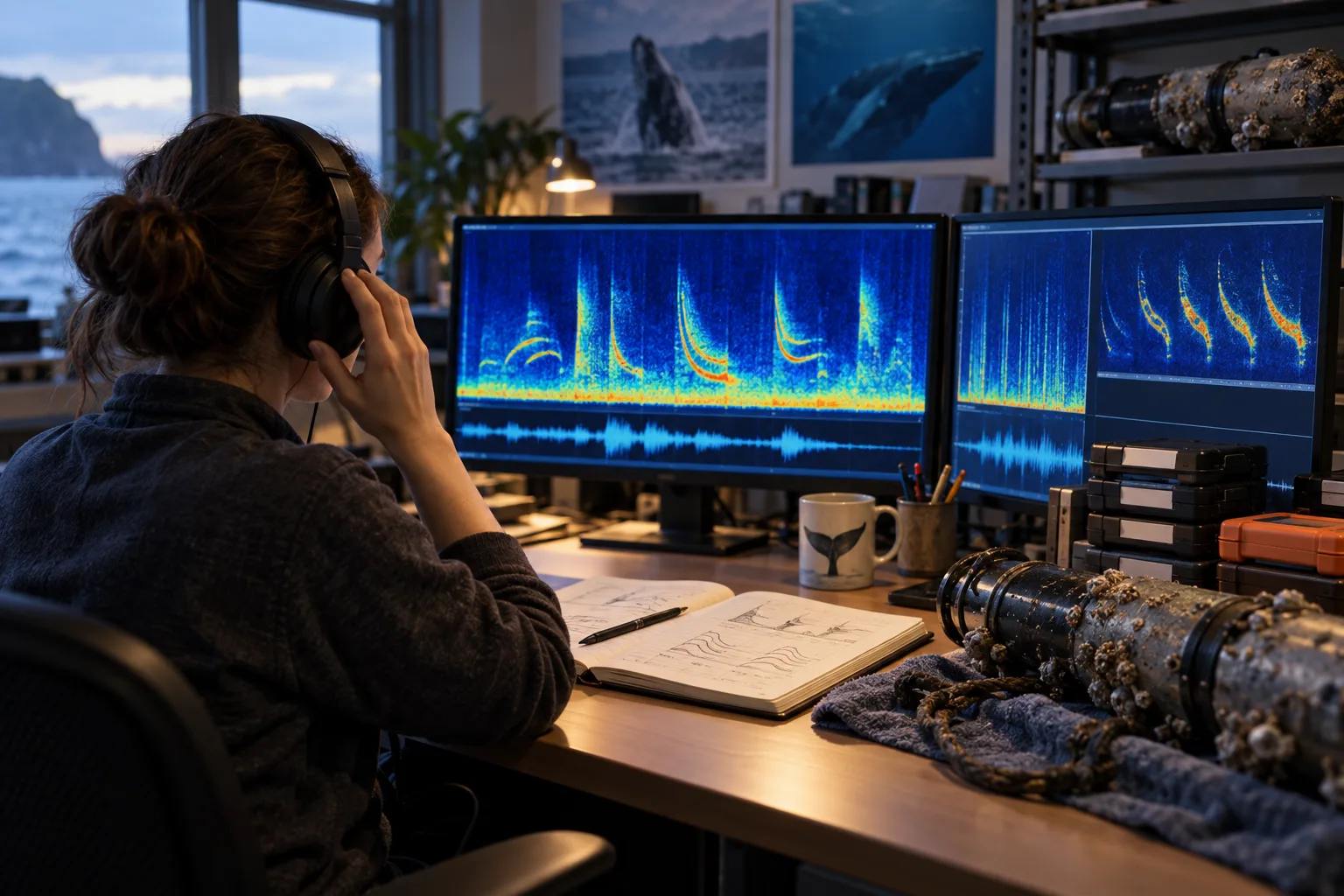
Call her Mara. She had spent nine years studying how underwater noise from shipping, construction, and seismic surveys affects marine mammals. After a doctorate in oceanography and a postdoctoral appointment, she took a research scientist position at a coastal marine research institute in the United States, where she ran a long-term passive acoustic monitoring program: networks of underwater microphones, called hydrophones, recording continuously along a busy stretch of coastline.
When a colleague suggested she consider an EB-2 National Interest Waiver, Mara dismissed it. She had read online discussions full of applicants comparing citation counts, h-indexes, and journal impact factors. Hers were respectable but modest. Her field was small, and the most important things she had produced were not papers at all.
What she had produced was harder to summarize. A continuous acoustic dataset spanning more than seven years. An open-source software tool that automatically detected the calls of several whale species in long recordings, which other monitoring programs had adopted. A series of technical reports prepared for state and federal agencies evaluating noise from proposed offshore construction. Training workshops for agency scientists and environmental consultants. None of this showed up well on a citation profile.
Citation counts measure one kind of influence: how often other academic papers refer to yours. In applied and data-heavy fields, a great deal of influence flows through channels citation databases do not capture, such as agency reports, software adoption, datasets reused by others, and methods built into regulatory practice. If your field works that way, your evidence strategy should too.
The First Assessment
The initial review of Mara's record started where the National Interest Waiver framework starts. Under Matter of Dhanasar, USCIS may grant a national interest waiver if the petitioner shows that the proposed endeavor has substantial merit and national importance, that the petitioner is well positioned to advance it, and that on balance it would benefit the United States to waive the job offer and labor certification requirements. Before that analysis, the petitioner must qualify for EB-2, which Mara did through her doctorate.
Her first draft of a proposed endeavor read something like this: to continue research on the effects of anthropogenic noise on marine mammals. That framing had two problems. It was too general to show national importance clearly, and it pointed attention toward her publication record, which was her weakest evidence.
| Element | First framing | Problem |
|---|---|---|
| Proposed endeavor | Continue research on noise effects on marine mammals | Broad and academic; national importance unclear |
| Main evidence | Publications and citations | Modest numbers in a small field |
| Positioning | Research scientist title | Did not explain why she specifically was well positioned |
| Expert letters | Planned from former academic advisers | Likely to praise talent without documenting use |
Reframing the Endeavor Around a National Problem
The turning point came from asking a different question. Not what has Mara published, but who uses her work, and for what decisions?
The answers were concrete. State and federal agencies used her acoustic data and analyses when reviewing permits for offshore construction projects. Offshore energy developers and their environmental consultants used her detection tool to meet monitoring obligations. Other research programs on different coastlines had adopted her software and methods. Her long-term dataset served as a baseline against which changes in ocean noise could be measured.
That pointed toward a sharper endeavor: developing and deploying passive acoustic monitoring methods and baseline data that allow federal and state agencies, and the industries they regulate, to evaluate and reduce the impact of underwater noise from offshore energy construction and shipping on protected marine species.
This framing did several things at once. It connected her work to issues of clear national scope: the expansion of offshore energy development, the management of commercial shipping, and the protection of marine species under federal law. It moved attention from her papers to the uses of her work. And it made her positioning argument much easier, because she was one of a small number of people operating exactly this kind of long-term monitoring and detection program.
The general principles behind that kind of reframing are covered in our guide on how to frame a national importance endeavor.
A reframed endeavor must still be truthful and specific to what the petitioner actually does and plans to do. Inflating an endeavor to sound more nationally significant than the work supports can undermine credibility. The goal is to describe the real work more precisely, not to describe different work.
Building the Evidence Around Use
With the endeavor clarified, the evidence strategy shifted from prestige to use. Mara and her advisers organized the record around four kinds of proof.
1. Agency Reliance
Several publicly available environmental review documents cited her institute's acoustic data and her analyses. These were not academic citations, but they showed something arguably more relevant to national importance: government decision makers relied on her work. Each document was excerpted with the relevant passages highlighted and a short explanation of what decision the analysis supported.
2. Software Adoption
Her open-source detection tool had a public code repository with a history of contributions and downloads, documentation, and issue discussions from users at other institutions. More importantly, several monitoring programs had written about adopting it in their own reports and methods sections. Letters from two program leads described how the tool had changed their workflow, replacing weeks of manual review with automated detection followed by targeted verification.
3. The Long-Term Dataset
Long-term environmental datasets are valuable precisely because they are rare and cannot be recreated after the fact. Her multi-year continuous record was documented through data access agreements with other researchers and agencies, and through an expert letter explaining why baseline acoustic data matters for measuring change over time.
4. Training and Knowledge Transfer
She had led workshops for agency scientists and consultants on acoustic monitoring methods. Attendance records, agendas, and a letter from a workshop sponsor showed that she was not just producing tools, but actively building capacity among the people responsible for applying them.
Our article on how practitioners build NIW cases without a research record explores this same principle from the industry side: impact through use can carry a petition when the publication record is thin.
Choosing the Right Expert Letters
The original plan had been to ask former academic advisers for letters. Those letters would likely have described Mara as talented and hardworking, which is not the same as documenting national importance or positioning.
The revised plan sought letters from people who had used her work and could explain why it mattered.
| Letter writer | Relationship | What the letter documented |
|---|---|---|
| Monitoring program lead at another institution | Independent user of her software | Adoption of the detection tool and its effect on their program's capacity |
| Senior acoustician at a research university | Independent expert, no direct collaboration | Significance of long-term baseline data and her methods in the field |
| Environmental consultant who worked on offshore projects | Professional user of her data and tools | Practical role of her methods in meeting monitoring obligations |
| Institute director | Employer | Her leadership of the monitoring program and future plans |
| Workshop sponsor at a professional society | Organizer of training events | Her role in training agency and industry scientists |
Three of the five writers were independent of her, which strengthened the letters' credibility. Each letter focused on specific uses and consequences rather than general praise. The underlying principles are discussed in our article on expert letters that avoid becoming generic recommendations.
The Well Positioned and Balancing Arguments
For the second Dhanasar prong, the petition explained why Mara was well positioned to advance the endeavor. The argument rested on her record of success in building and running the monitoring program, the adoption of her tools, the reliance of agencies on her analyses, her funding history, and a concrete plan for the next several years of work at her institute, including expansion to additional monitoring sites.
For the third prong, the petition argued that the national interest would be served by waiving the job offer requirement. Her work served multiple agencies and users rather than a single employer's narrow interest, the continuity of a long-term monitoring program depended on her leadership, and requiring a labor certification process would add delay and uncertainty without serving any corresponding purpose. Our article on why the third Dhanasar prong needs its own argument explains why this part should never be treated as an afterthought.
The RFE and the Response
In this composite, the petition received a Request for Evidence. The officer accepted that the endeavor had substantial merit but questioned whether its national importance extended beyond the region where Mara's monitoring program operated.
The response did not change the endeavor. Instead, it provided more evidence for the endeavor as described. It documented that her software was used by programs on other coastlines, that her methods had been presented at national and international scientific meetings attended by agency scientists, and that the questions her work addressed, such as how to measure and manage construction noise from offshore energy projects, were being faced nationwide. A supplementary letter from a senior acoustician at a university in a different region explained how her methods had influenced monitoring approaches there.
The petition was approved. In a composite story, that outcome illustrates a pattern rather than a promise: a clearly framed endeavor, supported by evidence of real use and independent corroboration, can be more persuasive than a strong citation profile alone.
How the Exhibits Were Organized
A record built around use rather than publications can be harder for an officer to follow, because it does not fit the familiar shape of a research petition. The exhibits were therefore organized to mirror the Dhanasar framework, so that each piece of evidence clearly served one prong.
| Exhibit group | Contents | Prong supported |
|---|---|---|
| A. The national problem | Public government and authoritative materials describing offshore energy development, shipping noise, and protected species management | Substantial merit and national importance |
| B. Agency reliance | Excerpts from public environmental review documents citing her data and analyses, with short explanatory notes | National importance and well positioned |
| C. Tools and data | Software repository documentation, adoption reports, data access agreements | Well positioned |
| D. Independent letters | Letters from users and independent experts | All three prongs |
| E. Record of success | Grants, program milestones, workshops, publications | Well positioned |
| F. Future plan | Institute letter and her own detailed plan for expanding monitoring | Well positioned and balancing |
Publications were still included, but as one exhibit group among several rather than the centerpiece. That ordering signaled to the officer what the petition was really about.
What Almost Went Wrong
Several early instincts would have weakened the case if they had not been caught.
- Leading with metrics. The first draft opened with her h-index and total citations. Those numbers were accurate but invited comparison with researchers in much larger fields, which did her no favors.
- Treating agency reports as background. She had initially planned to mention agency use in a single sentence. Those documents turned out to be some of the most persuasive evidence in the petition.
- Relying on a single regional story. The early narrative focused entirely on one coastline. Documenting use of her tools elsewhere before filing would have helped avoid the RFE that eventually arrived.
- A vague future plan. Her first plan said she would continue monitoring work. The revised plan named new sites, partner programs, and specific methodological goals.
The lesson from the third point is worth emphasizing. The RFE asked a question the original petition could have answered. Anticipating likely objections, especially about national scope for work that operates in a particular region, is part of building the record. Our article on the Dhanasar prong that turns on trajectory discusses how forward-looking evidence can close gaps like this before an officer has to ask.
Three Variations on Mara's Situation
These short hypothetical variations show how the same principles apply to different profiles.
Variation One: The Soil Hydrologist
A soil hydrologist developed a field sensor protocol used by agricultural extension services in several states to estimate irrigation needs. Her publications were modest, but extension service documents and training materials referenced her protocol. Her NIW endeavor focused on improving irrigation efficiency in water-stressed agricultural regions, and her evidence centered on adoption by extension services rather than on citations.
Variation Two: The Wildfire Smoke Modeler
An atmospheric scientist built an open forecasting tool for wildfire smoke dispersion that several regional air quality agencies used in issuing public health advisories. His strongest evidence was agency use documented in public advisory materials and letters from agency forecasters. His endeavor focused on improving the accuracy and accessibility of smoke forecasts for public health decisions.
Variation Three: The Bridge Inspection Data Engineer
A civil engineer developed a data standard and analysis method for drone-based bridge inspections that a group of state transportation departments piloted. Her endeavor focused on improving the safety and efficiency of bridge inspection programs. Pilot reports, letters from transportation department engineers, and a technical committee appointment carried her case more than her conference papers did.
Each variation shares a pattern with Mara's story: impact that lives in use by agencies and practitioners, documented through public records and independent letters, framed around a specific endeavor with clear national relevance. Our earlier composite about a physicist whose work resisted benchmarking explores a related problem from the opposite direction, where the work was highly theoretical rather than applied.
What Mara's Case Teaches
- Start with who uses the work. National importance is often easier to show through users and decisions than through prestige metrics.
- Define the endeavor precisely. A specific endeavor connected to a national problem is more persuasive than a general research agenda.
- Treat datasets and software as evidence. Long-term data, open tools, and methods adopted by others are real contributions and can be documented.
- Choose letter writers who used the work. Independent users who can describe concrete consequences are more persuasive than admiring former mentors.
- Answer an RFE with more evidence, not a new endeavor. Strengthening the original framing is generally safer than replacing it.
Checklist: Is Your Applied Research Ready for an NIW?
- Can you name specific agencies, programs, or organizations that use your work, and for what purpose?
- Is there public documentation of that use, such as reports, advisories, or methods sections?
- Have you documented datasets, software, or protocols you created, including adoption by others?
- Is your proposed endeavor specific and connected to an issue of national scope?
- Do you have letter writers who used your work, not just people who supervised you?
- Can you explain why you specifically are well positioned to advance the endeavor?
- Have you addressed the balancing prong with its own argument?
- Do you have a concrete plan for future work in the endeavor?
Frequently Asked Questions
Is this a real client story?
No. It is a composite that combines common patterns into one illustrative narrative. Details are simplified, and outcomes in real cases depend on individual records.
Can an EB-2 NIW succeed with a modest citation record?
It can, if other evidence shows national importance and positioning. Citations are one form of evidence, not a requirement. Applied work often shows impact through use instead.
Do datasets and software count as contributions?
They can, especially when adoption and reliance by others is documented. The key is showing who uses them and what difference they make.
Can government reports that cite my work help?
Yes. Public agency documents that rely on your analyses can be strong evidence of national importance and of your positioning in the field.
Should my expert letters come from former advisers?
Letters from advisers can help describe your background, but independent letters from people who used your work are often more persuasive for national importance.
What if the RFE says my work is only regional?
Respond with evidence that the endeavor's implications extend nationally, such as use in other regions or relevance to nationwide policy questions, rather than changing the endeavor.
Do I need a job offer for an NIW?
No. The NIW waives the job offer and labor certification requirements, which is why the third Dhanasar prong asks whether that waiver benefits the United States.
Does environmental research qualify for national importance?
Environmental research can qualify when the endeavor addresses issues of national scope. The specific framing and evidence matter more than the field label.
How long should I prepare before filing?
It depends on how much documentation of use already exists. Gathering agency documents, adoption evidence, and independent letters often takes several months.
References and Further Reading
- Matter of Dhanasar, 26 I&N Dec. 884 (AAO 2016)
- USCIS Policy Manual, Volume 6, Part F, Chapter 5: Advanced Degree or Exceptional Ability
- USCIS: Employment-Based Immigration, Second Preference EB-2
- National Oceanic and Atmospheric Administration
- Bureau of Ocean Energy Management
- U.S. National Science Foundation
Requirements and agency practices change. Verify current guidance with official sources and qualified counsel.
Conclusion
Mara's composite case began with a mistaken assumption: that her modest citation numbers meant she could not qualify. Her real impact had never lived in citation databases. It lived in a long-term dataset that agencies relied on, an open tool other programs adopted, and analyses that shaped decisions about offshore construction and shipping noise. Once the endeavor was framed around that use, and the evidence was organized to prove it, the case told a far stronger and more accurate story.
Every case is unique, and outcomes depend on individual records and current USCIS practice. If your strongest work lives in data, tools, or agency reports rather than in highly cited papers, EB1 Mentor can help you identify the evidence that matters and frame an endeavor that reflects it. Explore our EB-2 NIW services, request a profile evaluation, or contact EB1 Mentor to talk through your record.
Does your strongest work live in data, tools, or agency reports rather than citations? Contact EB1 Mentor to build an NIW case around how your work is actually used, or start with a profile evaluation.