
Why EB-1A Final Merits Strategy Matters
Many accomplished professionals approach the EB-1A process with a simple question: How many criteria can I satisfy? That question is important, but it is not enough. EB-1A is not only a checklist exercise. A petition may include research publications, peer review, professional awards, media coverage, conference speaker invitations, expert letters, recommendation letters, leadership evidence, and high salary documentation, yet still feel incomplete if the overall record does not show why the applicant stands out in the field. Counting criteria is only the starting point; even an accessible one like the judging criterion is satisfied badly more often than well, as we discuss in judging the work of others as EB-1A evidence, done properly.
The stronger question is: When all evidence is reviewed together, does the record show sustained acclaim, field-level recognition, and a persuasive pattern of extraordinary ability? This is the heart of final merits strategy. It is where the immigration evidence must move from isolated documents into a coherent professional story. If that question has already been put to you in writing, the wording of the request itself usually indicates which part of the record fell short. For applicants already in the United States, the years before that question is asked are an opportunity to shape the answer — as we discuss in using an O-1A period to build the EB-1A you file later.
For EB1 Mentor clients, this is often where portfolio planning becomes most valuable. A strong immigration portfolio is not built by collecting every certificate, article, invitation, and screenshot. It is built by deciding which evidence matters, how it connects, what it proves, and what gaps must be addressed before filing. This article explains how high-achieving professionals can think about EB-1A final merits in a practical, organized, and evidence-driven way.
Understanding the Difference Between Criteria and Final Merits
In an EB-1A petition, the initial evidentiary criteria help organize the record. Applicants often present evidence under categories such as awards, memberships, published material, judging, original contributions, scholarly articles, exhibitions or showcases, leading or critical roles, high remuneration, or commercial success depending on the nature of their field. These categories create structure, but they do not automatically answer the larger question.
Final merits analysis looks at the entire record. It asks whether the applicant has demonstrated extraordinary ability and sustained recognition in a way that is meaningful for the field. This is why two applicants can appear similar on paper but have very different petition strength. One applicant may technically document several categories, while another may show a clearer pattern of influence, recognition, independence, and impact.
For example, a software engineer may have peer review service, a few publications, a senior title, conference presentations, and internal company achievements. Those items may be useful. But the final merits question is broader: Did the person influence important systems, tools, standards, products, or technical practices beyond routine employment? Were the contributions recognized by independent experts? Did the work affect users, companies, academic research, industry adoption, open-source communities, patents, or measurable outcomes?
Why Meeting Multiple Criteria May Still Be Insufficient
A common mistake is assuming that satisfying more criteria automatically creates a stronger case. Quantity can help, but only when the evidence is relevant, credible, and connected to a persuasive final narrative. Ten weak items do not necessarily outweigh three powerful items. A long petition can even become less convincing if it hides important achievements under repetitive or low-value documentation.
The strongest EB-1A portfolios usually have a clear center of gravity. The applicant is not presented as generally talented in many disconnected ways. Instead, the evidence points toward a defined professional identity: an AI infrastructure expert whose tools changed enterprise workflows, a researcher whose publications shaped a technical subfield, a healthcare innovator whose work improved clinical outcomes, a startup founder whose product gained market recognition, or a faculty member whose scholarship, citations, peer review, and invited talks show recognized expertise.
The Final Merits Mindset: Build a Case, Not a Folder
An EB-1A petition should not feel like a storage folder. It should feel like a carefully organized professional record. Every major document should have a purpose. Every evidence section should answer one or more of the following questions:
- What is the applicant known for?
- Who recognizes the applicant, and why does that recognition matter?
- How has the applicant contributed beyond ordinary job performance?
- What independent evidence supports the claimed impact?
- How do publications, citations, awards, media, peer review, and leadership connect to one professional narrative?
- What makes the applicant meaningfully different from competent peers in the same field?
This mindset is especially important for professionals in STEM, AI, software engineering, healthcare, entrepreneurship, and applied research. In these fields, major impact is often spread across multiple evidence types. A single paper, patent, press article, or job title may not tell the full story. The portfolio must connect technical achievement, independent recognition, measurable adoption, and credible expert validation.
Defining the Field Before Presenting the Evidence
One of the most overlooked parts of EB-1A strategy is field definition. If the field is too broad, the applicant may appear ordinary among millions of professionals. If the field is too narrow, the case may seem artificially constructed. A strong field definition should be accurate, defensible, and aligned with the evidence.
For example, a broad field such as software engineering may be too general for final merits positioning. A more useful framing might be enterprise AI infrastructure, cloud-native financial risk systems, construction technology optimization, medical imaging AI, autonomous systems safety, cybersecurity automation, or scalable product design systems. The goal is not to manipulate the field. The goal is to describe the applicant’s actual professional domain with enough precision that the evidence can be evaluated fairly.
Questions to Test Field Definition
- Does the field description match the applicant’s publications, projects, awards, talks, and expert letters?
- Would independent professionals in that area recognize the field as legitimate?
- Is the field broad enough to show meaningful influence beyond one employer?
- Is the field specific enough to explain why the applicant’s contributions matter?
- Can the evidence show recognition within that field, not just general professional competence?
A weak field definition often leads to weak final merits. If the petition cannot clearly explain the field, it becomes harder to show original contributions, major significance, critical roles, citation impact, or international recognition. Before building the evidence map, applicants should be able to describe their field in one clear paragraph.
Original Contributions: The Core of Many EB-1A Cases
Original contributions can become one of the most persuasive parts of an EB-1A case when handled correctly. However, this category is also commonly misunderstood. An original contribution is not simply something the applicant created. Many professionals create software, research papers, business processes, designs, products, and internal tools. The stronger question is whether the contribution has recognized significance in the field.
For final merits, original contributions should ideally connect to independent validation. This may include citations, adoption by outside organizations, expert letters from recognized professionals, patents or patent applications where relevant, product usage metrics, technical documentation, media coverage, conference invitations, awards, open-source adoption, industry references, or measurable effects on users, revenue, safety, efficiency, research direction, or professional practice.
Examples of Stronger Original Contribution Framing
| Profession | Weak Framing | Stronger Framing |
|---|---|---|
| AI Professional | Built an AI tool for the company. | Developed an AI decision-routing system adopted across multiple business units, reducing manual review time and referenced by independent experts as a model for enterprise AI governance. |
| Researcher | Published several papers. | Authored research publications that generated citation impact, influenced later studies, and led to invitations for peer review, conference speaking, and expert collaboration. |
| Healthcare Professional | Worked on a hospital quality project. | Led a clinical innovation initiative that improved measurable patient-care or operational outcomes and was recognized by senior medical leaders or external professional bodies. |
| Software Engineer | Created internal software features. | Architected a platform component used at scale, adopted by multiple engineering teams, and linked to measurable reliability, cost, performance, or user-experience gains. |
| Startup Founder | Started a company. | Built a product with market traction, customer adoption, press visibility, investor interest, industry recognition, or measurable commercial and technical impact. |
Common Mistakes in Original Contributions Evidence
- Relying only on personal statements without independent confirmation.
- Confusing job responsibilities with field-level contributions.
- Submitting technical documents without explaining why they matter.
- Using expert letters that praise the applicant but do not explain significance.
- Presenting publications without showing citation impact, usage, adoption, or influence.
- Overclaiming impact that the supporting evidence does not prove.
Expert Letters and Recommendation Letters: Useful but Not a Substitute for Evidence
Expert letters and recommendation letters can be powerful, but they must be used carefully. A letter should not merely say that the applicant is talented, hardworking, innovative, or respected. Those words are common and often too general. The most useful letters explain specific contributions, identify why those contributions matter, and connect the applicant’s work to broader field impact.
There is also an important difference between recommendation letters and expert letters. A recommendation letter often comes from someone who worked with the applicant and can describe direct experience. An expert letter may come from an independent authority who can evaluate the applicant’s work in the context of the field. Both can be valuable, but final merits strategy often benefits from a balanced mix.
What Strong Letters Should Include
- The writer’s credentials and why their opinion is meaningful.
- The relationship between the writer and the applicant.
- Specific contributions, not generic praise.
- Independent context explaining how the work compares to normal professional activity.
- Measurable or observable impact where available.
- Connections to publications, patents, products, awards, media, or adoption.
- A clear explanation of why the applicant is recognized in the field.
Letters are strongest when they are consistent with the rest of the record. If an expert says a technology changed industry practice, the petition should ideally include evidence that supports that statement. If a recommender says a researcher influenced later work, citation evidence, publication history, invited talks, or peer review records should help confirm it.
Peer Review, Judging, and Professional Recognition
Peer review and judging can be excellent evidence when the work shows that the applicant is trusted to evaluate others in the field. This can include journal peer review, conference review, grant review, competition judging, fellowship assessment, award judging, technical committee service, or expert evaluation roles. The key is to show that the applicant was selected because of recognized expertise, not merely because the opportunity was open to anyone.
For final merits, peer review becomes stronger when it connects to the applicant’s professional identity. For example, an AI researcher reviewing machine learning manuscripts, a civil engineering expert reviewing infrastructure papers, or a cybersecurity leader judging technical innovation competitions may show field relevance. A large number of unrelated reviews may be less persuasive than a focused record of high-quality review service in the applicant’s area of expertise.
How to Strengthen Peer Review Evidence
- Document the selection process when available.
- Show the reputation of the journal, conference, award, or organization.
- Include reviewer invitations, completed review confirmations, editorial acknowledgments, or official dashboards where appropriate.
- Organize reviews by date, venue, subject area, and role.
- Explain how the review work relates to the applicant’s field.
- Avoid presenting peer review as a numbers-only achievement.
Publications and Citation Impact: Quality, Relevance, and Interpretation
Research publications can support EB-1A, EB-1B, O-1 visa, and EB2 NIW strategies, but publications alone do not automatically prove extraordinary ability. The final merits question is how those publications fit into the applicant’s recognition and impact. A paper with meaningful citation impact, use by later researchers, conference visibility, or expert discussion may carry more value than a publication list presented without context.
Applicants should avoid assuming that all publications are equal. A strong publication strategy considers authorship role, journal or conference relevance, peer review process, subject matter, citation patterns, and how the research connects to the applicant’s overall field. Citation impact should also be explained responsibly. Numbers may matter, but interpretation matters too. A newer field, applied industry field, or niche technical area may have different citation behavior than a large academic discipline.
Publication Evidence Checklist
- Full citation list with authorship role and publication venue.
- Evidence of peer review or editorial standards when relevant.
- Citation reports from credible databases where available.
- Examples of citing papers and why they matter.
- Evidence that independent researchers built upon or discussed the work.
- Connections between publications and invited talks, expert letters, awards, patents, or media coverage.
- Plain-language explanation of the research contribution.
Awards, Memberships, and Media Coverage: Avoiding Surface-Level Evidence
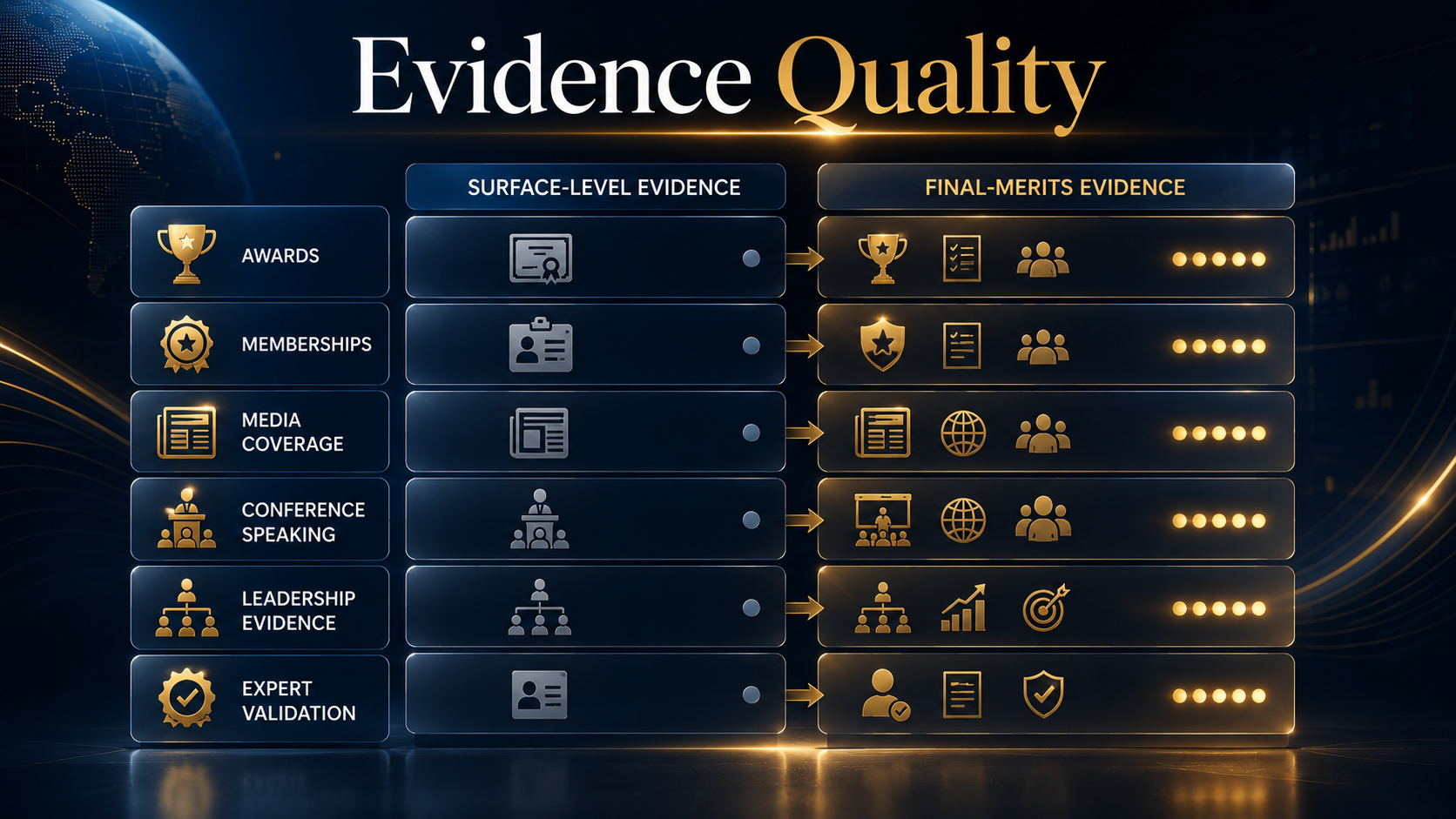
Professional awards, selective memberships, and media coverage can be persuasive, but only when the evidence shows meaningful recognition. A certificate by itself may not be enough. A membership badge by itself may not be enough. A press article by itself may not be enough. Final merits requires context.
For awards, applicants should document the selection criteria, judging process, number or quality of candidates, reputation of the awarding body, and why the award matters in the field. For professional memberships, applicants should show whether admission requires outstanding achievement, expert nomination, independent review, significant credentials, or selective evaluation. For media coverage, applicants should distinguish between independent editorial coverage and promotional content.
Evidence Quality Comparison
| Evidence Type | Surface-Level Evidence | Final Merits-Oriented Evidence |
|---|---|---|
| Award | Certificate and photo. | Certificate, award criteria, judging process, winner announcement, field reputation, and explanation of why the award recognizes exceptional achievement. |
| Membership | Membership confirmation email. | Admission standards, selectivity, nomination or review process, evidence of outstanding achievement requirement, and independent proof of status. |
| Media | Article link only. | Independent article, publication credibility, author or editorial context, audience relevance, and explanation of why the coverage reflects professional recognition. |
| Conference | Agenda screenshot. | Speaker invitation, selection process, event reputation, audience profile, topic relevance, and proof that the applicant was invited for expertise. |
Leadership and Critical Role Evidence
Leadership evidence can be highly valuable, especially for entrepreneurs, executives, senior engineers, product leaders, researchers, healthcare administrators, and technical directors. But leadership must be presented with precision. A title alone does not prove extraordinary ability. A job description alone does not prove critical role. The evidence should explain the importance of the organization, the significance of the applicant’s role, and the measurable results connected to that role.
For example, a senior software engineer at a major company may have strong credentials, but the petition should show what the applicant actually led. Did they own architecture for a major system? Did they influence a product used by millions? Did they reduce infrastructure cost, improve reliability, create a new technical standard, mentor teams, or lead a high-stakes migration? The stronger the connection between role, responsibility, organizational importance, and outcomes, the more useful the evidence becomes.
Leadership Evidence Should Answer These Questions
- What was the organization, team, product, research group, or initiative?
- Why was it important?
- What was the applicant’s specific role?
- Was the role leading, critical, or both?
- What outcomes resulted from the applicant’s work?
- Is there independent or internal documentation confirming the role?
- How does this leadership support the broader extraordinary ability narrative?
High Salary and Remuneration: Context Is Everything
High salary evidence can support an EB-1A case when the compensation is significantly high in relation to others in the field. The challenge is context. Applicants should not simply submit pay records and expect the evidence to speak for itself. The record should explain the relevant comparison group, geography, role, seniority level, industry, currency issues if applicable, and the source of wage or compensation data.
For entrepreneurs and founders, remuneration can be more complicated. Salary may not reflect the value of equity, company ownership, dividends, distributions, deferred compensation, or business performance. Applicants should handle this carefully and avoid unsupported claims. When compensation evidence is used, it should be presented in a disciplined and transparent way.
Building the EB-1A Evidence Map
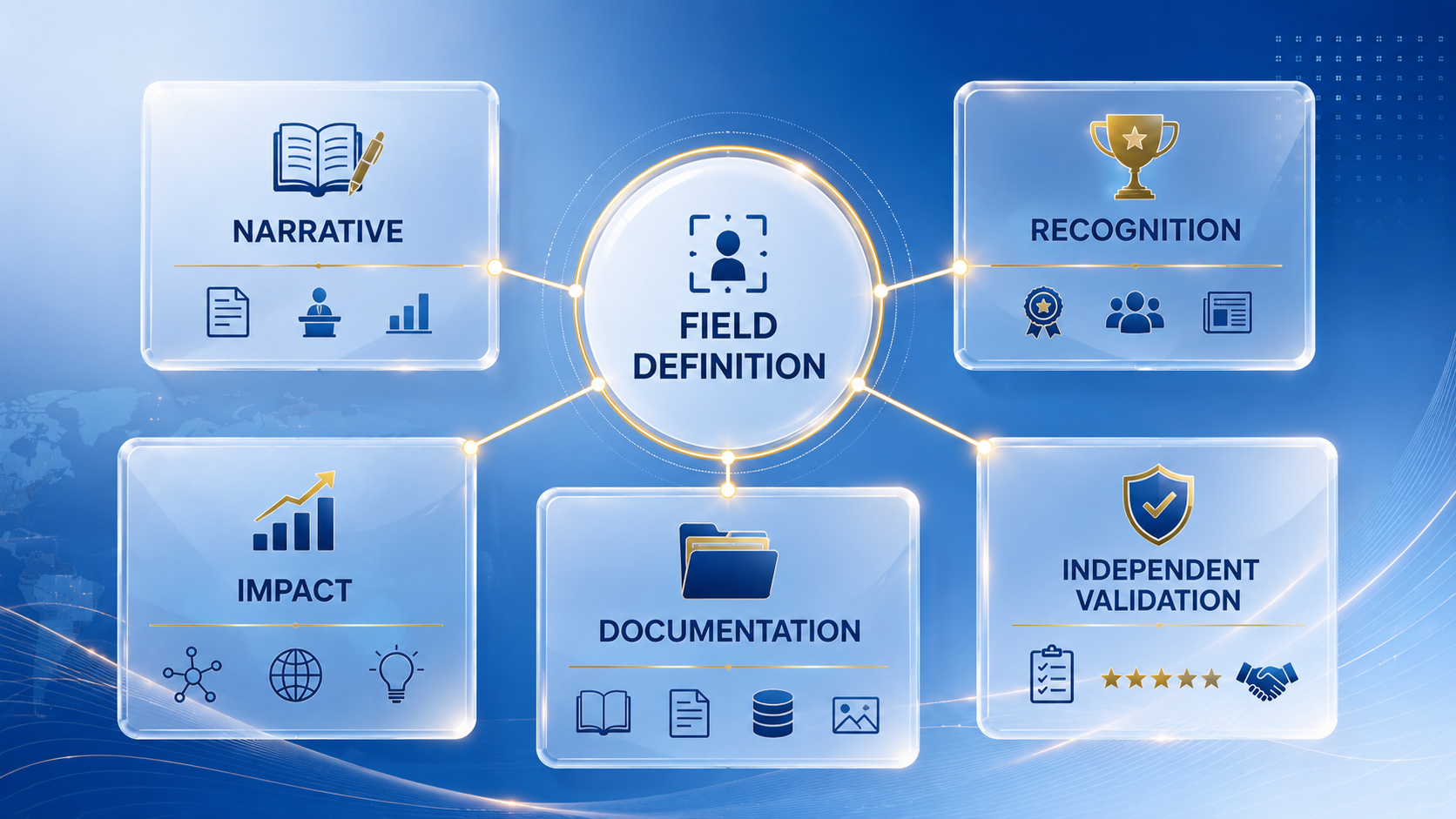
A practical way to improve final merits strategy is to create an evidence map before filing. This is not just an index. It is a strategic document that shows how each evidence category supports the central claim of extraordinary ability.
An evidence map may include:
- Field definition: The applicant’s precise professional domain.
- Core narrative: The main story of achievement and recognition.
- Primary evidence pillars: Original contributions, publications, citations, awards, leadership, media, peer review, memberships, or other relevant proof.
- Independent validation: External experts, third-party adoption, citations, press, awards, invited roles, or institutional recognition.
- Gap analysis: Weak areas that should be strengthened before filing.
- Timeline: Evidence development over months or years, not last-minute assembly.
Sample Evidence Map for an AI Professional
| Evidence Pillar | Possible Documentation | Final Merits Purpose |
|---|---|---|
| Original Contributions | Technical architecture, product adoption, expert letters, performance metrics, patents, internal and external references. | Shows meaningful technical impact beyond routine implementation. |
| Research Publications | Published papers, citation reports, citing-paper examples, conference proceedings. | Shows knowledge contribution and recognition by other researchers. |
| Peer Review | Journal review confirmations, conference reviewer roles, editorial acknowledgments. | Shows trust to evaluate others in the field. |
| Leadership | Org charts, project ownership, executive letters, product impact metrics. | Shows critical or leading role in important initiatives. |
| Media or Awards | Independent articles, award criteria, public announcements. | Shows recognition beyond the employer or immediate collaborators. |
Timing: Why Strong Portfolios Are Built Before the Petition
Some applicants wait until they are ready to file before thinking about evidence. That often creates avoidable problems. EB-1A, O-1 visa, EB-1B, and EB2 NIW strategies are usually stronger when evidence development begins early. A professional may need time to publish, increase research visibility, complete peer review work, apply for selective memberships, pursue conference speaking, document awards, secure expert letters, organize media coverage, or collect impact metrics.
A 6 to 12 month portfolio plan can be especially useful for professionals who already have strong achievements but lack documentation. Sometimes the work is impressive, but the evidence is scattered across emails, dashboards, press pages, internal records, conference websites, recommendation letters, and publication databases. Strategic preparation helps transform raw accomplishments into an organized immigration portfolio.
A Practical 12-Month Evidence Development Timeline
- Months 1-2: Define the field, identify core achievements, collect existing documentation, and complete gap analysis.
- Months 3-4: Strengthen publication and citation documentation, organize peer review records, and identify independent experts.
- Months 5-6: Pursue credible speaking opportunities, professional memberships, awards, and media opportunities where appropriate.
- Months 7-8: Build expert letter strategy, document original contributions, and collect leadership impact evidence.
- Months 9-10: Prepare evidence summaries, cross-reference supporting documents, and refine the professional narrative.
- Months 11-12: Review consistency, remove weak or distracting evidence, and finalize the portfolio structure with qualified professional guidance.
Red Flags That Can Weaken Final Merits
Not every document helps. Some evidence can distract from the strongest parts of the case. Applicants should be careful with evidence that appears promotional, unrelated, unverifiable, exaggerated, or disconnected from the field. A clean and credible record is usually better than a large but unfocused record.
- Letters that use broad praise but lack facts.
- Media coverage that appears paid or purely promotional without editorial independence.
- Awards with unclear selection standards.
- Memberships that do not require recognized achievement.
- Publications unrelated to the claimed field.
- Conference roles with no evidence of selection or audience relevance.
- Leadership claims unsupported by documentation.
- Technical impact claims without metrics, adoption evidence, or expert explanation.
- Overly broad field definitions that make the applicant appear ordinary.
- Overly narrow field definitions that seem created only for the petition.
How EB-1A Strategy Differs From O-1, EB-1B, and EB2 NIW Planning
Many accomplished professionals consider more than one immigration pathway. EB-1A, O-1 visa, EB-1B, and EB2 NIW strategies can overlap, but they are not identical. A strong portfolio plan should understand the differences before selecting evidence priorities.
| Pathway | Common Evidence Focus | Portfolio Planning Note |
|---|---|---|
| EB-1A | Extraordinary ability, sustained recognition, original contributions, awards, publications, judging, leadership, media, high salary. | Final merits strategy is critical. Evidence must show an overall pattern of extraordinary ability. |
| O-1 Visa | Extraordinary ability or achievement, advisory opinion where applicable, employer or agent structure, events or work itinerary. | Often useful for professionals needing a nonimmigrant pathway, but evidence must still be well organized. |
| EB-1B | Outstanding researcher or professor evidence, scholarly publications, citations, peer review, research impact, employer sponsorship. | Usually more academic or research-employment oriented than EB-1A. |
| EB2 NIW | Proposed endeavor, national importance, qualifications, publications, citations, business impact, policy or industry relevance. | Endeavor framing and national importance are central; it is not the same as proving extraordinary ability. |
The same achievement may be framed differently across pathways. A research publication may support scholarly contribution in EB-1A, research excellence in EB-1B, expertise for an O-1 visa, or national importance for EB2 NIW. This is why professional portfolio strategy should not rely on a single generic evidence package.
Practical Final Merits Checklist
Before filing, applicants can use the following checklist to evaluate whether the record feels final merits-ready:
- Is the field clearly and accurately defined?
- Does the petition explain what the applicant is known for?
- Are the strongest achievements easy to identify?
- Is there independent evidence of recognition?
- Do expert letters explain significance rather than just praise?
- Are original contributions supported by impact evidence?
- Do publications and citations connect to the field narrative?
- Are peer review and judging roles relevant and documented?
- Are awards, memberships, and media supported by selection or editorial context?
- Does leadership evidence show importance, responsibility, and outcomes?
- Has weak or distracting evidence been removed or minimized?
- Would a reader understand why the applicant stands out after reviewing the full record?
Frequently Asked Questions About EB-1A Final Merits
1. Is EB-1A only about meeting three criteria?
No. Meeting evidentiary criteria is important, but applicants should also prepare for the broader final merits assessment. The overall record should show extraordinary ability, sustained recognition, and meaningful distinction in the field.
2. Can a person satisfy several criteria and still have a weak case?
Yes. Evidence can satisfy categories in a technical sense but still fail to create a persuasive overall narrative. Weak documentation, limited independent recognition, unclear impact, or poor field definition can reduce final merits strength.
3. Are expert letters enough to prove original contributions?
Expert letters can help, but they are usually stronger when supported by independent documents such as citation evidence, adoption records, technical reports, awards, media coverage, patents, product metrics, or other proof of impact.
4. How many recommendation letters should an EB-1A portfolio include?
There is no universal number that works for every case. Quality matters more than quantity. A smaller set of specific, credible, well-supported letters can be more useful than many generic letters repeating similar praise.
5. Do citations matter for non-academic professionals?
Citations are especially relevant for researchers and publication-heavy professionals, but non-academic professionals may show impact through other evidence such as product adoption, industry use, patents, awards, media, conference invitations, leadership outcomes, or expert validation.
6. Can conference speaking support EB-1A?
Yes, conference speaker evidence can support a portfolio when it shows that the applicant was selected for expertise and the event is relevant to the field. Strong documentation may include invitations, agenda pages, speaker profiles, event reputation, audience information, and topic relevance.
7. Is media coverage always useful?
No. Media coverage is stronger when it is independent, credible, and focused on the applicant’s professional achievements. Purely promotional or low-context coverage may have limited value unless supported by other strong evidence.
8. How early should someone begin building an EB-1A immigration portfolio?
Many professionals benefit from planning 6 to 12 months before filing, and sometimes earlier. Evidence development takes time, especially for publications, citation strategy, peer review, awards, expert letters, conference speaking, and documentation of original contributions.
9. Should an applicant include every achievement?
Not necessarily. A strong petition is selective. Evidence should support the central narrative. Unrelated, weak, or poorly documented achievements can distract from stronger evidence.
10. Can EB1 Mentor provide legal advice or file the petition?
EB1 Mentor is not a law firm and does not provide legal representation. EB1 Mentor helps accomplished professionals strengthen their immigration portfolios through evidence strategy, publication planning, peer review opportunities, conference speaking, expert letters, recommendation letters, media visibility, awards, memberships, and long-term profile development.
Conclusion: Final Merits Is About the Whole Professional Story
EB-1A final merits strategy is where the evidence must come together. Publications, citations, peer review, awards, media, memberships, original contributions, expert letters, recommendation letters, leadership, high salary, and conference speaker roles are not isolated trophies. They should form a clear record of professional recognition and field-level significance.
The best immigration evidence portfolios are built with discipline. They define the field carefully, identify the strongest achievements, remove distractions, document impact, and explain why the applicant’s work matters beyond ordinary professional success. For AI professionals, software engineers, researchers, healthcare professionals, startup founders, university faculty, and technical leaders, this strategic organization can make the difference between a collection of documents and a persuasive professional narrative.
Build a Stronger EB-1A Portfolio With EB1 Mentor
Every immigration case is unique. EB1 Mentor is not a law firm and does not provide legal representation, but professional portfolio guidance can help applicants identify evidence gaps, strengthen original contributions, organize expert letters, improve publication and citation strategy, pursue peer review and conference opportunities, and present a more coherent immigration portfolio.
To discuss how EB1 Mentor can help you build a stronger profile for EB-1A, O-1, EB-1B, or EB2 NIW preparation, visit [https://eb1mentor.com/contact.php](https://eb1mentor.com/contact.php).
Strengthen Your Immigration Portfolio
Every immigration case is unique. EB1 Mentor is not a law firm and does not provide legal representation, but professional guidance can help accomplished applicants build stronger EB-1A, O-1, EB-1B, and EB2 NIW portfolios through evidence strategy, expert letters, publications, peer review, conference visibility, awards, media coverage, and long-term profile development.