This is a composite story. It combines patterns seen across many applied-science immigration portfolios into a single illustrative narrative. Names, institutions, and specific details are fictional, and the story does not describe any single real person or EB1 Mentor client. Outcomes in real cases depend on individual facts and on USCIS adjudication, and nothing here is legal advice.
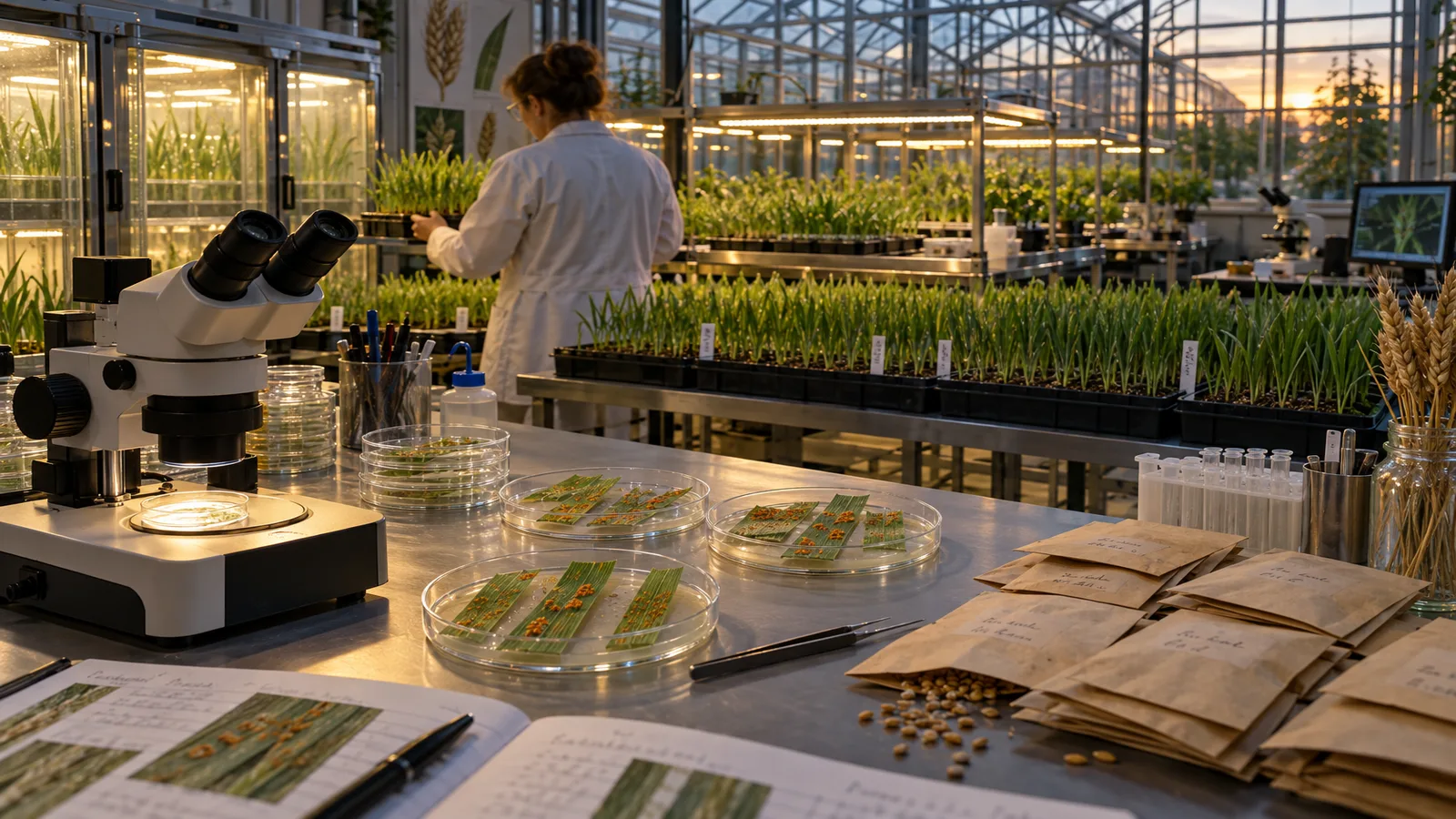
Dr. Amara Okonjo had spent nine growing seasons studying one of the oldest problems in agriculture: rust fungi that attack wheat. The pathogens evolve quickly, new races overcome resistance genes that breeders spent years deploying, and a single epidemic year can devastate a region's harvest. Her particular contribution was unglamorous and enormously practical. She had developed a seedling screening protocol that let breeding programs test candidate lines against multiple rust races in a fraction of the time field trials required, with results that correlated well with field performance.
By the time she began thinking about an O-1A petition, working as a research scientist at a U.S. land-grant university on a temporary status that was approaching its limit, her protocol was being used by breeding programs in several countries. Varieties screened with it were moving toward release. And yet, when she looked at her own record through the lens she assumed immigration officers would use, she saw a problem. Her papers were cited, but not dramatically. She had never won a major international prize. She had never been profiled in the press. She was, in her own words, a person whose work mattered a great deal to perhaps two thousand people in the world and was invisible to everyone else.
This story follows how that record was translated into a petition, and the three turning points that shaped it.
The First Assessment: A Record That Looked Thin on Paper
The initial review of Amara's materials produced a familiar picture. A list of publications. A CV. A few letters she had saved from collaborators. A spreadsheet of citation counts that she had assembled herself and found discouraging.
The O-1A standard for the sciences asks whether a person has extraordinary ability demonstrated by sustained national or international acclaim, generally shown either through a major internationally recognized award or by meeting at least three regulatory criteria, followed by an assessment of whether the totality of the evidence places the person among the small percentage at the very top of the field. The criteria include nationally or internationally recognized prizes or awards, membership in associations requiring outstanding achievement, published material about the person, judging the work of others, original scientific contributions of major significance, authorship of scholarly articles, a critical or essential role for distinguished organizations, and high remuneration.
On a first pass, only authorship was clearly established. Everything else was either absent or unclear. That first assessment was accurate about the documents, but it was not yet an assessment of the person. The record had not been built; it had only been collected.
| Criterion | First impression | What deeper review found |
|---|---|---|
| Scholarly articles | Clearly met | Met, with several first-author papers in respected plant pathology journals |
| Original contributions of major significance | Unclear; citations modest | Strong: documented adoption of the screening protocol by independent breeding programs |
| Judging | Occasional reviews, undocumented | Regular reviewing plus service on an international research grant panel |
| Critical role | Research scientist title, seemed ordinary | Led the screening component of a multi-institution consortium project |
| Awards | None known | An early-career award from a national scientific society, modest but real |
| Published material about her | None | None; not claimed |
Turning Point One: Proving Significance Without Relying on Citations
The most important insight came early. Amara's citation count understated her impact because the people who used her work most were not primarily writing papers about it. Wheat breeders run programs; they release varieties. When they adopt a screening method, the evidence of that adoption shows up in breeding protocols, variety release documentation, internal reports, training materials, and the memories of the people who changed their practice.
The work of the petition was to make that adoption visible. Over several months, Amara and her advisors gathered:
- Letters from leaders of breeding programs at independent institutions, each describing when and why they adopted the protocol, what it replaced, and what difference it made to their pipeline.
- Published protocols and methods documents from other groups that explicitly cited and incorporated her method.
- Records of training workshops she had been invited to lead for breeders from other countries.
- A small number of citations in which other authors described her method as a standard or reference approach, which carried more weight than a larger number of passing citations.
The resulting argument did not claim her work was famous. It claimed, with evidence, that it had changed how a specialized but important field operated. That distinction is at the heart of the original contributions criterion, which our article on how to prove original contributions discusses in depth. The same logic applies to the O-1A.
For applied scientists, the strongest evidence of significance often lives outside the publication record. Ask who changed their practice because of your work, then ask what documents or people could show that change. Adoption, reuse, and reliance speak louder than raw counts.
Her citation profile was then presented honestly rather than hidden. The petition explained the size of the field, the publication norms of applied plant pathology, and why a citation count that would look modest in a large field like molecular biology reflected meaningful uptake in hers. Our piece on what citation counts prove and what they quietly do not describes this kind of contextualization.
Turning Point Two: Judging Evidence That Had Been Hiding in an Inbox
Amara reviewed manuscripts regularly but had never kept records. Her first instinct was to list the journals on her CV. That would have been weak evidence. A search of her email turned up dozens of review invitations and completion confirmations spanning several years, across multiple journals in her field.
More significantly, she had served for two cycles on a technical review panel for an international agricultural research funding program, evaluating grant proposals from research teams in several countries. She had considered this a routine service obligation. In the petition, it became some of the strongest evidence in the record, because it showed she had been selected to evaluate the work of other researchers at an international level, and the selection itself reflected recognition of her expertise.
The judging documentation was assembled with care: the invitation letters, confirmation of her participation, a description of the panel's purpose and selection process from the program's public materials, and evidence of the standing of the journals she reviewed for. Our guide on judging the work of others, done properly covers why the documentation around a judging role matters as much as the role itself.
A judging criterion built from a single review or a line on a CV rarely persuades. It is also easy to overclaim, for example by presenting routine peer review as exceptional selection. Present judging accurately, with documentation of invitations, completion, and the standing of the venue, and let the pattern speak for itself.
Turning Point Three: A Critical Role That Needed Explaining
Amara's title, research scientist, did not suggest a leading or critical role. But within a multi-institution consortium funded to accelerate rust resistance in wheat, she had designed and run the screening component on which the rest of the project depended. Candidate lines from several partner institutions flowed through her screening before anything went to field trials. If her component had failed, the consortium's timeline would have collapsed.
The critical role evidence therefore focused on function rather than title. A letter from the consortium's principal investigator explained the project's structure and her place in it. An organizational chart from the funded proposal showed the screening component under her direction. Evidence of the consortium's standing, including its funding sources and the reputations of partner institutions, addressed the requirement that the organization have a distinguished reputation. The approach mirrors the principles in our article on building strong critical role evidence.
The Advisory Opinion
O-1A petitions generally require a written advisory opinion from a peer group, labor organization, or management organization with expertise in the beneficiary's field. For Amara, the natural source was a national professional society in plant pathology. The request was prepared well in advance, with a concise summary of her work and the proposed engagement, so that the organization could respond within the petition timeline. Our discussion of why the advisory opinion is not the same as a recommendation letter explains the difference between this document and supporting letters.
How the Final Petition Was Structured
The petition claimed four criteria: original contributions of major significance, scholarly articles, judging, and critical role. The early-career society award was included as supporting context but not claimed as a nationally or internationally recognized prize, because on honest assessment it was more modest than the criterion contemplates. That restraint mattered. Claiming a weak criterion can distract from strong ones and invite doubt about the petition's overall judgment.
The final merits section drew the pieces together. It argued that a person whose method was adopted by independent breeding programs internationally, who was selected to evaluate research proposals at an international level, and who led the component on which a major consortium depended, stood among the small percentage at the top of her specialized field. Each claim pointed back to exhibits. Nothing depended on adjectives alone.
| Petition section | Core evidence | What it was meant to show |
|---|---|---|
| Original contributions | Adoption letters, derivative protocols, workshop invitations | The method changed how breeding programs operate |
| Scholarly articles | First-author papers with journal standing | Sustained output in respected venues |
| Judging | Review records and international grant panel service | Recognized expertise used to evaluate others |
| Critical role | PI letter, proposal structure, consortium standing | Essential function in a distinguished multi-institution effort |
| Final merits | Synthesis of the above with field context | Placement among the small percentage at the top of the field |
The Preparation Timeline
One of the most common questions from applied scientists is how long this kind of preparation takes. In Amara's composite story, the work unfolded over roughly seven months, and most of that time was spent not on writing but on gathering. The table below summarizes the phases.
| Phase | Approximate duration | Main activity |
|---|---|---|
| Initial assessment | Several weeks | Reviewing existing materials and mapping them against the criteria |
| Evidence discovery | Two to three months | Identifying adopters, searching email records, collecting protocols and workshop materials |
| Letter development | Two to three months, overlapping | Contacting adopters and experts, agreeing on which points each letter would address |
| Advisory opinion | Several weeks, started early | Preparing and submitting the request to a relevant peer organization |
| Drafting and assembly | About a month | Writing the petition narrative, organizing exhibits, final review |
The longest delays came from the people rather than the paperwork. Breeding program leaders are busy, especially during planting and harvest seasons, and several letters took far longer than expected. Starting those requests early, and giving each writer a clear sense of what specific facts their letter could address, made a meaningful difference. Every case moves at its own pace, and these durations are illustrative rather than a benchmark.
The Outcome, and What Came Next
In this composite narrative, the O-1A petition was approved without a request for evidence. It would be a mistake to read too much into that. A clean approval reflects the particular record, the way it was presented, and the adjudication of a specific officer at a specific time; similar records have received requests for evidence, and nothing about this story predicts the outcome of another case.
What matters more is what the process left behind. Amara now had an organized, documented account of her impact that she had never had before. She kept adding to it: new adoption letters as more programs took up the protocol, records of every review and panel, and notes on the varieties screened with her method as they moved toward release. Two years later, when she and her employer began discussing a permanent path, the groundwork for an immigrant petition was largely in place. The O-1A had bought her not only status but time, and she had used that time to let the evidence mature.
She also changed a habit. Where she once treated reviews, workshops, and panel invitations as obligations to be completed and forgotten, she began filing each one with its invitation and confirmation. It took a few minutes each time, and it meant that the next petition would not require months of excavation.

Three Contrasting Scenarios: When the Same Approach Would Not Have Worked
Composite stories can make success look inevitable. It was not. These hypothetical variations show how different facts could have changed the outcome or the strategy.
Scenario One: Adoption Without Documentation
Imagine a researcher whose method was just as widely used, but whose adopters were unwilling or unable to write detailed letters, and who left no public trace of adoption in protocols or training materials. The contribution would have been real but much harder to prove. In that situation, building the record over another year or two, for example by publishing a methods comparison with independent groups, might have been wiser than filing immediately.
Scenario Two: Strong Judging, No Independent Contributions
Imagine a researcher with extensive reviewing and panel service but whose own contributions were largely derivative of a senior collaborator's work. Judging and authorship alone would likely not have carried the totality, and the final merits analysis would have been difficult. The honest strategy would have focused on developing and documenting independent contributions first.
Scenario Three: The Same Record, Aimed at an Immigrant Petition Too Soon
Imagine Amara choosing to file an EB-1A immediately instead of an O-1A. The two standards overlap substantially, but the EB-1A is an immigrant petition with permanent consequences, and a denial creates a record that later filings must address. For her, the O-1A offered stable status while the record continued to grow, with a stronger EB-1A possible later. Our article on using the years on an O-1A to build the EB-1A you file later describes that sequencing.
What Applied Scientists Can Take From This Story
- Impact that lives in practice rather than publications can be evidenced, but it has to be gathered deliberately.
- Letters are strongest when they describe specific changes in the writer's own work, not general praise.
- Service roles you consider routine, such as grant panels, may be significant evidence when documented properly.
- Titles do not define roles. Function, dependency, and organizational standing do.
- Restraint is a strength. Claim the criteria you can prove well, and present the rest as context.
- Citation counts should be contextualized, not hidden and not inflated.
Checklist: Translating Applied Impact Into Evidence
- List every group or organization that has adopted, adapted, or relied on your work.
- For each, identify a person who could describe the change specifically and a document that records it.
- Search your email for review invitations, panel service, and speaking invitations over the past several years.
- Gather evidence of the standing of each journal, panel, or organization involved.
- Document your role in multi-institution projects through proposals, organizational charts, and principal investigator letters.
- Prepare a short, factual explanation of publication and citation norms in your field.
- Identify an appropriate peer organization for the advisory opinion early.
- Decide which criteria to claim based on strength, not number.
Frequently Asked Questions
Can an applied scientist with modest citations qualify for the O-1A?
Potentially, yes. Citations are one form of evidence. Documented adoption, reuse, and reliance on a person's work can show significance directly, especially in specialized applied fields.
Is this story about a real person?
No. It is a composite that combines patterns from many applied-science portfolios. Names and details are fictional.
How many criteria should a petition claim?
At least three are generally required if no major internationally recognized award is available. Claiming more than three can help when each is well supported, but weak criteria can dilute a petition.
Does grant panel service count as judging?
Serving on a panel that evaluates the work of others in the same or an allied field can support the judging criterion, especially when the selection process and the panel's standing are documented.
What makes an adoption letter persuasive?
Specificity: what the writer's organization did before, what changed, when, why, and what difference it made, written by someone with direct knowledge and, ideally, no close personal relationship to the beneficiary.
Should a modest award be claimed as a criterion?
Only if it genuinely meets the standard of a nationally or internationally recognized prize or award for excellence in the field. Otherwise it can be included as context without being claimed.
Is the O-1A a good step before an EB-1A?
For many people, yes. The evidentiary standards overlap, and time in O-1A status can be used to strengthen the record for a later immigrant petition.
How long does it take to build an evidence record like this?
It varies widely. Gathering and documenting existing impact can take several months; creating new evidence, such as additional independent adoption, can take much longer.
References and Further Reading
- USCIS: O-1 Visa, Individuals with Extraordinary Ability or Achievement
- USCIS Policy Manual, Volume 2, Part M: Nonimmigrants of Extraordinary Ability or Achievement (O)
- 8 CFR 214.2(o): Classification of aliens of extraordinary ability or achievement
- USDA National Institute of Food and Agriculture
- USDA Agricultural Research Service
Conclusion
Amara's story is not about a hidden credential that suddenly appeared. It is about an ordinary-looking file that turned out to contain an extraordinary record once the right questions were asked. Her work had been shaping the future of wheat for years. The petition's task was simply to make that visible to someone outside her field, with evidence rather than enthusiasm.
Many accomplished applied scientists underestimate their own records for the same reasons she did: their impact lives in other people's practice, not in headlines. Every case is different, and professional guidance can help identify which parts of a record carry weight and how to document them. If your work matters more than your CV shows, EB1 Mentor can help you evaluate and build your portfolio. Review our O-1A portfolio services, request a profile evaluation, or contact EB1 Mentor to start the conversation.
Does your work matter more in practice than it looks on paper? Contact EB1 Mentor to talk through how your impact could be documented, or start with a profile evaluation.