Why Timing Matters in an EB-1A Immigration Portfolio
Many accomplished professionals think about EB-1A only after they already have a strong resume: publications, awards, leadership titles, media coverage, peer review invitations, patents, conference presentations, or senior roles. Those achievements matter, but timing often determines whether the evidence can be shaped into a persuasive immigration portfolio. A strong EB-1A strategy is not only about what an applicant has done. It is also about when the evidence is collected, how it is documented, how different achievements connect to each other, and whether the overall record shows sustained recognition in the field. Those already on an O-1A have a particularly natural window for this, which we take up in how to use the O-1A years to prepare a stronger EB-1A.
The EB-1A category is designed for people who can demonstrate extraordinary ability. In practical portfolio terms, that means the evidence should not feel like a scattered list of credentials. It should show a coherent professional story: a person with recognized expertise, meaningful contributions, independent validation, and field-level visibility. This is where planning becomes powerful. A publication can support research visibility. A peer review record can support professional standing. A conference speaker role can support recognition. Media coverage can support public or industry attention. Expert letters can explain why the record matters. But these pieces become more persuasive when they are developed intentionally over time.
This article explains how to build a long-term EB-1A portfolio timeline, what evidence should be prioritized early, which mistakes create avoidable risk, and how professionals in STEM, AI, software engineering, healthcare, academia, entrepreneurship, and other fields can organize their immigration evidence before an urgent filing deadline appears.
EB-1A Is Not Just a Filing Event; It Is a Portfolio Development Process
An EB-1A petition is often filed at a specific moment, but the strongest records are usually built over months or years. The applicant may already have real achievements, yet the supporting documentation may be incomplete, poorly organized, or difficult for an immigration attorney to present clearly. For example, a software engineer may have led a high-impact architecture project, but the evidence may not show the number of users, internal adoption, revenue influence, technical complexity, or independent recognition. A researcher may have publications and citation impact, but the record may not explain why those citations matter within the field. An entrepreneur may have media coverage and awards, but the coverage may be promotional, local, or not clearly connected to field-level recognition. For a closer look at how this plays out across different professions, see five composite eighteen-month turnarounds. In applied fields much of that record turns out to already exist and simply go unrecorded — one composite account traces how.
Early planning gives applicants time to convert achievements into evidence. It allows them to gather third-party documentation, identify gaps, pursue relevant professional memberships, strengthen research publications, build peer review activity, develop conference speaking records, collect expert letters, and document original contributions with measurable impact. It also gives the applicant time to avoid weak evidence that looks impressive at first glance but does not meaningfully support extraordinary ability.
EB1 Mentor helps clients with this type of portfolio development. EB1 Mentor is not a law firm and does not provide legal representation, but it helps professionals strengthen the evidence profile that may later be reviewed by immigration counsel. The goal is to make the portfolio more organized, credible, and strategically aligned before petition preparation begins.
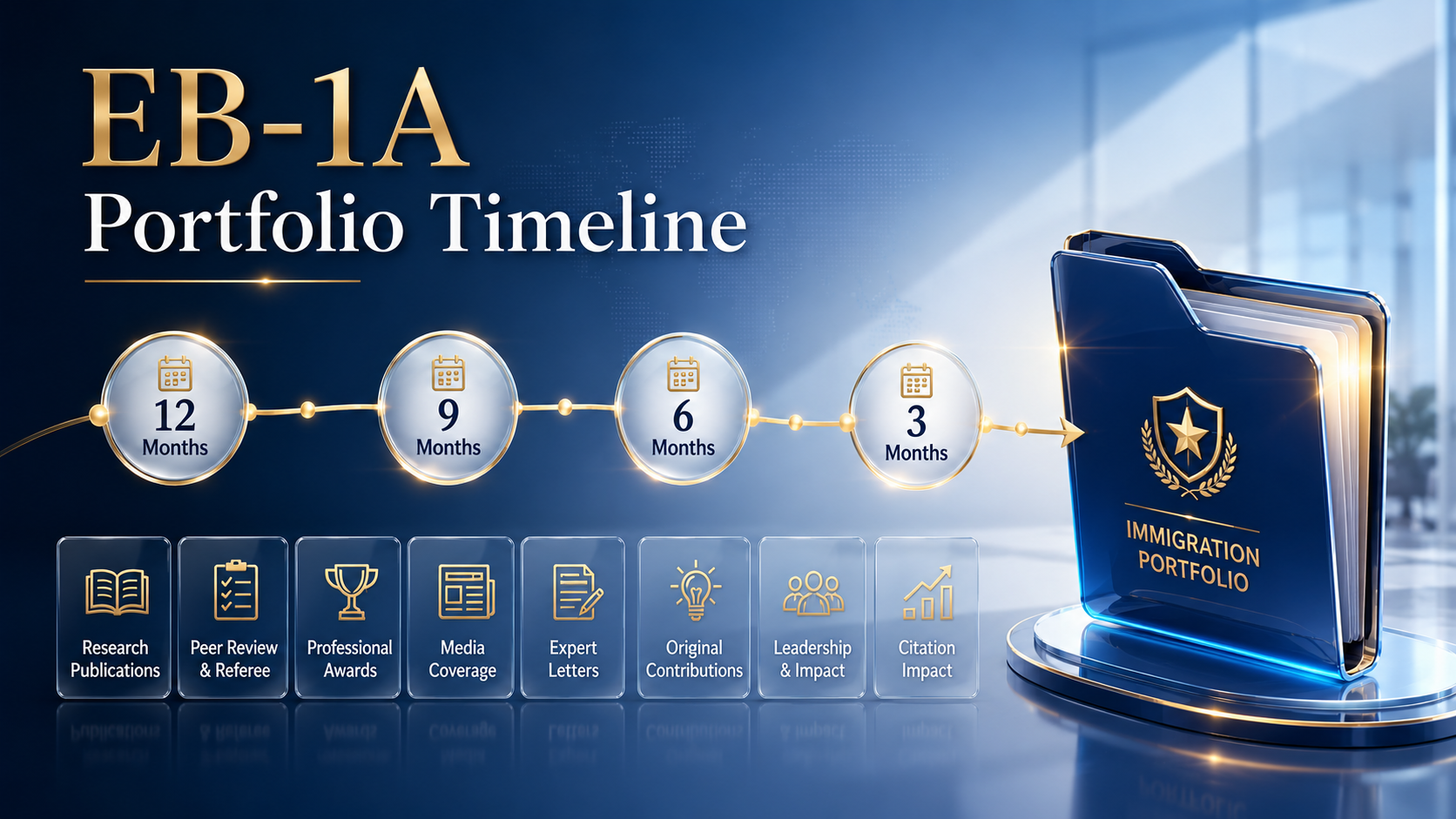
The Core Timeline: What to Build 12, 9, 6, and 3 Months Before Filing
Every case is different, but a practical EB-1A planning timeline often works best when divided into stages. The purpose is not to manufacture credentials. The purpose is to identify legitimate achievements, document them properly, and strengthen areas where the applicant already has a credible foundation.
12+ Months Before Filing: Define the Field, Narrative, and Evidence Map
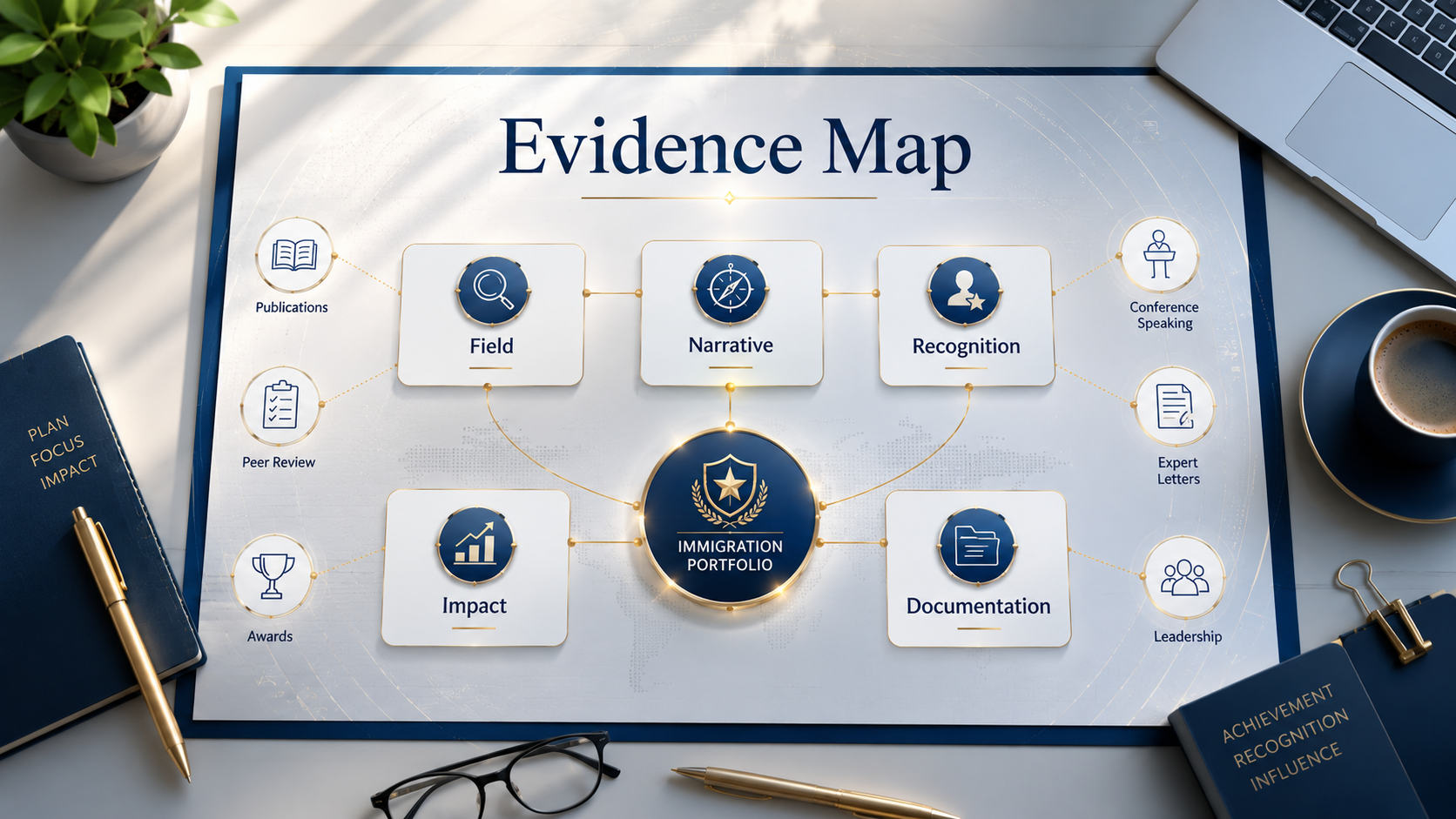
The earliest stage should focus on positioning. Many applicants skip this step and immediately start collecting documents. That can lead to a portfolio that looks large but unfocused. Before collecting evidence, the applicant should define the field of expertise as precisely as possible. A narrow, credible field often helps the evidence feel more coherent. For example, instead of presenting a broad identity as a technology professional, an applicant may be better positioned as an AI infrastructure leader, cybersecurity researcher, healthcare innovation strategist, computational engineering specialist, or enterprise software architecture expert.
At this stage, the applicant should also identify the main evidence categories that are realistically available. This may include research publications, peer review activity, professional awards, media coverage, original contributions, leadership evidence, critical role evidence, high salary evidence, conference speaker roles, professional memberships, or expert letters. The goal is to build an evidence map that shows where the case is already strong and where it may need development.
- Define the field: Choose a field description that is accurate, specific, and supported by the applicant’s record.
- Identify the strongest achievements: Separate major evidence from ordinary career history.
- Map evidence categories: List which EB-1A-related evidence themes may be supported now and which need more work.
- Check documentation quality: Determine whether each achievement has independent proof, not only self-written statements.
- Start a master evidence folder: Organize publications, awards, media links, certificates, letters, contracts, project records, review invitations, and speaking invitations.
This is also the best time to identify whether EB-1A is the right target or whether another path, such as O-1A, EB-1B, or EB2 NIW, may need to be considered as part of a broader strategy. The same professional record can sometimes support multiple immigration pathways, but each pathway requires a different framing strategy.
9 Months Before Filing: Strengthen Independent Recognition
At the 9-month stage, the applicant should focus on independent recognition. USCIS officers generally look for evidence that comes from sources beyond the applicant’s own employer, own company, close collaborators, or paid promotional channels. Independent recognition can appear in many forms: citations by unrelated researchers, invitations to review manuscripts, selection for competitive judging roles, speaking invitations from established conferences, awards from recognized organizations, independent media coverage, or expert letters from respected professionals who can explain the applicant’s influence.
For researchers, this may mean strengthening publication visibility, building citation impact, and pursuing legitimate peer review opportunities. For engineers, this may mean documenting technical contributions that were adopted by teams, clients, users, or industry stakeholders. For entrepreneurs, this may mean gathering evidence of market traction, innovation, press recognition, awards, patents, or influential partnerships. For healthcare professionals, this may mean documenting clinical innovation, research, invited presentations, leadership, protocols, patient-care improvements, or professional recognition.
The key is quality. A small number of strong independent signals may be more persuasive than a large pile of weak, promotional, or unclear materials.
6 Months Before Filing: Document Original Contributions and Impact
Original contributions are often one of the most challenging evidence themes. Applicants frequently describe their work as innovative, but the supporting documents do not clearly show broader significance. A strong contribution record should answer three questions: What exactly did the applicant create, improve, discover, design, lead, or influence? Why was it original or meaningfully different? What evidence shows that others recognized, adopted, cited, implemented, used, relied on, or benefited from it?
At the 6-month stage, applicants should collect impact documentation. This can include product metrics, adoption records, citation data, implementation records, client or institutional validation, patents, technical reports, independent expert commentary, internal performance data, public case studies, press coverage, conference materials, awards, or third-party references to the work. The goal is to make the contribution understandable to someone outside the applicant’s immediate technical environment.
For example, a machine learning engineer should not only say that they built a model. The portfolio should explain the problem, the innovation, the deployment context, the measurable improvement, who used it, and why it mattered. A civil engineer should not only list projects. The record should show project scale, technical leadership, public or commercial significance, adopted methods, and independent validation. A medical researcher should not only list publications. The evidence should show whether the research influenced later studies, clinical discussion, guidelines, practice, technology, or ongoing research directions.
3 Months Before Filing: Build the Petition-Ready Evidence Package
By the final 3 months, the focus should shift from building new evidence to organizing existing evidence. This is when applicants should avoid rushing into weak last-minute activities that may look artificial. Instead, they should refine the narrative, confirm documentation, request expert letters, organize exhibits, and coordinate with immigration counsel.
Expert letters and recommendation letters often become important at this stage. A strong expert letter does not merely praise the applicant. It explains the field, the applicant’s role, the significance of specific achievements, and the reason those achievements matter beyond ordinary employment. Letters are most useful when they are consistent with objective evidence. If a letter claims major influence but the file contains no independent support, the letter may feel unsupported. If the letter explains evidence already visible in the record, it can help connect the dots.
The final stage should also include a risk review. The applicant should ask whether each evidence category is strong, whether any documents are promotional, whether awards are truly selective, whether media coverage is independent, whether memberships require outstanding achievement, and whether leadership evidence shows actual influence rather than a job title alone.
Portfolio Planning Table: What to Prioritize by Evidence Type
| Evidence Theme | What Strong Evidence Usually Shows | Common Weakness | Planning Priority |
|---|---|---|---|
| Research publications | Peer-reviewed work, relevance to the field, citation impact, journal or conference context, independent use by others | Listing publications without explaining significance | Build visibility early and track citations regularly |
| Peer review | Invitations from journals or conferences, completed reviews, editorial trust, relevance to expertise | Review activity unrelated to the applicant’s field or poorly documented | Develop consistently over time |
| Professional awards | Competitive selection, recognized organization, clear criteria, field-level relevance | Pay-to-play awards or awards with unclear selection standards | Prioritize credible, selective awards |
| Media coverage | Independent articles about the applicant or work, reputable outlet, meaningful professional context | Promotional press releases or articles not focused on the applicant’s achievements | Focus on quality and independence |
| Original contributions | Specific innovation plus evidence of adoption, influence, citations, implementation, or measurable results | Claims of innovation without proof of broader impact | Collect objective impact documents early |
| Leadership or critical role | Major responsibility in distinguished organizations or important projects, measurable outcomes, senior validation | Relying only on job title or employment contract | Document role, organization, project importance, and results |
| Expert letters | Independent explanation of achievement significance supported by evidence | Generic praise or unsupported superlatives | Use after the evidence map is clear |
How Different Professionals Should Approach EB-1A Planning
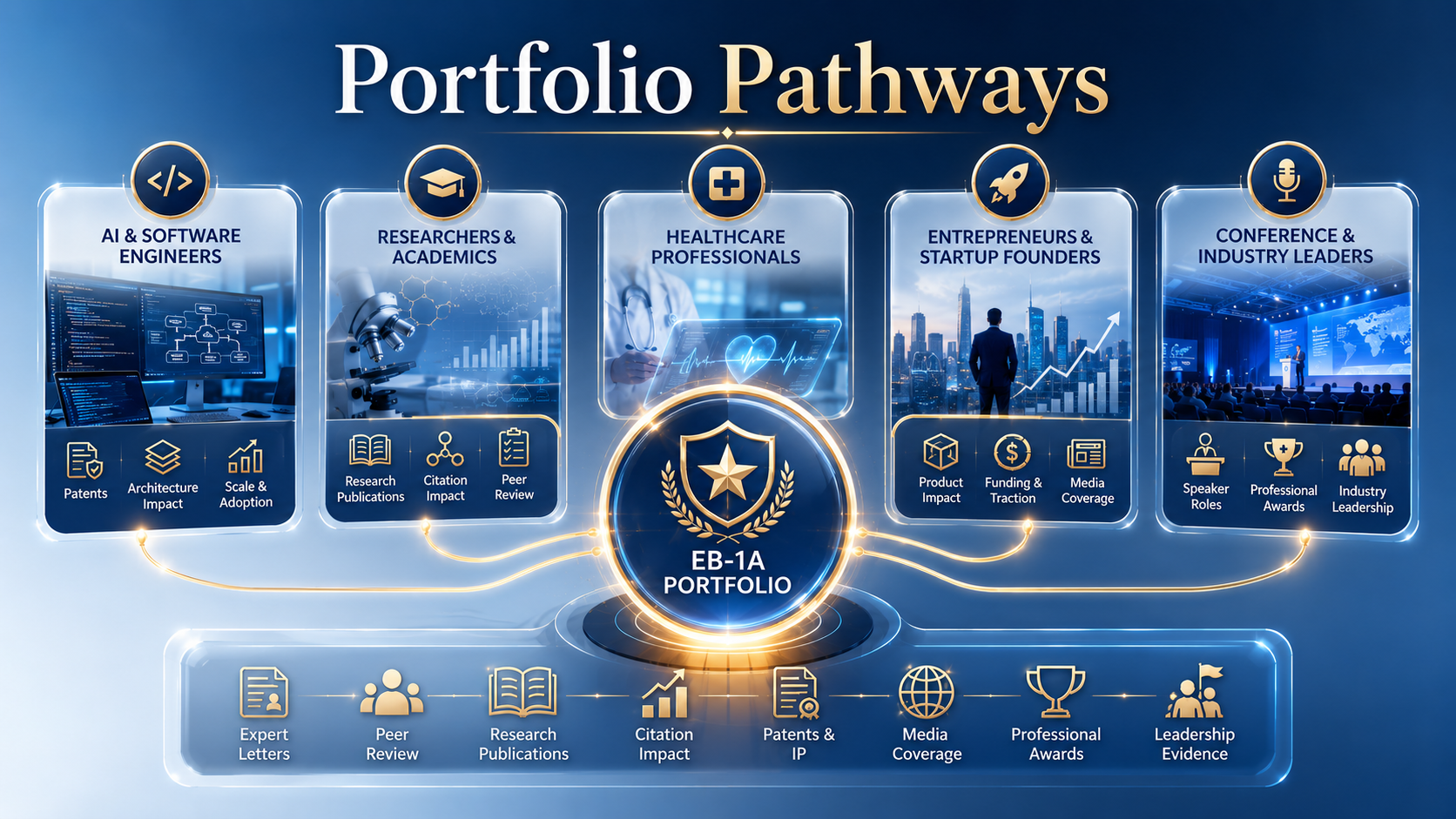
EB-1A is not limited to academics, but the evidence strategy varies by profession. A research-heavy profile may rely on publications, citations, peer review, conference presentations, and expert letters. A business or technology profile may rely more on original contributions, leadership, critical role evidence, awards, media coverage, patents, high salary evidence, and independent recognition. The best strategy is not to copy another applicant’s portfolio. It is to build the strongest version of the applicant’s own record.
Software Engineers and AI Professionals
Software engineers often underestimate the immigration value of their technical work because much of the evidence is internal. They may have built systems used by thousands or millions of users, improved performance, reduced infrastructure costs, led architecture decisions, or created tools adopted across organizations. The challenge is documentation. Strong evidence may include architecture diagrams, product metrics, adoption records, internal recognition, patent filings, open-source impact, conference talks, technical articles, expert letters, and proof of leadership in important projects.
AI professionals should be especially careful to avoid vague language. Words like artificial intelligence, machine learning, automation, and innovation can sound impressive, but the portfolio should explain the actual contribution. Did the applicant create a new model, improve a system, deploy a tool at scale, influence decision-making, publish research, receive citations, or lead a high-impact implementation? Clear evidence is more persuasive than buzzwords.
Researchers and University Faculty
Researchers usually have a more traditional evidence path, but traditional does not mean automatic. Publications should be contextualized. Citation impact should be explained carefully. Peer review should be documented with invitations, completed review records, journal or conference information, and relevance to the applicant’s expertise. Conference speaker roles should show whether the invitation was selective, whether the event was reputable, and whether the applicant’s topic reflects recognized expertise.
Faculty members should also document grants, academic awards, editorial roles, invited talks, major collaborations, student or lab leadership, research adoption, patents, and influence on the field. Expert letters can be especially valuable when they explain why the applicant’s research is important within a specialized area.
Healthcare Professionals
Healthcare professionals often have strong practical impact but may lack publication-heavy records. EB-1A planning should identify evidence of professional recognition, leadership, clinical innovation, research involvement, invited presentations, awards, memberships, protocols, training roles, or contributions to healthcare systems. A physician, pharmacist, biomedical scientist, hospital leader, or healthcare technology specialist may need to document both technical expertise and real-world impact.
For healthcare applicants, patient privacy and institutional restrictions can make evidence collection more complicated. Planning early allows the applicant to gather permissible documents, anonymized metrics, public records, letters from senior professionals, conference materials, and proof of adoption without violating confidentiality rules.
Entrepreneurs and Startup Founders
Entrepreneurs can build powerful EB-1A evidence, but they must distinguish business promotion from professional recognition. A founder’s portfolio may include media coverage, awards, investment records, customer traction, revenue growth, patents, product adoption, industry partnerships, accelerator selection, speaking invitations, and expert letters. However, not every startup achievement automatically supports extraordinary ability. The evidence should show that the founder’s work is recognized as significant, original, or influential within the field.
Founders should be careful with paid media, vanity awards, and exaggerated growth claims. Independent validation matters. A credible third-party article, selective award, patent adoption, major client usage, or industry expert explanation can be much stronger than generic promotional content.
Common Immigration Evidence Mistakes That Can Weaken an EB-1A Case
Even strong professionals can create weak portfolios when they treat evidence collection as a volume exercise. EB-1A preparation is not about adding as many pages as possible. It is about presenting relevant, credible, and well-supported evidence. Below are common mistakes applicants should avoid.
Mistake 1: Confusing Employment Success with Field Recognition
A senior job title can help, but it rarely tells the whole story. USCIS may look for evidence that the applicant’s work is recognized beyond ordinary employment. A vice president, lead engineer, principal scientist, or founder should document what they actually achieved, why the organization or project was important, and how their role produced measurable results.
Mistake 2: Using Promotional Media as Recognition Evidence
Media coverage can be valuable, but only when it is credible, independent, and focused on the applicant or their work. A press release, sponsored article, or company announcement may have limited value if it does not show independent recognition. Applicants should evaluate who wrote the article, why it was published, what it says, and whether the outlet has relevance to the field.
Mistake 3: Treating All Awards Equally
Professional awards should be evaluated for selectivity, reputation, criteria, and relevance. An award from a recognized professional body with clear selection standards may support the portfolio. A paid listing or low-selectivity business badge may not help much. Applicants should collect award rules, judging criteria, announcement pages, winner lists, and information about the awarding organization.
Mistake 4: Listing Publications Without Explaining Impact
Research publications are important, but a list alone may not explain significance. Applicants should include citation data where available, evidence of use by other researchers, journal or conference context, and expert explanation. A publication strategy should focus on quality, relevance, and visibility, not only quantity.
Mistake 5: Submitting Generic Recommendation Letters
Recommendation letters that sound like character references may not add much. Strong letters explain specific achievements, field context, and the applicant’s impact. They should be consistent with objective evidence and should avoid unsupported exaggeration. Independent expert letters may be particularly useful when the expert can credibly explain why the applicant’s work matters.
Mistake 6: Waiting Too Long to Collect Evidence
Last-minute preparation often leads to missing documents, rushed letters, weak screenshots, broken links, and incomplete explanations. Many forms of evidence are easier to collect when the achievement is recent. Conference pages disappear, award pages change, employers update websites, and internal records become harder to access. A strong immigration portfolio should be maintained continuously.
How Expert Letters and Recommendation Letters Fit Into the Timeline
Expert letters and recommendation letters are most effective when they are integrated into the evidence strategy instead of treated as a substitute for evidence. A letter can explain why a contribution matters, but it should not be the only proof that the contribution exists. A letter can describe a leadership role, but supporting documents should show the organization’s importance and the applicant’s actual responsibilities. A letter can discuss citation impact, but the record should include citation data and publication context.
Applicants should identify potential letter writers early. Strong candidates may include independent experts, senior industry professionals, professors, journal editors, conference organizers, executives, clients, or recognized professionals who understand the field. The relationship should be transparent. Some letters may come from people who worked directly with the applicant, while others may come from independent experts who know the applicant’s work through publications, products, patents, conference talks, or industry reputation.
Good letters usually include the writer’s credentials, relationship to the applicant, field context, specific examples, explanation of impact, and a professional conclusion. Weak letters rely heavily on adjectives, repeat the applicant’s resume, or make claims that are not supported by documents.
Building a Portfolio for EB-1A While Also Considering O-1A, EB-1B, or EB2 NIW
Some professionals plan for EB-1A but also want to understand how their evidence may support other options. This is a normal part of immigration portfolio planning. The O-1 visa also focuses on high-level achievement, but it is a temporary visa category and has its own structure and requirements. EB-1B is generally associated with outstanding researchers or professors and requires a different employment-based context. EB2 NIW focuses on a proposed endeavor and its importance, and the evidence strategy often emphasizes the applicant’s ability to advance that endeavor.
The same achievement may be framed differently depending on the pathway. A publication may support EB-1A extraordinary ability, EB-1B research recognition, O-1A distinction, or EB2 NIW endeavor credibility. A patent may support original contributions in EB-1A, technical distinction in O-1A, or national importance in EB2 NIW. A leadership role may support critical role evidence in EB-1A, professional distinction in O-1A, or the applicant’s capacity to advance a proposed endeavor in EB2 NIW.
Because the legal standards and petition structures differ, applicants should verify strategy with qualified immigration counsel. EB1 Mentor’s role is portfolio development: helping applicants organize achievements, strengthen evidence, identify gaps, and present a clearer professional record for later legal review.
A Practical EB-1A Evidence Checklist
The following checklist can help applicants begin a structured portfolio review. It is not a legal checklist and does not replace attorney guidance, but it can help identify the documents that often matter in EB-1A planning.
- Field definition: A clear description of the applicant’s area of expertise and professional niche.
- Achievement summary: A concise list of the most important achievements, not every job responsibility.
- Publication records: Full citations, journal or conference details, indexing information, citation data, and evidence of influence.
- Peer review records: Invitations, completed review confirmations, reviewer profiles, editorial acknowledgments, and relevance to expertise.
- Award evidence: Certificates, announcement pages, selection criteria, judging process, winner lists, and organization background.
- Media coverage: Independent articles, outlet information, publication dates, author details, and evidence that the coverage focuses on professional achievements.
- Original contributions: Technical descriptions, adoption records, metrics, patents, implementation evidence, client or user impact, and independent validation.
- Leadership evidence: Role descriptions, organizational reputation, project importance, team size, budgets, outcomes, and senior validation.
- Conference speaker evidence: Invitations, programs, speaker pages, audience details, event reputation, and topic relevance.
- High salary evidence: Compensation records, market comparisons, job level, industry context, and location-adjusted analysis where appropriate.
- Expert letters: Independent and internal letters that explain specific evidence rather than offering generic praise.
- Portfolio organization: A clean folder structure, exhibit labels, saved PDFs, screenshots with dates, and source links.
FAQ: EB-1A Portfolio Planning
1. When should I start preparing an EB-1A portfolio?
Ideally, applicants should start at least 6 to 12 months before filing, and earlier if their record needs development. Some evidence, such as peer review activity, research visibility, conference speaking, and independent recognition, is difficult to build credibly at the last minute.
2. Can I prepare for EB-1A if I do not have many publications?
Yes, some applicants have strong non-academic profiles. Publications can help, but EB-1A portfolios may also involve original contributions, leadership, awards, media coverage, judging, professional memberships, high salary evidence, and expert letters. The right strategy depends on the applicant’s field and achievements.
3. Are expert letters enough to prove extraordinary ability?
Usually, letters are strongest when they explain and support objective evidence. A letter without documents behind it may feel weak. The better approach is to combine letters with publications, citation impact, awards, media coverage, project records, patents, peer review, adoption evidence, or other independent proof.
4. How important is citation impact for researchers?
Citation impact can be important, especially for research-oriented applicants, but it should be interpreted in context. Different fields have different citation patterns. Applicants should explain the relevance of citations, the credibility of citing sources, and how the work influenced later research or practice.
5. Does peer review help an EB-1A case?
Peer review can support a record of professional recognition, especially when the reviews are for reputable journals, conferences, or publishers and are related to the applicant’s expertise. Documentation should show invitations, completed reviews, and the importance of the reviewing venue.
6. Is media coverage useful for EB-1A?
Media coverage can be useful when it is independent, credible, and focused on the applicant’s professional achievements. Promotional articles, paid placements, or generic company announcements may have less value unless they are supported by stronger context.
7. Can startup founders qualify for EB-1A?
Startup founders may build strong portfolios if they can document recognized achievements, original contributions, product impact, awards, media coverage, patents, speaking roles, major partnerships, or market influence. The evidence should show more than ordinary business ownership.
8. Should I also plan for O-1A or EB2 NIW?
Some applicants benefit from parallel planning. O-1A, EB-1A, EB-1B, and EB2 NIW use different legal structures, but evidence development can overlap. A professional should consult qualified immigration counsel to decide which pathway fits their goals and status situation.
9. What is the biggest mistake in EB-1A preparation?
One of the biggest mistakes is waiting until the filing deadline to organize evidence. Another is assuming that impressive career achievements automatically translate into persuasive immigration evidence. The portfolio must explain significance, recognition, and impact clearly.
10. Can EB1 Mentor file my petition?
No. EB1 Mentor is not a law firm and does not provide legal representation or legal advice. EB1 Mentor helps clients strengthen and organize immigration portfolios so they can work more effectively with qualified immigration attorneys.
Conclusion: Strong EB-1A Portfolios Are Built Before the Deadline
A persuasive EB-1A portfolio rarely appears overnight. It is built through careful planning, credible evidence, independent recognition, clear documentation, and a professional narrative that connects the applicant’s achievements to broader field-level impact. Whether the applicant is a researcher, software engineer, AI professional, healthcare specialist, entrepreneur, university faculty member, or executive, the same principle applies: the evidence should show not only what the applicant did, but why it matters.
Every immigration case is unique. Professional guidance can help applicants identify strengths, close documentation gaps, improve portfolio organization, and avoid common mistakes before working with immigration counsel. If you are preparing for EB-1A, O-1A, EB-1B, or EB2 NIW and want to build a stronger immigration portfolio, you can contact EB1 Mentor here: [https://eb1mentor.com/contact.php](https://eb1mentor.com/contact.php).
Important note: EB1 Mentor is not a law firm and does not provide legal representation. Immigration rules and USCIS guidance can change, and applicants should verify legal strategy with qualified immigration counsel.
Build a Stronger Immigration Portfolio
Every immigration case is unique. EB1 Mentor helps accomplished professionals strengthen evidence for EB-1A, EB-1B, O-1A, and EB2 NIW portfolio planning. EB1 Mentor is not a law firm and does not provide legal representation.