

Expert letters can be powerful immigration evidence, but they are also one of the most misunderstood parts of an EB-1A, O-1A, EB-1B, or EB2 NIW portfolio. Many applicants collect letters from supervisors, collaborators, former professors, clients, or respected professionals and assume that strong praise will automatically help. In practice, the value of an expert letter depends less on how impressive the writer sounds and more on what the letter proves.
For EB-1A extraordinary ability cases, the letter should not simply say that the applicant is talented, hardworking, innovative, or important to an employer. It should help explain why the applicant's work matters in the field, how independent experts understand that work, and how the evidence connects to recognized immigration themes such as original contributions, leadership, critical role, publications, citation impact, conference speaking, peer review, professional awards, and broader recognition. That same specificity matters even more for original contributions letters, where the letter needs to explain the mechanism of field-wide impact, not just praise the work.
This article explains how expert letters should be planned, drafted, reviewed, and integrated into a complete immigration portfolio. It is written for accomplished professionals, researchers, software engineers, AI professionals, healthcare innovators, startup founders, university faculty, and other applicants who want their letters to support a stronger evidence strategy rather than simply add more pages to a petition.
Why Expert Letters Matter in Immigration Evidence Strategy
An expert letter can perform several strategic functions. It can provide context for technical work that may not be obvious from publications, patents, product documents, media coverage, or employer materials. It can explain why a contribution was difficult, original, influential, or adopted beyond a narrow internal setting. It can also connect scattered evidence into a coherent story.
However, a letter is usually strongest when it supports evidence that already exists. A letter that says the applicant made an important contribution is more persuasive when it refers to measurable indicators such as implementation, adoption, publication history, citations, peer review invitations, conference invitations, professional awards, independent media coverage, commercial deployment, institutional use, or expert recognition from outside the applicant's immediate workplace.
In other words, expert letters should not replace evidence. They should interpret evidence.
Strategic principle: A strong expert letter does not merely praise the applicant. It helps a reader understand the field-level meaning of documented achievements.
Expert Letters vs. Recommendation Letters
Many applicants use the terms expert letter and recommendation letter interchangeably. That creates risk. A recommendation letter often focuses on personal qualities, work ethic, job performance, character, reliability, leadership style, or employability. Those topics can be useful in some professional settings, but they may not be enough for an immigration evidence portfolio that needs to show extraordinary ability, outstanding research impact, national importance, or high-level professional recognition.
An expert letter is different. It should be written by someone who can evaluate the applicant's work from a position of professional knowledge. The writer may be independent or closely connected to the applicant, but the strongest letters usually demonstrate that the writer understands both the applicant's field and the significance of the applicant's specific achievements.
| Letter Type | Main Purpose | Common Weakness | Stronger Use |
|---|---|---|---|
| Recommendation letter | Supports the applicant's character, role, or professional reliability | May read like an employment reference | Useful when tied to leadership, critical role, or documented accomplishments |
| Expert letter | Explains the significance of achievements in the field | Can become generic if it lacks evidence and technical detail | Useful for original contributions, impact, recognition, and field-level context |
| Independent expert letter | Shows recognition by someone outside the applicant's immediate circle | May be too vague if the expert does not know the work deeply | Useful when it explains why the work is known, useful, cited, adopted, or influential |
| Internal stakeholder letter | Explains the applicant's role, responsibility, and organizational impact | May look employer-centered rather than field-centered | Useful for critical role, leadership, product impact, and implementation evidence |
What USCIS-Oriented Readers Usually Need From an Expert Letter
An immigration petition is not a biography. It is an evidence-based argument. The reader needs to understand what happened, why it matters, who can verify it, and how it fits the requested immigration category. For EB-1A, an expert letter may help show that the applicant has sustained recognition and achievements that rise above ordinary professional success. For O-1A, it may help explain extraordinary ability in a specific area. For EB-1B, it may help contextualize outstanding research. For EB2 NIW, it may help frame the proposed endeavor and the applicant's ability to advance it.
The exact legal and evidentiary analysis should be handled by qualified immigration counsel where legal advice is needed. EB1 Mentor is not a law firm and does not provide legal representation. From a portfolio-building perspective, however, letters are most useful when they make evidence easier to understand and harder to dismiss as ordinary employment, routine collaboration, or unsupported praise.
A strong expert letter should usually answer these questions
- Who is the expert, and why is the expert qualified to evaluate the applicant's work?
- How does the expert know the applicant's work?
- What specific achievements, publications, systems, patents, research findings, products, awards, peer review work, or leadership roles are being discussed?
- Why were those achievements difficult, original, selective, influential, or important?
- What objective evidence supports the expert's opinion?
- Was the impact internal, external, national, international, academic, commercial, technical, clinical, industrial, or policy-related?
- How does the applicant compare with typical professionals in the field?
- What is the broader relevance of the applicant's work?
The Biggest Mistake: Collecting Praise Instead of Evidence-Based Interpretation
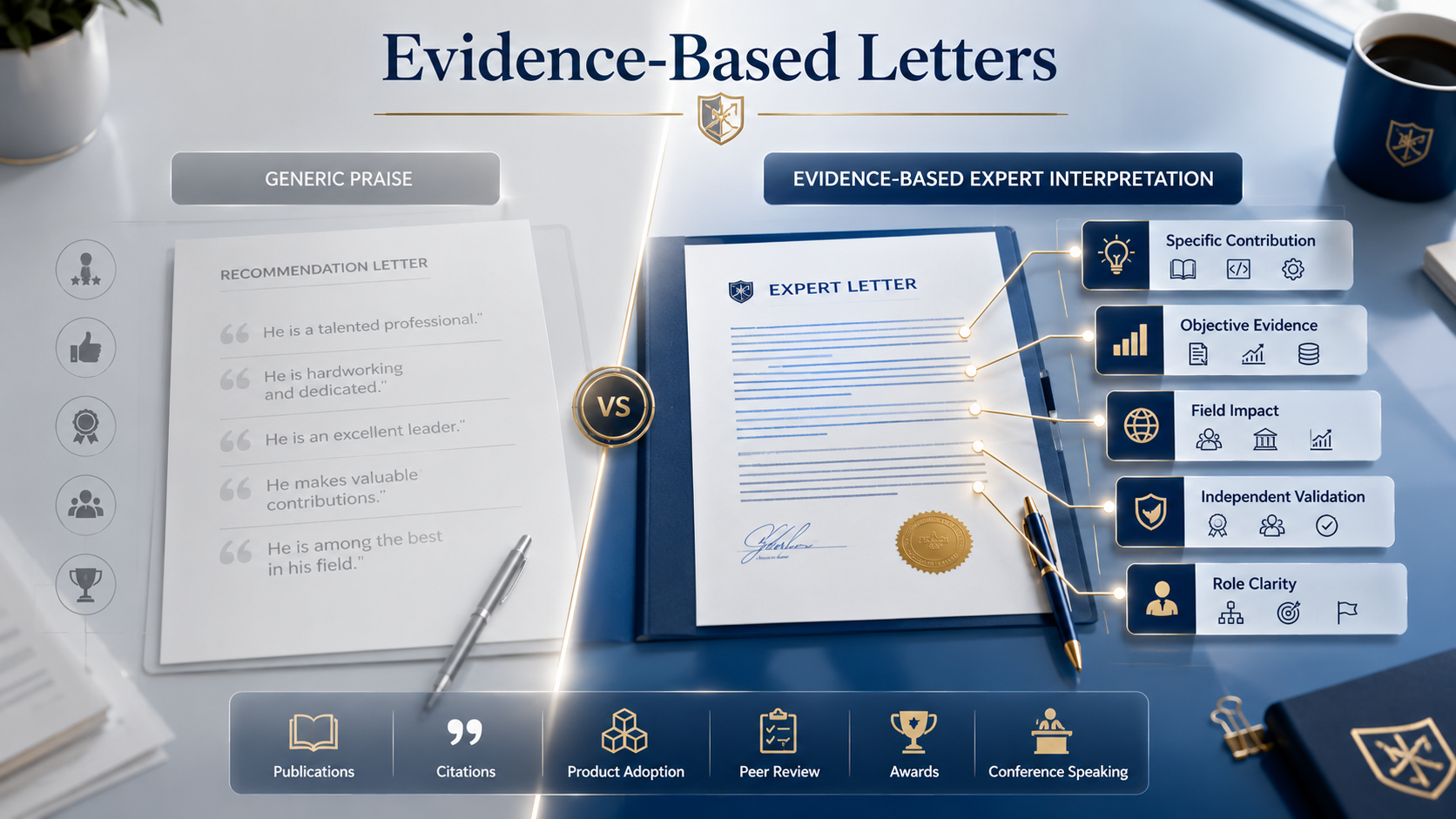
One of the most common immigration evidence mistakes is collecting many letters that all say essentially the same thing. The applicant is brilliant. The applicant is respected. The applicant is a leader. The applicant is among the best. The applicant has made meaningful contributions. These statements may sound positive, but if they are unsupported, repetitive, and vague, they can create the opposite impression: that the portfolio relies on opinion rather than documentation.
Strong letters do not need to be exaggerated. They need to be specific. A credible expert letter should contain concrete details that would be difficult to write without actually understanding the applicant's work.
Weak letter language often looks like this
- The applicant is a highly talented professional.
- The applicant has made outstanding contributions to the field.
- The applicant is recognized internationally.
- The applicant is one of the best experts I know.
- The applicant's work is very important and innovative.
Stronger letter language does more
- It identifies a specific contribution and explains what problem it solved.
- It describes the technical, scientific, commercial, academic, or organizational difficulty of the work.
- It connects the work to independent indicators such as citations, adoption, peer review, awards, invited talks, conference presentations, or implementation.
- It explains why the contribution is not routine within the field.
- It distinguishes the applicant's role from the role of a team, company, supervisor, or institution.
Choosing the Right Experts
The identity of the letter writer matters, but title alone is not enough. A letter from a famous professor, senior executive, journal editor, conference chair, investor, physician, engineer, or industry leader may carry little value if it does not explain the applicant's achievements with precision. A letter from a less famous but highly relevant expert can be more useful if the writer gives a detailed, evidence-based explanation.
Independent experts
Independent experts are often valuable because they can reduce the appearance that the letter is merely an internal reference. Independence may come from the expert not being the applicant's supervisor, employee, close collaborator, or current employer. For researchers, this may include scholars who cited the applicant's work, journal editors, conference organizers, peer reviewers, or senior researchers in the same domain. For entrepreneurs, it may include industry experts, investors, enterprise customers, ecosystem leaders, or technical authorities who understand the product or market. For software engineers and AI professionals, it may include recognized architects, open-source maintainers, technical reviewers, senior engineering leaders, or researchers who can speak to the applicant's systems or models.
Internal experts
Internal letters can also be useful. They may provide information that independent experts cannot know, such as the applicant's exact role in a product launch, infrastructure project, research program, clinical initiative, or high-impact business function. Internal letters are especially useful for leadership evidence, critical role evidence, high-responsibility assignments, product ownership, team influence, and measurable organizational outcomes.
The key is to avoid making internal letters sound like ordinary performance reviews. They should not only say that the applicant was a good employee. They should explain why the applicant's role was critical, what would have been difficult without the applicant, and how the work produced measurable or strategically important results.
Hybrid strategy: independent plus internal
Many strong portfolios use both independent and internal letters. Independent letters can support recognition and field-level significance. Internal letters can support role, execution, leadership, and implementation. When coordinated properly, the two types of letters complement each other rather than repeat each other.
How Many Expert Letters Should an Applicant Have?
There is no universal number that fits every case. More letters are not automatically better. A portfolio with six carefully differentiated letters may be stronger than a portfolio with fifteen repetitive letters. The goal is coverage, not volume.
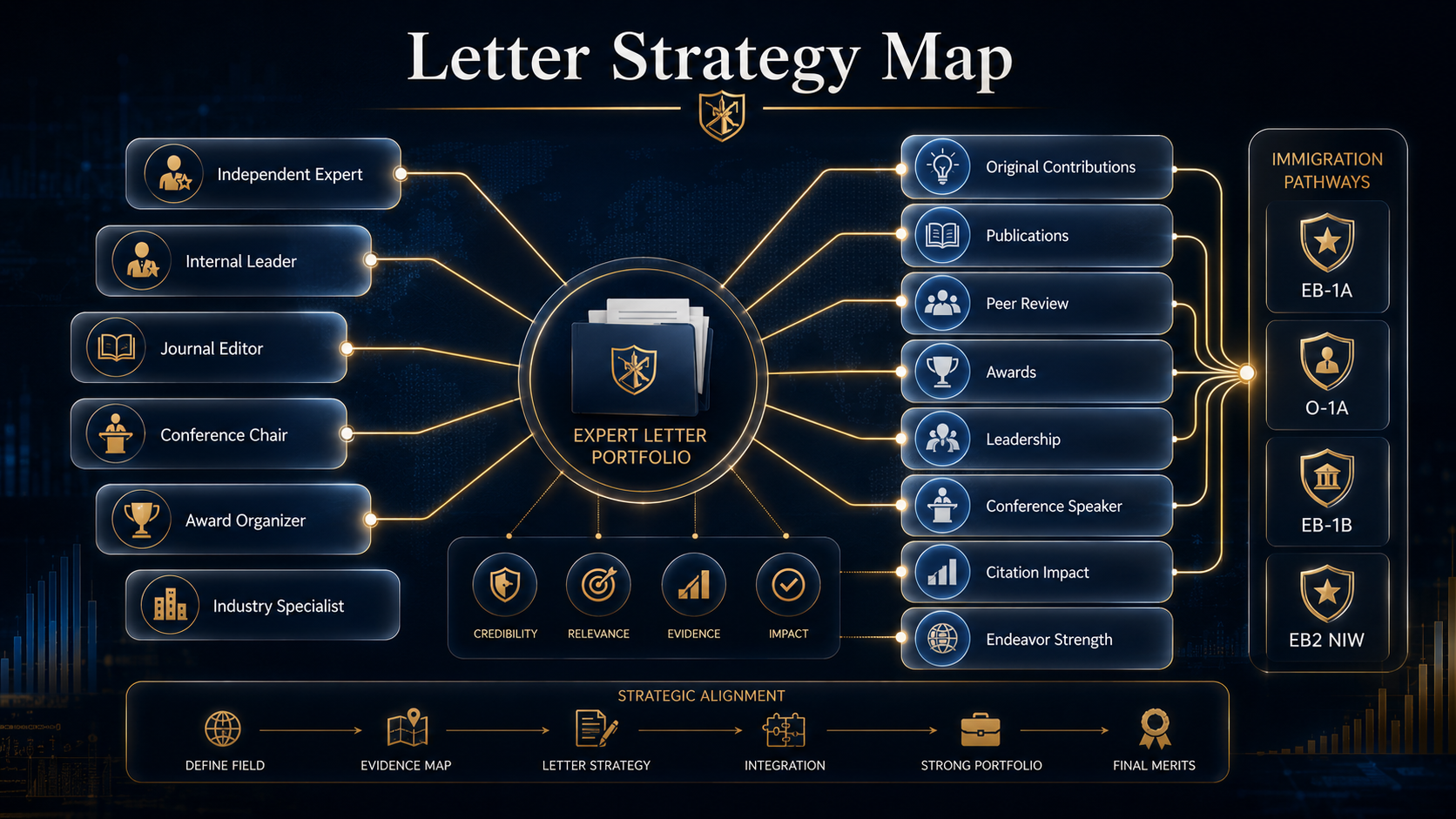
A useful approach is to map each letter to a strategic purpose. One letter may explain original contributions. Another may address research publications and citation impact. Another may document peer review, judging, or editorial service. Another may explain leadership or critical role. Another may discuss conference speaker invitations or professional awards. Another may describe national importance for an EB2 NIW endeavor.
Sample expert letter map
| Evidence Theme | Best Letter Writer Type | What the Letter Should Explain |
|---|---|---|
| Original contributions | Independent technical expert, cited researcher, product authority, or field specialist | What was new, why it mattered, and how it influenced practice, research, systems, products, or institutions |
| Research publications | Senior researcher, editor, professor, or citation-connected expert | The publication's field relevance, quality, and relationship to later work |
| Peer review | Journal editor, conference chair, editorial board member, or publisher representative | Selectivity, reviewer qualifications, review volume, subject matter difficulty, and trust placed in the applicant |
| Professional awards | Award organizer, selection committee member, or independent expert | Selection process, competition pool, judging criteria, and why the award signals recognition |
| Conference speaker evidence | Conference chair, program committee member, or respected attendee | Why the applicant was invited, audience quality, topic relevance, and professional significance |
| Leadership or critical role | Executive, founder, principal investigator, department leader, or senior stakeholder | The applicant's responsibility, decision-making authority, and measurable effect on an important organization or initiative |
What Makes an Expert Letter Credible?
Credibility comes from specificity, evidence, and proportion. A letter should not sound like a marketing brochure. It should sound like a knowledgeable expert giving a careful professional assessment.
1. The expert's qualifications are relevant
The letter should briefly establish why the writer is qualified. This may include academic role, industry role, publications, patents, leadership positions, editorial work, awards, technical specialization, commercial experience, or professional recognition. The goal is not to write the expert's full biography. The goal is to show that the expert has enough standing to evaluate the applicant's achievements.
2. The relationship is transparent
The letter should explain how the expert knows the applicant or the applicant's work. Did the expert cite the applicant's paper? Review the applicant's research? Invite the applicant to speak? Evaluate an award submission? Work with the applicant on a major product? Use the applicant's open-source tool? Observe the applicant's contribution in a professional society? Transparency can increase credibility.
3. The letter discusses specific achievements
Generic letters are easy to discount. Strong letters identify specific projects, papers, products, patents, platforms, systems, clinical programs, awards, conference presentations, or leadership roles. They explain what was done and why it was meaningful.
4. The letter uses objective anchors
Objective anchors may include citation numbers, journal selectivity, conference audience, product adoption, revenue impact, cost savings, user base, technical benchmarks, award criteria, review assignments, institutional deployment, independent media, or professional society recognition. These anchors should be accurate and supported elsewhere in the portfolio when possible.
5. The letter avoids unsupported superlatives
Words like leading, top, exceptional, world-class, groundbreaking, and internationally recognized can help only when they are tied to evidence. Without support, they may sound inflated. A measured, detailed explanation often feels more credible than dramatic language.
Using Expert Letters for EB-1A Original Contributions
Original contributions are often difficult to document because the applicant must usually explain not only what was created but why it was significant. Expert letters can be especially helpful here, but only when they go beyond saying that something was innovative.
A strong original contributions letter should explain the problem in the field, the applicant's solution, the difference between the solution and ordinary practice, and the evidence that others recognized, adopted, built upon, cited, implemented, or benefited from the work.
For researchers
A researcher may use expert letters to explain how a publication influenced later studies, introduced a method, advanced a subfield, supported clinical or engineering practice, or helped establish a new research direction. Citation impact can be important, but the letter should avoid simply repeating citation counts. It should explain why the cited work matters.
For software engineers and AI professionals
A software engineer or AI professional may use expert letters to explain architecture, scalability, algorithmic novelty, model performance, infrastructure reliability, open-source adoption, enterprise deployment, or technical influence. The letter should distinguish the applicant's role from the broader engineering team and connect the work to measurable outcomes where possible.
For healthcare professionals
A healthcare professional may use expert letters to explain clinical innovation, protocol development, patient-care improvements, research translation, health technology deployment, quality improvement, medical education leadership, or public health relevance. The strongest letters usually connect the applicant's work to documented institutional, clinical, academic, or field-level effects.
For entrepreneurs and startup founders
A founder may use expert letters to explain market innovation, product originality, business model significance, customer adoption, fundraising relevance, patents, media coverage, awards, or industry recognition. The letter should not simply praise entrepreneurial ambition. It should explain why the company or technology represents a meaningful contribution and what evidence supports that conclusion.
Using Expert Letters for Peer Review and Judging Evidence
Peer review and judging can be meaningful evidence because they show that the applicant was trusted to evaluate the work of others. But the strength of this evidence depends on selectivity, subject matter relevance, volume, quality, and professional context.
An expert letter from an editor, conference organizer, program chair, publisher, award administrator, or judging coordinator can help explain why the applicant was selected. It can also clarify that the role required recognized expertise rather than routine participation.
Useful points for peer review letters
- How reviewers or judges are selected
- Whether the applicant was invited because of specialized expertise
- The number and type of manuscripts, abstracts, papers, products, projects, or applications reviewed
- The quality or competitiveness of the journal, conference, award, or program
- The applicant's subject matter area
- Whether the applicant completed reviews consistently, thoughtfully, or at a high professional standard
Applicants should be careful not to exaggerate the selectivity of routine review invitations. If the review opportunity is open to many people, the letter should focus on the actual professional significance and the applicant's documented performance rather than unsupported prestige.
Using Expert Letters for Conference Speaker Evidence
Conference presentations can support an immigration portfolio when they show recognition, field relevance, and meaningful professional visibility. An expert letter can explain why the applicant was invited, who attended, how the topic related to the field, and whether the invitation reflected independent selection.
The letter should ideally discuss audience quality, program selectivity, speaker selection process, session importance, keynote status if applicable, and the applicant's contribution to professional discussion. It should also connect the presentation to other evidence, such as publications, original contributions, awards, media coverage, or leadership.
Using Expert Letters for Awards, Memberships, and Media Coverage
Professional awards, selective memberships, and media coverage often need context. An award certificate alone may not explain whether the award is selective, competitive, national, international, field-specific, or based on recognized achievement. A membership certificate alone may not show whether selection is based on accomplishments. A media article alone may not show independent editorial significance.
Expert letters can help explain these signals, but they should not invent prestige. They should be accurate and carefully supported.
Award letters should explain
- The selection criteria
- The selection committee or judging process
- The applicant pool, if known and verifiable
- The number of winners or level of competition
- Why the applicant's achievement was recognized
- How the award relates to the applicant's field
Membership letters should explain
- Whether membership is selective
- Whether admission depends on professional achievement
- Who evaluates the applicant
- How the applicant's accomplishments supported selection
- Whether the membership category is different from ordinary paid membership
Media letters should explain
- Why the applicant was covered
- Whether the coverage was independent editorial coverage
- The relevance of the publication or audience
- How the coverage relates to professional recognition
How to Build a Letter Strategy Before Drafting
Applicants often start by asking, who can write me a letter? A stronger question is, what evidence theme needs explanation? The letter writer should be selected after the strategy is clear.
Step 1: Build an evidence map
Create a list of major evidence themes: publications, citations, peer review, awards, media, memberships, original contributions, leadership, critical role, conference presentations, patents, high salary, or national importance. Then identify which themes are strong, which need context, and which are vulnerable.
Step 2: Assign each letter a purpose
Each expert letter should have a job. One letter may explain the applicant's research visibility. Another may explain the applicant's original contribution. Another may document critical role. Another may explain a professional award. Avoid asking every writer to cover everything.
Step 3: Gather documents before drafting
Before writing or requesting a letter, gather supporting evidence. This may include CV, publication list, citation profile, patents, award pages, conference programs, review invitations, media articles, project documentation, product metrics, employer letters, professional society records, or screenshots of public evidence.
Step 4: Create a fact sheet for each expert
A concise fact sheet helps the writer stay accurate. It can include the applicant's role, key achievements, dates, evidence references, metrics, and the specific themes the writer is asked to address. This also reduces the risk of inconsistent letters.
Step 5: Avoid copy-paste repetition
Letters should not sound identical. Repetition can make the evidence feel manufactured. Each letter should reflect the writer's perspective, relationship, field knowledge, and specific reason for evaluating the applicant.
Common Red Flags in Expert Letters
Even strong applicants can weaken their immigration evidence with poorly planned letters. The following red flags are common and avoidable.
- Generic praise: The letter uses broad compliments without evidence.
- Unsupported rankings: The writer says the applicant is among the top professionals but gives no basis for comparison.
- Employer-only framing: The letter focuses only on internal job performance without explaining field relevance.
- Overly similar letters: Multiple letters use the same wording, structure, or claims.
- Missing expert credentials: The writer does not explain why they can evaluate the applicant's work.
- Unclear relationship: The letter does not explain how the writer knows the applicant or the work.
- Inflated claims: The language sounds stronger than the supporting documents.
- No connection to criteria: The letter is positive but does not support a clear evidence theme.
- No objective anchors: The letter lacks dates, metrics, publications, awards, adoption, citations, or verifiable details.
- Contradictions: The letter conflicts with the applicant's CV, petition timeline, project documents, or other letters.
Practical Checklist for Expert Letter Preparation
Before finalizing an expert letter for an EB-1A, EB1 visa, O-1 visa, EB-1B, or EB2 NIW portfolio, applicants should review the letter against a practical quality checklist.
- Does the letter clearly identify the writer's qualifications?
- Does it explain the writer's relationship to the applicant or the work?
- Does it discuss specific achievements rather than general character?
- Does it connect opinions to objective evidence?
- Does it explain why the achievement matters beyond ordinary employment?
- Does it avoid unsupported superlatives?
- Does it support a clear evidence theme?
- Does it match the rest of the immigration portfolio?
- Does it avoid repeating other letters too closely?
- Does it help the reader understand the applicant's field, role, and impact?
How Expert Letters Fit Into the Final Portfolio
Expert letters should be integrated into the portfolio rather than attached as isolated documents. The petition narrative, evidence index, exhibit organization, and supporting documents should make it easy to see how each letter supports a specific point.
For example, a letter about original contributions should be placed near the evidence it interprets: publications, patents, product materials, implementation records, citation data, media articles, or adoption evidence. A letter about peer review should be near review invitations, completed review records, journal information, and editorial correspondence. A letter about conference presentations should be near the conference program, speaker invitation, agenda, audience information, and session materials.
This structure helps the letter function as a guide to the evidence, not a substitute for it.
Special Considerations for Different Immigration Categories
EB-1A extraordinary ability
For EB-1A, expert letters should support the argument that the applicant has a record of high achievement and recognition in the field. They may help with original contributions, leading or critical role, judging, published material, awards, memberships, conference speaker evidence, research publications, and citation impact. They should be careful, evidence-based, and aligned with the overall final merits strategy.
O-1A visa strategy
For O-1A, expert letters can help explain extraordinary ability in the applicant's area of expertise, especially when evidence spans technical work, research visibility, awards, media, leadership, and specialized industry impact. Letters should connect the applicant's achievements to the proposed work in the United States when relevant.
EB-1B outstanding researcher or professor
For EB-1B, letters can support the applicant's standing as an outstanding researcher or professor by explaining research significance, publication quality, peer review work, citations, institutional recognition, and contributions to the academic or scientific field. Which framing a letter should serve depends on a decision made earlier, and faculty weighing the choice between the two first-preference routes are better off settling it before commissioning anything.
EB2 NIW endeavor framing
For EB2 NIW, expert letters can help explain the proposed endeavor, its potential importance, and the applicant's ability to advance it. Letters may discuss the applicant's track record, technical capacity, research background, entrepreneurial work, clinical relevance, public benefit, or industry need. Because NIW strategy depends heavily on the specific endeavor, applicants should verify their approach with appropriate professional guidance.
Example Letter Strategy: AI Infrastructure Professional
Consider an AI infrastructure professional who has built large-scale systems, published research, reviewed manuscripts, spoken at conferences, and led important engineering initiatives. A weak letter strategy would collect five letters from colleagues saying the applicant is an excellent engineer. A stronger strategy would assign each letter a distinct purpose.
- An independent AI researcher explains how the applicant's publication contributed to model deployment practices.
- A senior engineering executive explains the applicant's critical role in a major infrastructure platform and gives measurable outcomes.
- A journal editor explains why the applicant was trusted with peer review assignments in a specialized area.
- A conference organizer explains why the applicant was invited as a speaker and why the topic mattered to the audience.
- An industry expert explains how the applicant's system influenced adoption, reliability, scalability, or technical practice beyond a routine internal project.
This structure is stronger because each letter reinforces a different part of the immigration evidence map.
Example Letter Strategy: Researcher With Publications and Citations
A researcher with publications, citation impact, peer review service, and conference presentations may need letters that explain why the research matters. Citation numbers alone do not always communicate significance. A senior researcher can explain how a specific article is used in the field, why the method is valuable, and how later work built upon it. An editor can explain the applicant's peer review expertise. A conference chair can explain why the applicant's presentation was selected. A department or lab leader can explain the applicant's role in a major research program.
The goal is not simply to repeat the publication list. The goal is to translate the record into a clear professional significance narrative.
Example Letter Strategy: Startup Founder
A startup founder may have product traction, media coverage, awards, customer adoption, investment, patents, or leadership evidence. Letters should help distinguish genuine field or market impact from ordinary business promotion. A customer may explain why the product solved a significant problem. An investor may explain market relevance and founder capability. An industry expert may explain the originality of the technology. A former executive or advisor may explain leadership and strategic role. An award organizer may explain the selectivity of recognition.
For founders, the strongest letters usually connect innovation to evidence of adoption, validation, or influence.
Frequently Asked Questions About Expert Letters
1. Are expert letters required for EB-1A?
There is no single letter formula that applies to every EB-1A case. Many strong petitions use expert letters because they help explain complex achievements, original contributions, leadership, and recognition. However, letters should support documented evidence rather than replace it.
2. Is an independent expert letter better than a supervisor letter?
It depends on the purpose. Independent letters can be useful for field-level recognition and external validation. Supervisor or internal stakeholder letters can be useful for critical role, leadership, and implementation details. A balanced strategy may use both.
3. Can a colleague write an expert letter?
Yes, if the colleague is qualified to evaluate the applicant's work and can provide specific, evidence-based insight. However, letters from close colleagues may be viewed differently from independent expert letters, so they should be used strategically.
4. Should expert letters be very long?
Not necessarily. A concise, specific, well-supported letter is often better than a long letter filled with general praise. The letter should be long enough to explain the evidence clearly but not so long that the main points become diluted.
5. Can one letter cover all criteria?
It can, but that is often not ideal. A stronger portfolio usually assigns different letters to different evidence themes, such as original contributions, peer review, conference speaking, awards, leadership, or research publications.
6. What makes an expert letter weak?
A weak letter usually contains generic praise, unsupported superlatives, unclear relationship details, no objective evidence, and no connection to a specific immigration evidence theme. Repetitive letters can also weaken the portfolio.
7. Should expert letters mention EB-1A or USCIS criteria directly?
Sometimes letters may refer to achievements in a way that aligns with immigration evidence themes. However, they should still sound like authentic professional assessments, not legal briefs. The petition strategy should coordinate how letters are used.
8. Can expert letters help after an RFE or denial?
They may help if they directly address weaknesses identified in the case and are supported by evidence. However, simply adding more letters after an RFE or denial may not solve the problem if the underlying evidence remains weak or unclear.
9. Are letters from famous people always stronger?
No. A famous writer who gives vague praise may be less useful than a specialized expert who explains the applicant's work in detail. Relevance, credibility, and specificity matter more than name recognition alone.
10. How should applicants prepare a writer?
Applicants should provide an accurate CV, evidence summary, project or publication details, dates, metrics, and a clear explanation of what theme the letter should address. The final letter should remain truthful, specific, and consistent with the record.
Conclusion: Expert Letters Should Strengthen the Evidence, Not Decorate It
Expert letters can be one of the most valuable parts of an immigration portfolio when they are planned carefully. They help translate complex achievements into clear professional significance. They explain why publications matter, why peer review invitations reflect expertise, why conference speaker roles show recognition, why awards are meaningful, why leadership was critical, and why original contributions may have field-level importance.
But letters are not magic. They cannot turn weak evidence into strong evidence by using dramatic adjectives. They work best when they are specific, credible, differentiated, and supported by documentation.
Every immigration case is unique. A researcher with citation impact needs a different letter strategy from a software engineer, healthcare professional, entrepreneur, university faculty member, or AI professional. The strongest approach is to build an immigration portfolio where expert letters, recommendation letters, publications, peer review, professional awards, media coverage, leadership evidence, and original contributions all support one coherent narrative.
Build a Stronger Immigration Evidence Portfolio
EB1 Mentor helps accomplished professionals organize and strengthen evidence for EB-1A, EB-1B, O-1A, and EB2 NIW preparation. EB1 Mentor is not a law firm and does not provide legal representation, but professional portfolio guidance can help applicants identify stronger evidence themes, reduce common mistakes, and present achievements more clearly.
Contact EB1 Mentor to discuss how your expert letters, publications, peer review, awards, media coverage, conference speaking, leadership, and original contributions can fit into a stronger immigration portfolio strategy.
Build a Stronger Immigration Evidence Portfolio
EB1 Mentor helps accomplished professionals organize and strengthen evidence for EB-1A, EB-1B, O-1A, and EB2 NIW preparation. EB1 Mentor is not a law firm and does not provide legal representation, but professional guidance can help applicants build stronger portfolios.