

Why Endeavor Framing Is the Foundation of Every EB-2 NIW Petition
Most professionals filing for an EB-2 National Interest Waiver understand that they need to show their work is important. What many underestimate is how precisely USCIS expects that importance to be defined, scoped, and evidenced. The endeavor framing is not a paragraph you write at the top of a cover letter. It is the strategic architecture that holds your entire petition together. Establishing that importance is only the first prong, however; the remaining two ask why you are the one positioned to advance the endeavor and why the waiver itself is justified. Once the endeavor itself is framed clearly, a related question usually follows: does a strong salary count as evidence of being well positioned to advance it? Only partially — we unpack exactly what it does and does not prove.
If the endeavor is framed too broadly — 'I work in cancer research' or 'I am an AI engineer' — USCIS adjudicators may find it too vague to evaluate. If it is framed too narrowly — 'I am developing a specific algorithm for one industrial client' — the national significance may not be apparent. Getting this balance right is both an art and a science, and it is where many otherwise strong petitions lose credibility before adjudicators even reach the evidence.
This guide walks through the legal standard, the strategic thinking behind endeavor scoping, and practical examples across different professional backgrounds. Whether you are a researcher, engineer, healthcare professional, or entrepreneur, this framework applies to you.
The Dhanasar Framework: What USCIS Actually Evaluates
The current legal standard for EB-2 NIW petitions derives from the 2016 Administrative Appeals Office (AAO) precedent decision Matter of Dhanasar, 26 I&N Dec. 884 (AAO 2016). This decision replaced the older New York State Dep't of Transportation framework and created a three-prong test that all NIW petitions must satisfy.
Under Dhanasar, a petitioner must demonstrate that:
- The proposed endeavor has substantial merit and national importance;
- The petitioner is well-positioned to advance the proposed endeavor; and
- On balance, it would be beneficial to the United States to waive the job offer and labor certification requirements.
This guide focuses primarily on the first prong — substantial merit and national importance — because how you define and frame the endeavor directly determines how well you can satisfy all three prongs. If your endeavor is poorly scoped at the outset, you cannot recover from it later in the petition, no matter how impressive your credentials are.
Expert Insight: The AAO has clarified that 'national importance' does not require your work to affect every American, nor does it require you to be the only person doing it. It requires that the work has significant potential implications for the United States — economically, scientifically, medically, or socially. Framing your work within that lens from the very first page of your petition is the strategic imperative.
What Makes an Endeavor 'Nationally Important'?
One of the most common misconceptions among NIW petitioners is assuming that working in an important field automatically makes their specific work nationally important. It does not. USCIS adjudicators are trained to distinguish between field-level importance and individual-level contribution. Your petition must bridge that gap explicitly.
The AAO has found national importance in work that does the following:
- Addresses a documented national priority (healthcare access, clean energy, cybersecurity, food security, infrastructure)
- Has the potential to generate broader economic benefits beyond a single employer or region
- Advances scientific or technological knowledge with downstream applications
- Solves a problem that U.S. policy documents, federal agency priorities, or congressional reports have identified as a national challenge
- Protects public health, national security, or environmental sustainability
Notice that this list is not limited to academic researchers. Engineers, clinicians, entrepreneurs, policy analysts, educators, and technologists have all received NIW approvals when their specific work was anchored to national priorities with credible documentation.
The Common Framing Mistakes That Weaken NIW Petitions
Before walking through how to frame an endeavor correctly, it is worth understanding what commonly goes wrong. These patterns appear repeatedly in petitions that receive Requests for Evidence or outright denials.
Mistake 1: Conflating the Field with the Endeavor
Stating that you work in 'renewable energy' or 'machine learning for healthcare' is a description of a field, not an endeavor. USCIS wants to understand what specific problem you are working on, what your approach is, and what impact successful completion of that work would have. The endeavor needs a subject, a method, and a projected outcome.
Mistake 2: Making the Endeavor Employer-Dependent
Because NIW is a self-petition, the endeavor must exist independently of any specific employer. If your endeavor reads like a job description for your current position — 'I develop software for Company X's logistics platform' — it signals that your work is commercially valuable to one employer, not nationally important. Even if your current job involves nationally important work, the framing must transcend the employment relationship.
Mistake 3: Overstating Impact Without Evidence
Claiming that your work will 'revolutionize American healthcare' or 'transform the national energy grid' without supporting documentation sends credibility concerns to adjudicators. The standard is not that your work will certainly achieve transformative outcomes. The standard is that the endeavor has substantial merit and that national importance is plausible and well-evidenced.
Mistake 4: Ignoring the Policy Anchor
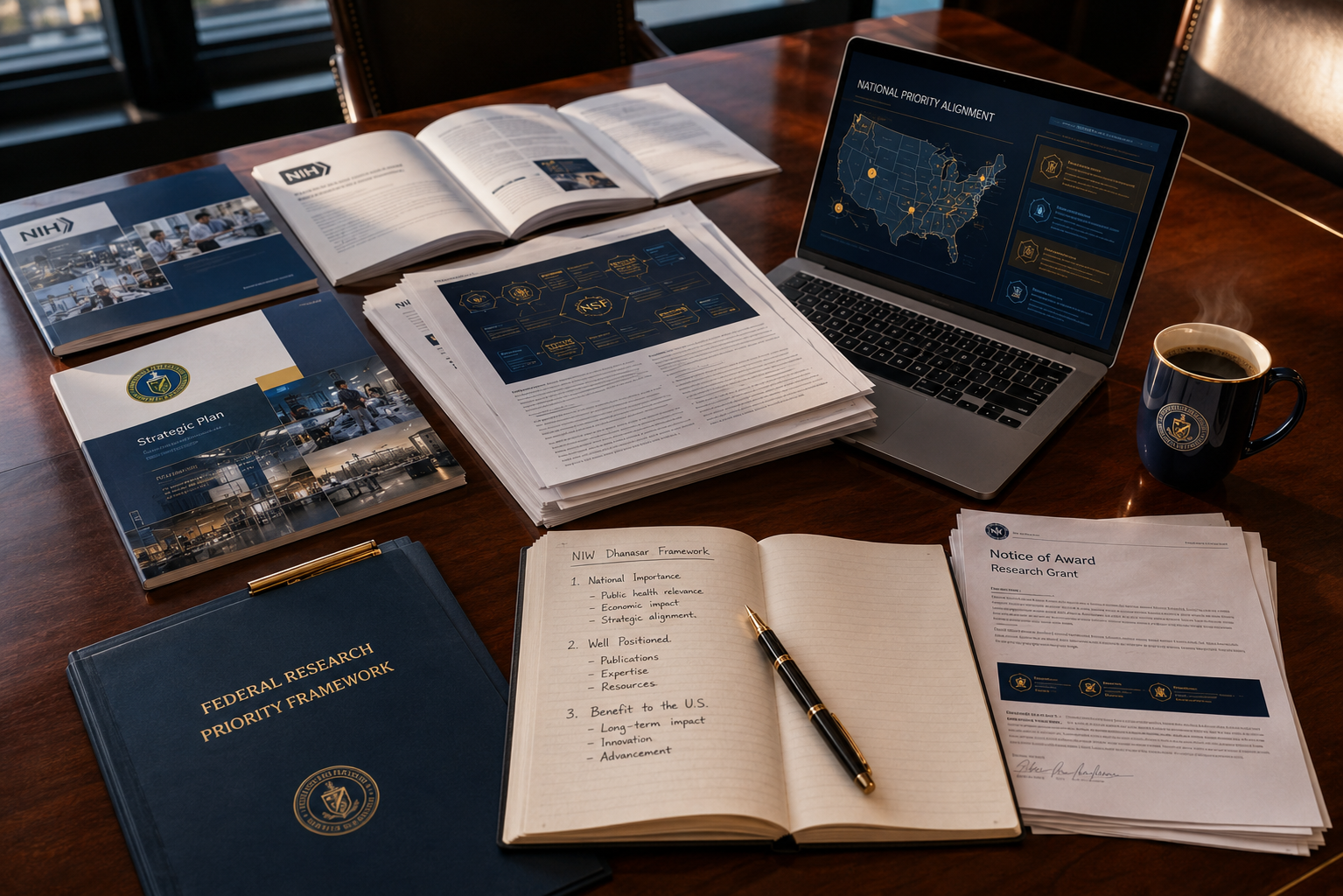
One of the most powerful and underused framing strategies is anchoring your endeavor to an existing federal priority. The U.S. government publishes agency strategic plans, executive orders, national science and technology priorities, and congressional research reports. When your endeavor aligns with an explicitly stated federal priority, USCIS has a much easier time recognizing national importance without needing to make an independent inference.
Important Caution: Do not fabricate policy alignments or misrepresent the scope of federal programs to make your work appear more relevant. USCIS adjudicators are trained to verify these connections, and misrepresentation can have serious consequences for your petition and your immigration history. Always base policy anchors on actual, verifiable federal documents.
A Strategic Framework for Scoping Your Endeavor
The most effective NIW endeavors share a common structural logic. Whether you write them in two paragraphs or ten, they answer the same questions in sequence. Think of this as your endeavor architecture.
Step 1: Identify the National Problem or Priority
Begin with the documented national need that your work addresses. This is not about your biography or your credentials. It is about the landscape your work exists within. What problem exists? How has it been recognized at the national level? Where is the documentation? Federal agency strategic plans, NIH priority areas, NSF program descriptions, Department of Energy roadmaps, and congressional reports are all legitimate anchors.
Step 2: Define Your Specific Approach
Within that national landscape, what is your specific method, technology, research direction, or intervention? This is where the endeavor gets scoped. It should be specific enough to be evaluable but broad enough to transcend any single employer or project. Think of it as your professional lane within a nationally important highway.
Step 3: State the Projected Impact
What would happen if your work advances successfully? Who benefits, and in what way? How does that benefit connect back to the national priority you identified in Step 1? This does not require certainty — it requires plausibility and documentation. Letters from experts, citations to your published work, industry reports, or government data can all support this section.
Step 4: Establish Your Positioning
Why are you, specifically, well-positioned to advance this endeavor? This bridges the first and second Dhanasar prongs. Your credentials, track record, publications, collaborations, and institutional affiliations all become relevant here. But they should be framed in service of the endeavor, not as a standalone credential list.
| Framing Element | Weak Version | Strong Version |
|---|---|---|
| National Problem | 'Cancer is a major disease.' | 'The National Cancer Institute's 2022 strategic plan identifies early biomarker detection as a critical gap with over $X billion in annual burden. Current diagnostic tools miss early-stage cases at a rate that federal health reports characterize as a public health priority.' |
| Specific Approach | 'I work on cancer diagnostics.' | 'My endeavor focuses on developing machine learning models to identify early-stage pancreatic cancer biomarkers from standard imaging data, enabling detection at a stage where surgical intervention is still viable.' |
| Projected Impact | 'This will save lives.' | 'Earlier detection in this cancer type could plausibly reduce late-stage diagnoses by a meaningful percentage. The methodology, if validated, is scalable to community hospitals without specialized equipment.' |
| Positioning | 'I have a PhD and 10 publications.' | 'My published work in this specific detection methodology has been cited in subsequent studies and referenced in a National Cancer Institute workshop summary, establishing my standing as a recognized contributor to this research direction.' |
Three Professional Scenarios: How Endeavor Framing Works in Practice
Abstract guidance is useful, but it becomes most actionable when illustrated through realistic professional profiles. The following scenarios demonstrate how the framing framework applies across different fields and career stages.
Scenario 1: The Biomedical Engineer Working on Medical Device Innovation
Dr. A. is a biomedical engineer who has spent seven years developing low-cost, portable diagnostic devices for cardiovascular conditions. Her employer is a medical device startup, and her work is commercially motivated. However, the devices she designs could serve rural and underserved communities where specialist access is limited.
A weak endeavor frame would describe her job responsibilities and note that she 'works in medical devices for cardiovascular care.' A strong endeavor frame identifies the federally documented shortage of cardiovascular diagnostic access in rural America, anchors her specific device category within HRSA and NIH priority areas for health equity, explains the technical innovation that makes her approach different from existing tools, and articulates the potential for her work to expand diagnostic access without requiring specialist infrastructure.
Her employer's commercial interest does not disqualify her. What matters is that the national importance of the endeavor is established independently of whether any particular product launches successfully. The endeavor is the research and development direction, not the employment relationship.
Scenario 2: The AI Researcher in Cybersecurity
Mr. B. is a machine learning researcher at a national laboratory who develops anomaly detection systems for identifying cyber intrusions in critical infrastructure. His work has both academic dimensions (published papers, conference presentations) and applied dimensions (active collaborations with federal agencies).
His endeavor framing benefits from an extremely clear national priority anchor. Cybersecurity of critical infrastructure — power grids, water systems, financial networks — is explicitly named in executive orders, CISA strategic documents, and National Science Foundation program areas. Mr. B. does not need to argue for the national importance of this field; he needs to show how his specific technical contribution (anomaly detection using a particular ML architecture that performs well in low-data-availability environments) addresses a documented gap within that national priority area.
The strength of this framing comes from the combination of policy documentation plus specific technical differentiation. Anyone can claim to work in cybersecurity. Mr. B.'s petition succeeds because it shows what his specific approach solves that existing methods do not.
Scenario 3: The Public Health Researcher Studying Health Disparities
Dr. C. is an epidemiologist studying the relationship between environmental exposures and chronic disease outcomes in minority communities. Her work is not commercially driven. She has publications, grant funding, and collaborations with state health departments, but she does not have a high citation count and has not received major awards.
Her endeavor framing must work harder on the 'well-positioned' prong because her credential profile is solid but not exceptional. However, her national importance framing is strong: health equity is a documented federal priority with substantial DHHS, NIH, and CDC documentation. Her specific research methodology — linking environmental exposure registries to longitudinal health outcomes in populations that are underrepresented in existing studies — fills a documented evidence gap. Her collaborations with state health departments create a credible pathway from research to policy impact.
This scenario illustrates that endeavor framing can carry petitions where raw credential metrics are modest, as long as the national importance argument is carefully constructed and well-documented.
Matching Your Endeavor to Federal Priority Documentation
One of the most practical things you can do before drafting your NIW petition is to build a reference file of federal documents that validate the national importance of your work area. This is not about padding your petition with attachments. It is about building the evidentiary foundation for every claim your attorney or consultant makes about national importance.
Useful sources include:
- Agency strategic plans published by federal departments (NIH, NSF, DOE, CISA, USDA, DOT, EPA, HRSA)
- Executive orders naming specific national priorities
- Congressional Research Service reports on national challenges
- National Science and Technology Council strategy documents
- National Academies of Sciences, Engineering, and Medicine reports
- Federal Register notices describing priority research areas for grants
- Agency-specific program priority announcements
Expert Insight: A single, well-chosen federal document that explicitly names your research area as a national priority can be more persuasive than ten pages of general argument about the importance of your field. USCIS adjudicators are not scientists. They are looking for credible anchors that allow them to confirm national importance without making independent expert judgments. Give them those anchors explicitly.
How Endeavor Framing Interacts with the Other Two Dhanasar Prongs
A well-framed endeavor does not just satisfy the first prong. It creates a logical foundation for the second and third prongs as well. This is the strategic leverage that makes endeavor framing so consequential.
Prong Two: Well-Positioned to Advance
If your endeavor is clearly scoped, your evidence of being well-positioned becomes directly relevant rather than generic. Publications in the specific research area, grants related to the specific problem, collaborations with institutions that work on the same issue, and recognition from peers in the same space all map cleanly to a well-defined endeavor. Without that definition, the same evidence feels like a general credential list that could belong to anyone in the field.
Prong Three: On Balance, Beneficial to Waive
USCIS must find that the United States benefits more from waiving the labor certification requirement than from requiring it. This is easier to establish when the endeavor is nationally important, when there is a shortage of qualified people who can advance it, or when requiring standard labor certification would slow down or prevent work that the nation needs. A clearly framed, nationally important endeavor makes this argument far more straightforward.
| Dhanasar Prong | How Endeavor Framing Supports It | Evidence Types That Connect |
|---|---|---|
| Substantial Merit and National Importance | Directly defines and evidences the endeavor scope and national priority alignment | Federal documents, expert letters, national statistics, policy anchors |
| Well-Positioned to Advance | Establishes that the petitioner's credentials map specifically to the defined endeavor | Publications, citations, grants, collaborations, institutional recognition |
| On Balance, Beneficial to Waive | Shows that the national importance is real and time-sensitive enough to justify bypassing standard processes | Field demand data, documented workforce gaps, ongoing impact, future plans |

The Role of Expert Letters in Endeavor Validation
Expert letters play a distinct role in EB-2 NIW petitions compared to EB-1A petitions. In the NIW context, expert letters are particularly valuable for validating the national importance of your endeavor from a credible external perspective. Adjudicators who are not domain experts benefit from letters that explain why a particular research direction matters, why the petitioner's approach is differentiated, and why the work serves national interests.
A strong expert letter for NIW purposes should do three things: establish the author's own credibility in the relevant field, articulate the national landscape and the gap your work addresses, and specifically affirm that your approach represents a meaningful contribution to advancing the endeavor. Letters that simply praise your credentials without connecting them to the national importance narrative are significantly less useful in this context.
If you are working with EB1 Mentor on your NIW portfolio, the expert letter strategy is one area where careful preparation pays particularly large dividends. The framing in your letters should align precisely with the endeavor definition in your petition. Inconsistencies between how different letters describe your work — or between the letters and the petition cover letter — create openings for USCIS to question whether the endeavor is coherently defined. You can explore this as part of a broader EB-2 NIW portfolio strategy.
Checklist: Is Your Endeavor Ready for USCIS Review?
Use this checklist to evaluate your endeavor framing before your petition is filed. Every item on this list should be answerable with 'yes' before submission.
- National problem identified: Have you named a specific, documented national problem or priority that your work addresses?
- Policy anchor documented: Can you cite at least one credible federal document — a strategic plan, executive order, agency priority statement, or congressional report — that confirms national importance in your area?
- Endeavor scoped correctly: Is the endeavor specific enough to evaluate but broad enough to exist independently of any single employer or project?
- Employer-independent framing: Does the endeavor description stand on its own without depending on the existence of your current job?
- Projected impact stated: Have you articulated a plausible national benefit that would result from advancing the endeavor?
- Evidence aligned: Does your supporting evidence — publications, grants, collaborations, expert letters — map directly to the endeavor as you have framed it?
- Consistency across documents: Is the endeavor described consistently across the cover letter, expert letters, and any supporting statements?
- Prong two connection: Is it clear how your specific credentials and track record make you well-positioned to advance this specific endeavor?
- No overreach: Are all impact claims either documented or explicitly framed as potential rather than certain outcomes?
- Legal review completed: Has a qualified immigration attorney reviewed the endeavor framing within the context of current USCIS adjudication patterns?
Common Fields and Their National Importance Anchors
While every petition is individual, the following field-level guidance may help you identify where to begin your policy anchor research. These are starting points, not complete arguments — you will need to identify the specific federal documents that are current and relevant to your exact research direction.
Biomedical research and public health: NIH strategic plans, Cancer Moonshot initiative, ARPA-H priorities, CDC public health priorities, DHHS health equity initiatives. Fields with particularly strong federal documentation include oncology, infectious disease, mental health, and health disparities research.
Engineering and applied sciences: NSF program priorities, NIST research areas, DOE Office of Science strategic plan, Advanced Manufacturing National Program Office priorities, infrastructure resilience initiatives. Clean energy, semiconductor manufacturing, advanced materials, and quantum information science are currently well-documented federal priorities.
Cybersecurity and information technology: CISA strategic plan, National Cybersecurity Strategy, NSF SaTC program, NIST cybersecurity framework development priorities. AI safety, cryptographic resilience, and critical infrastructure protection are particularly strong areas.
Agriculture and food systems: USDA research priority areas, Farm Bill research provisions, food security national strategy. Climate-resilient crop development, soil health, and agricultural biotechnology have recent federal priority documentation.
Social and behavioral sciences: This field requires more careful framing because national importance is less immediately visible to adjudicators. Economic policy research, education research with documented national gaps, criminal justice reform research with federal program connections, and behavioral health research with SAMHSA or NIH backing can all work with careful framing.
Important Caution: Federal priority landscapes change. A research area that was prominently featured in one administration's strategic documents may receive different emphasis in subsequent years. Before anchoring your endeavor to a specific policy document, verify that it is current and still reflects active federal priority. This is especially important for executive orders and agency strategic plans, which can be revised or rescinded. Always verify current requirements with official government sources and qualified legal counsel.
Timing and Evolution: When Your Endeavor Changes
One challenge that professionals face, particularly those who have been building toward an NIW petition over several years, is that their actual research direction may have evolved. If your publication record reflects a research trajectory that does not precisely match your current endeavor description, you need to address that evolution explicitly rather than hoping adjudicators will not notice the apparent inconsistency.
The good news is that endeavor evolution is normal in research careers, and USCIS does not expect a straight-line trajectory. What it does expect is coherence. If your work has shifted from computational materials science to battery technology applications, for example, you can describe an endeavor that encompasses both phases as a logical progression — from foundational computational methods to applied energy storage innovation with specific national relevance. The key is to tell that story intentionally rather than leaving the adjudicator to guess at the connection.
If you are in an early-to-mid career stage and your endeavor is still developing, plan the filing timing with your career evolution in mind. An NIW petition filed too early, before your track record provides meaningful evidence of being well-positioned to advance the endeavor, is harder to win. A petition filed when your track record and your endeavor framing are mutually reinforcing is significantly stronger. You can learn more about long-term portfolio planning through EB1 Mentor's immigration resources library.
How EB1 Mentor Approaches NIW Portfolio Development
At EB1 Mentor, we work with researchers, engineers, healthcare professionals, and innovators at different stages of their careers to strengthen the foundations of NIW petitions — and we start with endeavor framing. The reason is simple: every other element of the portfolio has to connect back to a coherent, credibly defined endeavor. Without that foundation, even impressive evidence can fail to land with the force it should.
Our approach involves a detailed initial assessment of where your work sits within the national priority landscape, what documentation already exists to support your national importance argument, and where the gaps are. We then help clients develop the evidence structure — including publication strategy, expert letter positioning, and policy anchor research — that builds toward a petition where the endeavor framing and the evidence are genuinely mutually reinforcing.
This is not legal representation. EB1 Mentor is not a law firm, and we work alongside your immigration attorney, not in place of one. What we provide is strategic expertise in portfolio development that many attorneys are not positioned to offer within a standard legal engagement. If you want to explore how this works for your specific situation, you can request an evaluation or review our EB-2 NIW services.
Frequently Asked Questions About EB-2 NIW Endeavor Framing
1. Can my endeavor be the same as my current job responsibilities?
Your current job can be related to your endeavor, but the endeavor itself must be framed independently of your employment. The NIW is a self-petition, meaning your green card is tied to your own work and intentions, not to a specific employer. If your endeavor reads like a job description, adjudicators may question whether it would continue if you left your current employer — and if the answer is no, that weakens the NIW argument significantly. Frame the endeavor around the research direction, innovation area, or professional mission that you would continue to advance regardless of employer.
2. Does my work need to already be impacting the nation, or is future impact acceptable?
The NIW standard does not require that your work has already produced national impact. USCIS recognizes that significant research and innovation often has future impact. What is required is that the potential for national importance is credible and well-supported. A track record that demonstrates meaningful progress toward the endeavor, combined with expert letters and policy documentation, can support a petition even where the national impact is still developing.
3. I work in private industry, not academia. Can I still file an NIW?
Absolutely. The NIW is available to professionals in private industry, non-profit organizations, government agencies, and academia. What matters is the substance of your work and whether it can be framed as nationally important — not where your paycheck comes from. Industry-based petitions often require more careful framing to disentangle commercial significance from national importance, but many have succeeded. Engineers developing critical technology, healthcare innovators building scalable tools, and startup founders solving documented national problems all have viable NIW pathways. Entrepreneurs in particular can qualify, though their evidence looks quite different from a researcher's — a distinction we develop in the founder's version of a national interest waiver.
4. How many federal documents should I reference in my petition?
Quality matters more than quantity. One or two highly relevant, specific, and current federal documents that directly name your research area as a national priority are far more persuasive than ten loosely related documents that only tangentially connect to your work. Adjudicators are looking for clear anchors, not volume. Choose documentation that is specific, current, and from credible official sources.
5. What if there is no exact federal priority document for my specific research niche?
Many NIW petitions succeed without a perfectly on-point federal document. If your exact niche is not explicitly named, you can use broader federal priority areas and then narrow down with expert testimony, field-specific publications, or professional society position papers that establish the national significance of your specific contribution. The argument becomes more demanding to construct, but it is not impossible. In such cases, the expert letters carry additional weight in validating national importance.
6. Is the Dhanasar framework still the governing standard?
As of this writing, the Matter of Dhanasar (2016) framework remains the governing AAO precedent for NIW adjudication. However, USCIS policy and adjudication practices can evolve through policy memos, updated agency guidance, and new AAO decisions. Always verify current adjudication standards with official USCIS guidance and qualified immigration counsel before filing. Requirements and timelines may change.
7. Can I file both EB-1A and EB-2 NIW simultaneously?
Yes. Many highly accomplished professionals file both classifications simultaneously, either in the same filing package or in separate petitions around the same time. This provides priority date flexibility and hedges against a denial on one path. However, the evidentiary demands and framing strategies are distinct — an EB-1A is about extraordinary ability meeting ten regulatory criteria, while an NIW is about national importance and self-sufficiency as a petitioner. If you are considering a dual-track strategy, that should factor into your portfolio planning from early on. Explore EB-1A services and EB-2 NIW services together if this applies to your situation.
8. My research is interdisciplinary. How do I frame the endeavor without it feeling scattered?
Interdisciplinary work is increasingly common and USCIS adjudicators are familiar with it. The key is to frame the endeavor around the problem you are solving or the outcome you are advancing, rather than trying to list every discipline your work touches. If your research combines computational methods, environmental science, and public health to understand pollution exposure effects on child development, the endeavor is not 'interdisciplinary environmental health computation.' The endeavor is 'understanding how early environmental exposures affect developmental health outcomes in underserved communities, using novel computational methods that integrate across data types that existing approaches treat separately.' That is a coherent endeavor with a clear national importance hook, regardless of how many disciplines it touches.
9. How important is it to explain why the United States should waive the job offer requirement?
The third prong — that it is beneficial to waive the job offer and labor certification — is often addressed more briefly than the first two, but it should not be overlooked. Arguments that typically support this prong include the urgency of the work, the documented shortage of qualified professionals who can advance the specific endeavor, and the fact that labor certification timelines would delay nationally important work. If you are in a field with a well-documented talent shortage, federal data or professional society reports documenting that shortage can strengthen this argument significantly.
10. Should I file NIW before I feel my credentials are 'strong enough'?
Timing depends heavily on the quality of your endeavor framing and the strength of your positioning evidence. It is generally better to wait until your track record meaningfully demonstrates that you are well-positioned to advance the endeavor than to file prematurely and receive a denial that can complicate future filings. That said, 'strong enough' is not a fixed threshold — it depends on the quality of the framing, the strength of the national importance argument, and the alignment of your evidence. A structured evaluation of where you stand is usually the most reliable way to assess readiness. You can request an evaluation from EB1 Mentor if you are unsure.
References and Further Reading
The following authoritative sources are referenced throughout this article and are recommended for professionals preparing EB-2 NIW petitions. Readers are encouraged to verify current requirements directly with official sources, as immigration policy and agency guidance may change.
- USCIS Policy Manual, Volume 6, Part F, Chapter 5 — National Interest Waivers
- Matter of Dhanasar, 26 I&N Dec. 884 (AAO 2016) — Governing NIW Precedent Decision
- USCIS EB-2 Immigration Category Overview
- National Science Foundation Strategic Plan
- NIH Strategic Priorities and Research Directions
- U.S. Department of Energy Office of Science Strategic Plan
- CISA Strategic Plan — Cybersecurity and Infrastructure Security
Conclusion: Framing Is Strategy, Not Paperwork
The EB-2 National Interest Waiver is a powerful immigration pathway precisely because it allows exceptional professionals to petition for themselves, on the strength of their work and its contribution to the nation. But that power comes with a demand: you must be able to articulate, precisely and credibly, what your endeavor is and why it matters at the national level.
Endeavor framing is not an afterthought you address in the first paragraph of a cover letter. It is the strategic architecture of your entire petition. Done well, it makes every other element — your publications, your expert letters, your collaborations, your grants — cohere into a single, compelling argument. Done poorly, it leaves adjudicators uncertain about what you are actually trying to accomplish and why the United States should grant a waiver to support it.
The professionals who succeed with NIW petitions are not always those with the longest publication lists or the most prestigious affiliations. They are the ones who invest in framing their work coherently, anchoring it credibly to national priorities, and building a petition where every element reinforces the same core argument. That is the standard to aim for.
If you are in the early stages of building your NIW portfolio, exploring how to position your endeavor, or evaluating whether your current credentials are sufficient to support a strong petition, the team at EB1 Mentor is available to help. You can also browse our immigration strategy blog for additional guidance across EB-1A, O-1A, and EB-2 NIW topics, or visit our FAQ page for common questions.
Ready to Evaluate Your EB-2 NIW Endeavor Framing?
Every immigration case is unique. The right endeavor definition depends on your specific field, career stage, and professional track record — and getting it right from the start can make a measurable difference in your petition outcome.
EB1 Mentor works with accomplished professionals to develop stronger immigration portfolios — from endeavor framing to expert letter strategy to evidence development. We are not a law firm, and we do not provide legal representation, but we provide strategic portfolio guidance that complements your legal team.
Contact EB1 Mentor to discuss your NIW strategy or request a portfolio evaluation to see where you stand.