Why EB-1A success begins before the petition is assembled
Many accomplished professionals start thinking seriously about EB-1A only when they are ready to file. They gather research publications, awards, recommendation letters, conference materials, employment records, media articles, membership certificates, peer review invitations, and salary documents, then ask whether the evidence is enough. That approach can work for a small group of applicants who already have unusually strong recognition. For many others, however, the stronger strategy is to treat EB-1A as an immigration portfolio project rather than a last-minute document collection exercise.
The EB-1A category is designed for individuals with extraordinary ability. In practical terms, the evidence must do more than show that someone is talented, hardworking, senior, or valuable to an employer. A persuasive portfolio should help explain how the applicant has risen above ordinary professional achievement, how the field recognizes the applicant, and why the evidence fits together as a credible pattern of distinction. That is why portfolio planning matters so much. Before assuming your own record falls short of that bar, it is worth checking whether the gap is real or just a common misconception about what the standard actually requires.
EB1 Mentor works with professionals who want to strengthen the evidence profile behind EB-1A, EB-1B, O-1, and EB2 NIW preparation. The company is not a law firm and does not provide legal representation. Its role is to help clients develop stronger professional visibility, better documentation, clearer positioning, and more strategic immigration evidence before legal filing decisions are made.
This article explains how to build an EB-1A evidence portfolio before filing, how to avoid common mistakes, and how different types of professionals can create a more persuasive record over time. It is especially useful for software engineers, AI professionals, researchers, healthcare professionals, university faculty, entrepreneurs, startup founders, and other professionals whose achievements may be strong but not yet fully documented.
Understanding the difference between achievements and immigration evidence
A common mistake is assuming that every impressive achievement automatically becomes strong immigration evidence. In reality, EB-1A evidence usually needs context. A publication is stronger when its venue, citations, readership, or influence can be explained. A professional award is stronger when the selection criteria, judging process, competitiveness, and field relevance are documented. A leadership role is stronger when the applicant can show why the organization, project, or initiative mattered beyond ordinary employment.
In other words, the question is not only: What did you do? The more important question is: What does this prove about your standing in the field?
An immigration portfolio should convert professional facts into evidence signals. A fact may be: an applicant reviewed manuscripts for a journal. The evidence signal may be: independent experts trusted the applicant to judge the work of others in the field. A fact may be: an applicant led an engineering project. The evidence signal may be: the applicant played a critical role in a significant initiative with measurable technical or business impact. A fact may be: an applicant was quoted in the media. The evidence signal may be: external publications recognized the applicant as a relevant expert or notable professional.
Achievement versus evidence: a practical comparison
| Professional achievement | Possible EB-1A evidence signal | What makes it stronger |
|---|---|---|
| Research publication | Scholarly contribution and research visibility | Citation impact, venue quality, independent use, expert discussion, field relevance |
| Peer review service | Judging the work of others | Journal or conference selectivity, number of reviews, editor invitations, reviewer recognition |
| Professional award | Recognition for excellence | Competitive selection, independent judges, clear criteria, limited winners, field-level significance |
| Conference presentation | Professional visibility and invited expertise | Invited speaker status, international audience, selective program, topic relevance, post-event coverage |
| Leadership role | Critical or leading role in a distinguished organization | Organizational importance, applicant responsibility, measurable outcomes, independent validation |
| Media coverage | Public or professional recognition | Independent editorial coverage, reputable publication, applicant-focused article, field relevance |
| High salary | Compensation above peers | Reliable comparison data, same geography, same occupation, same time period, clear documentation |
The portfolio mindset: build the story before collecting documents
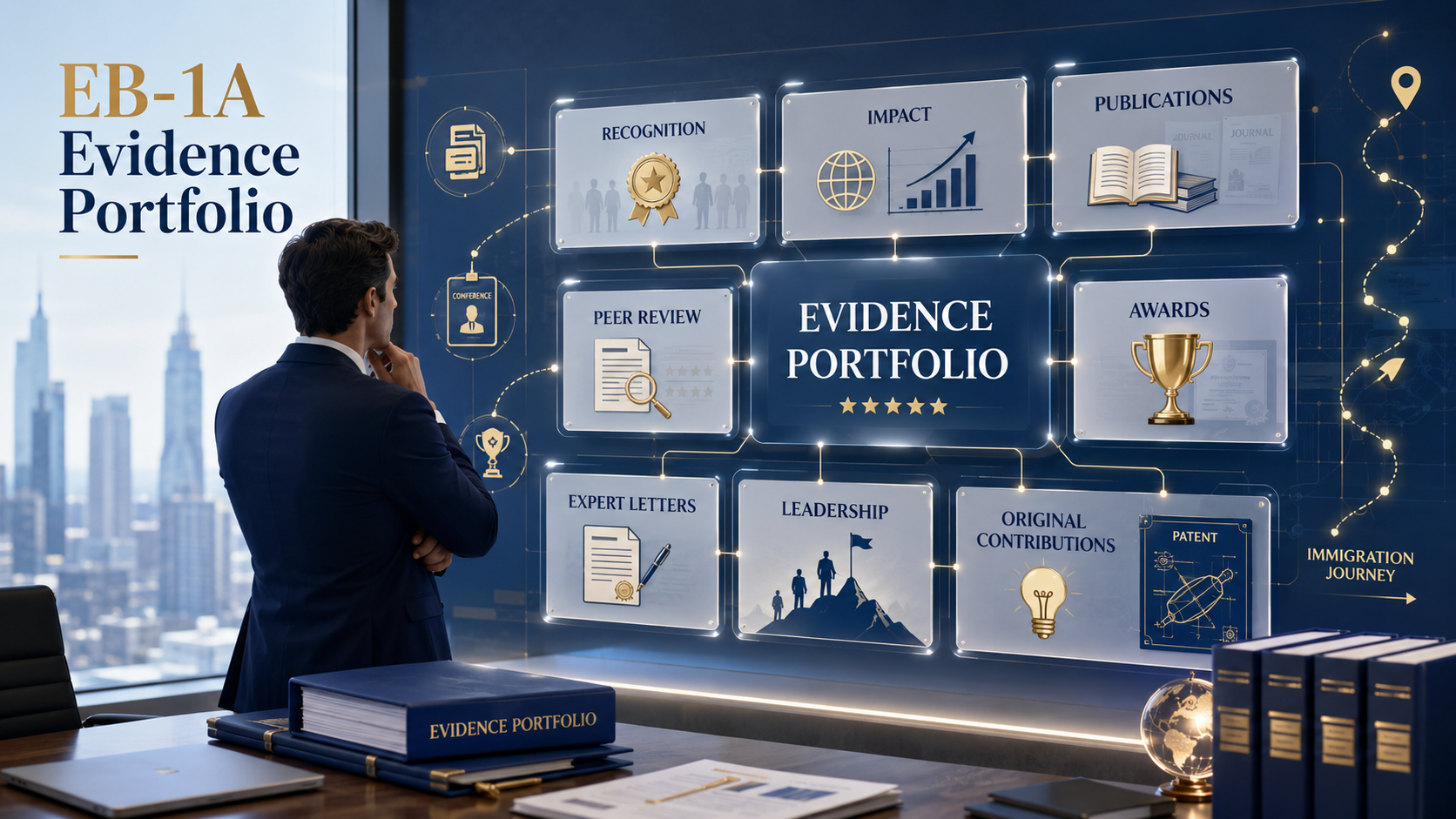
A strong EB-1A portfolio is not just a folder of certificates and letters. It is a structured story supported by evidence. The portfolio should answer several questions clearly: What is the applicant's field? What is the applicant known for? Which achievements show recognition? Which achievements show original contributions? Which independent sources validate the applicant? Which documents support final merits analysis?
Without this structure, even strong evidence can feel scattered. For example, an applicant may have research publications in one area, media coverage in another, a leadership role in a company, and peer review service in a broader technical field. Each item may be real, but the petition can become harder to understand if the evidence does not connect to a coherent professional identity.
The best time to solve this problem is before filing. Applicants should define the field, identify the strongest evidence themes, and build future activities around those themes. That does not mean manufacturing achievements. It means documenting real work in a way that is consistent, strategic, and easier to evaluate.
Start with a clear field definition
Field definition is one of the most important planning decisions. If the field is too broad, the evidence may appear generic. If the field is too narrow, it may be difficult to show broader recognition. A software engineer might not want to present the field simply as software engineering if the evidence is concentrated in AI infrastructure, cloud optimization, cybersecurity automation, healthcare data systems, or fintech platforms. A researcher may need to define whether the field is biomedical engineering, machine learning for medical imaging, computational materials science, or another specific domain.
The right field definition should be accurate, supportable, and aligned with the evidence. It should not be artificially narrow, but it should help USCIS understand the professional context. This is especially important in emerging areas such as artificial intelligence, data science, digital health, robotics, and advanced software systems, where job titles can be less informative than the actual work.
Identify the applicant's strongest evidence themes
Most applicants have stronger and weaker categories. A researcher may have research publications, citation impact, peer review, and conference presentations, but limited media coverage. A startup founder may have leadership, original contributions, professional awards, press coverage, and industry adoption, but fewer scholarly publications. A healthcare innovator may have clinical leadership, patents, invited speaking, expert letters, and institutional impact, but limited public recognition.
Instead of trying to make every category look equal, applicants should identify the most authentic strengths and build around them. EB-1A is not about collecting random credentials. It is about presenting a credible pattern of extraordinary ability.
A practical EB-1A evidence map
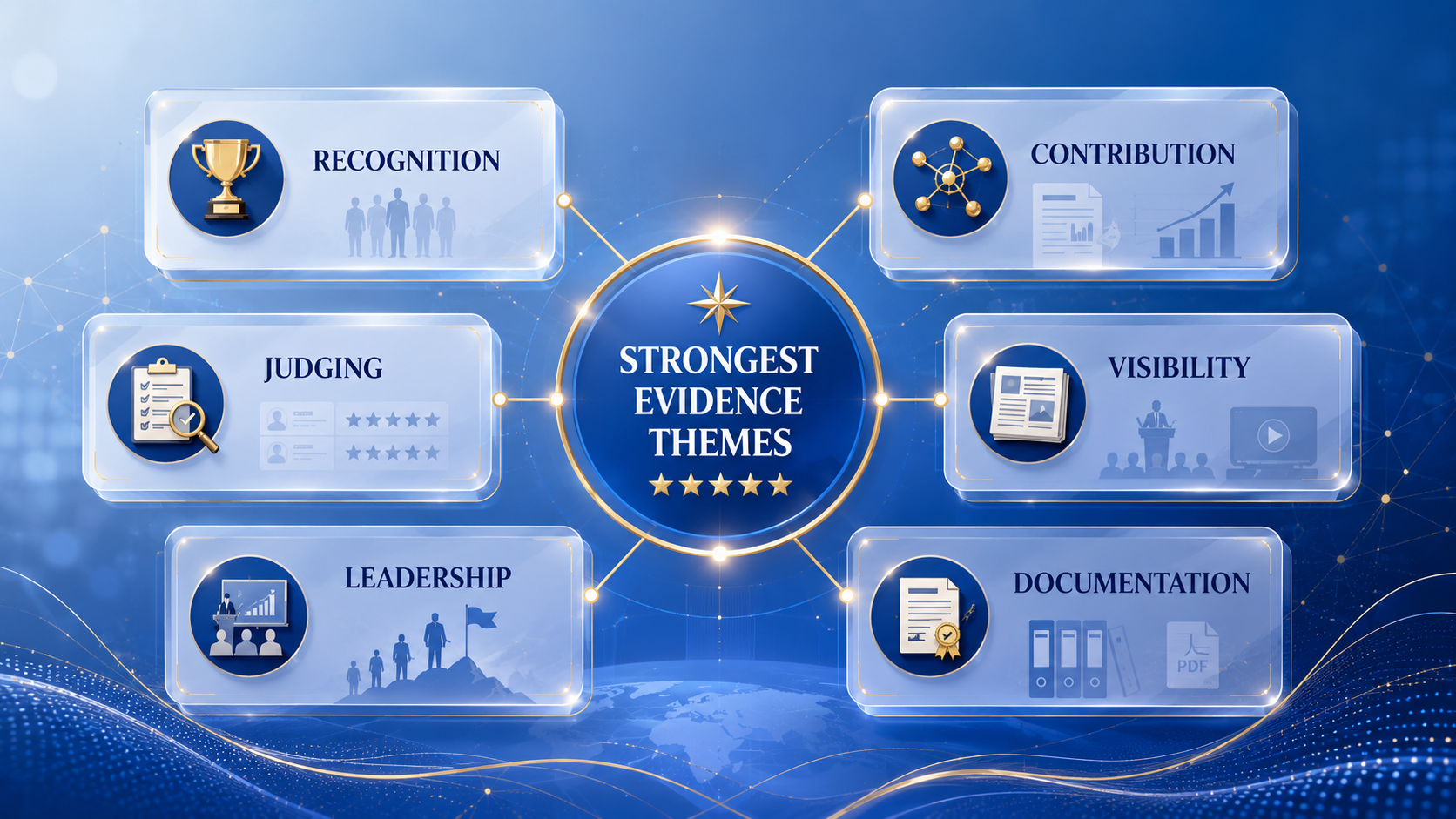
An evidence map is a planning tool that organizes achievements by immigration value rather than by chronology alone. It helps applicants see which parts of the portfolio are already strong, which parts need documentation, and which parts need future development. A useful EB-1A evidence map usually includes at least six layers: recognition, contribution, judging, visibility, leadership, and documentation quality.
Layer 1: Recognition
Recognition evidence helps show that others in the field have noticed the applicant's work. This may include professional awards, selective memberships, invited speaking roles, media coverage, honors, fellowships, or expert commentary. The key issue is independence. Recognition is usually stronger when it comes from outside the applicant's employer, client, or personal network.
For professional awards, applicants should collect the award criteria, number of applicants or nominees if available, judging process, identity or qualifications of judges, winner list, press release, and evidence that the award is field-relevant. A trophy or certificate alone is rarely enough. The surrounding documentation tells USCIS why the award matters.
Layer 2: Original contributions
Original contributions are often misunderstood. An applicant may have created a product, written code, developed a model, improved an internal system, built a platform, filed a patent, or led a technical breakthrough. These facts may be important, but the portfolio should show whether the contribution had significance in the field.
Evidence of significance may include adoption by independent organizations, citations, patents or patent applications, technical documentation, expert letters from independent authorities, industry use, measurable impact, press coverage, conference discussion, implementation at scale, or influence on later work. The stronger the independent validation, the more persuasive the contribution tends to be.
Layer 3: Judging and peer review
Peer review and judging evidence can be powerful because it shows that the applicant was trusted to evaluate the work of others. This may include journal manuscript review, conference paper review, grant review, hackathon judging, award panel participation, fellowship evaluation, startup competition judging, or technical committee review.
Applicants should document invitations, completed reviews, reviewer dashboards if available, editor confirmations, conference or journal information, review volume, subject matter alignment, and the selectivity or reputation of the reviewing venue. For researchers, peer review can support both judging and professional recognition. For engineers and industry leaders, judging hackathons, awards, technical competitions, and innovation programs may help create a similar evidence signal.
Layer 4: Publications and research visibility
Research publications are not useful only for academics. AI professionals, software engineers, healthcare innovators, data scientists, and entrepreneurs can also strengthen their immigration portfolio through thoughtful publication strategy when it fits their real expertise. Publications may include peer-reviewed papers, conference papers, technical articles, industry white papers, book chapters, or reputable professional commentary.
However, publication strategy should be credible. Applicants should avoid low-quality venues, irrelevant topics, rushed articles, or publications that do not connect to their field. A few strong, well-positioned publications can be better than many weak ones. Citation impact, independent references, readership, venue relevance, and expert discussion can all improve the value of publication evidence.
Layer 5: Leadership and critical role evidence
Leadership evidence should show more than a title. A title such as founder, director, senior engineer, principal scientist, department head, or project manager may be helpful, but the real question is what the applicant actually controlled, influenced, or delivered. USCIS may need to see that the organization or initiative was distinguished and that the applicant's role was critical to important outcomes.
Useful documentation may include organizational charts, project descriptions, product metrics, revenue impact, user adoption, technical architecture, board or executive letters, independent media coverage, award recognition, client testimonials, and measurable before-and-after results. The goal is to move from ordinary employment to evidence of significant leadership.
Layer 6: Documentation quality
Documentation quality can make or break a portfolio. Many applicants have real achievements but weak evidence. A conference speaker role may be documented only with a screenshot. A media article may not clearly show publication circulation or editorial independence. A professional membership may not include selection criteria. A high salary claim may lack reliable comparison data. A critical role claim may depend only on a supervisor letter. Media coverage is one of the evidence types most often documented poorly — see our closer look at what actually counts as published material about the applicant for EB-1A, and what does not.
Applicants should collect primary source evidence, independent sources, objective data, dated records, screenshots with URLs, official letters, archived pages, author pages, award rules, event programs, and supporting context. The portfolio should be easy to verify and easy to understand.
How to build an EB-1A portfolio over 12 months
Not every applicant has a full year, but a 12-month planning framework is useful because it shows how evidence can develop in a logical sequence. The purpose is not to create artificial credentials. The purpose is to make real professional work more visible, better documented, and better connected to the applicant's field.
Months 1-2: Audit the existing evidence
The first step is a brutally honest evidence audit. Applicants should list every possible achievement, then separate strong evidence from weak evidence. The audit should include publications, citations, peer review, awards, media coverage, memberships, speaking roles, patents, leadership roles, compensation, original contributions, client impact, product impact, and expert relationships.
For each item, ask: Is it independent? Is it field-relevant? Is it documented? Does it show recognition? Does it show impact? Does it connect to the applicant's defined field? Is there objective support beyond personal claims?
Months 3-4: Strengthen documentation around existing achievements
Before pursuing new activities, applicants should improve documentation for what already exists. This may involve gathering award criteria, obtaining conference programs, documenting citation impact, collecting media circulation data, saving public pages, requesting verification letters, organizing review invitations, and building a timeline of contributions.
This stage often reveals easy wins. For example, an applicant may discover that a conference was international and selective, but the original evidence did not show it. Another applicant may have judged dozens of submissions but only saved one invitation email. A founder may have strong product adoption but no concise evidence packet explaining the scale and impact.
Months 5-6: Build professional visibility
Professional visibility should be aligned with the applicant's field. Researchers may focus on publications, conference presentations, peer review, citations, and research collaborations. Software engineers may focus on technical articles, open-source impact, conference talks, patents, industry panels, and engineering leadership. Healthcare professionals may focus on clinical innovation, invited lectures, professional society roles, research publications, and institutional impact. Entrepreneurs may focus on media coverage, awards, product adoption, industry recognition, and leadership evidence.
Visibility should be authentic. USCIS-focused planning should never become a substitute for real professional activity. The most persuasive evidence comes from meaningful achievements that would matter even outside immigration.
Months 7-8: Add independent validation
Independent validation often separates a routine portfolio from a stronger one. Expert letters can be helpful, but they are strongest when written by people who can credibly explain the applicant's work, the field context, and the significance of the contribution. Independent experts are usually more persuasive than only current supervisors or close collaborators.
Applicants should also look for independent records that support the expert letters: citations, media articles, conference programs, adoption evidence, awards, public documentation, user metrics, patents, and professional society records. Expert letters should explain evidence, not replace it.
Months 9-10: Connect the evidence into a narrative
At this stage, applicants should refine the portfolio narrative. The narrative should identify the applicant's field, key contributions, recognition signals, independent validation, and future professional direction. It should also explain why the evidence belongs together.
For example, an AI infrastructure engineer might connect publications, patents, peer review, invited talks, and product leadership around one theme: scalable AI systems for enterprise operations. A healthcare innovator might connect clinical leadership, research publications, conference speaking, and institutional adoption around one theme: improving patient outcomes through digital health implementation. A startup founder might connect awards, media coverage, product adoption, expert letters, and leadership evidence around one theme: building commercially adopted technology in a specialized market.
Months 11-12: Prepare for legal review
Before filing, applicants should work with qualified immigration counsel to evaluate eligibility, legal strategy, risks, and petition structure. EB1 Mentor can help strengthen and organize the professional portfolio, but legal filing decisions should be handled by appropriate legal professionals. The goal of portfolio planning is to give counsel better evidence to work with and to reduce preventable weaknesses before the petition is assembled.
Common EB-1A evidence mistakes that weaken strong profiles
Some applicants are genuinely accomplished but still present weak evidence. The problem is not always the achievement itself. Often the problem is how the achievement is framed, documented, or connected to the overall case.
Mistake 1: Treating recommendation letters as the whole case
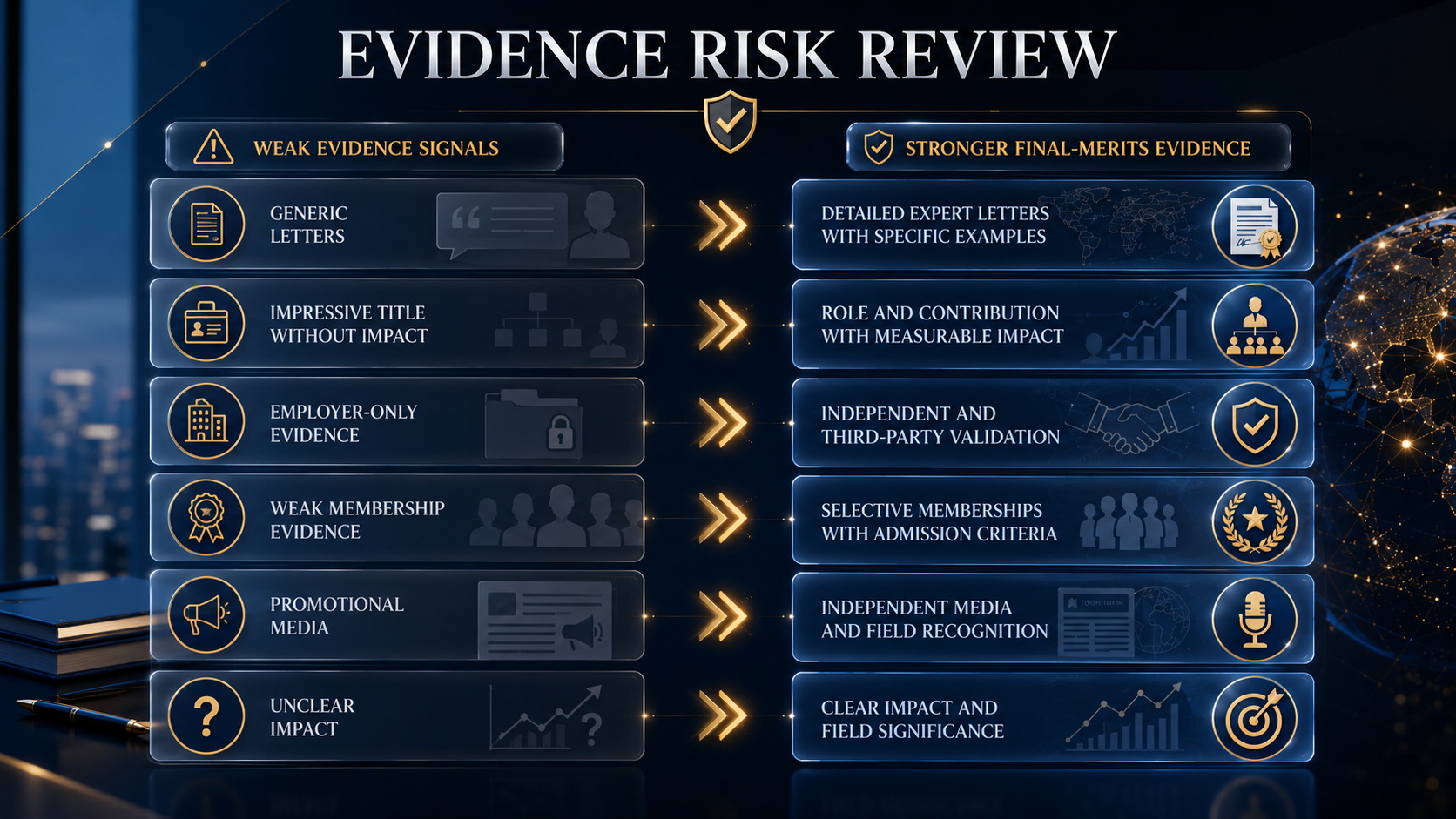
Recommendation letters and expert letters can be important, but they should not carry the entire portfolio. A strong letter explains the significance of objective evidence. A weak letter simply praises the applicant with broad statements. USCIS may give limited weight to letters that are unsupported, generic, or written mainly by close colleagues.
Applicants should use letters strategically. The best letters often explain technical contribution, field context, independent significance, adoption, influence, or why the applicant's work is above ordinary professional performance.
Mistake 2: Using impressive titles without impact evidence
A senior title can help, but it does not automatically prove extraordinary ability. A vice president, founder, lead engineer, professor, chief scientist, or director still needs evidence showing why the role was significant. What did the applicant build, lead, improve, publish, judge, create, influence, or change? Who recognized it? What measurable outcomes resulted?
Mistake 3: Relying on employer-controlled evidence only
Employer letters, internal dashboards, and company documents can be useful, but a portfolio becomes stronger when it includes independent validation. Media coverage, external awards, citations, professional society roles, peer review invitations, conference speaker materials, client adoption, patents, and independent expert letters can all help show recognition beyond the employer.
Mistake 4: Submitting memberships without selection proof
Professional memberships vary widely. Some organizations are open to anyone who pays dues, while others require selective admission based on achievements. Applicants should not assume a membership certificate is enough. They should document the membership level, admission criteria, selection process, number or percentage of members admitted if available, and why the membership reflects professional distinction.
Mistake 5: Confusing media mentions with major media evidence
Media coverage should be evaluated carefully. A brief quote, paid placement, copied press release, or company announcement may be weaker than an independent article focused on the applicant's work. Stronger media evidence usually includes editorial independence, applicant-focused coverage, publication credibility, audience relevance, and clear connection to professional achievements.
Mistake 6: Ignoring final merits
Even when individual evidence categories appear strong, the overall case still needs to make sense as a whole. Final merits analysis asks whether the total evidence demonstrates sustained acclaim and that the applicant is among the small percentage who have risen to the top of the field. Applicants should therefore avoid thinking only in checkboxes. The portfolio must show a broader pattern of recognition, significance, and professional standing.
Portfolio strategies for different professional profiles
EB-1A portfolio planning is not the same for every applicant. The right evidence strategy depends on the field, career stage, achievements, documentation, and realistic development opportunities.
Software engineers and AI professionals
Software engineers often struggle because their best work may be internal, confidential, or difficult to explain. A strong strategy may include technical publications, open-source contributions, patents, conference presentations, peer review or hackathon judging, expert letters, product metrics, architecture documentation, and evidence of adoption. AI professionals can also build visibility through research publications, model evaluation work, responsible AI contributions, industry panels, and specialized technical commentary.
The key is to translate technical work into field impact. Instead of saying the applicant built a platform, the evidence should explain what problem the platform solved, how it improved performance or scale, who used it, whether others adopted the approach, and why the work required unusual expertise.
Researchers and university faculty
Researchers often have a more traditional evidence path: publications, citations, peer review, conference presentations, grants, awards, editorial roles, invited talks, and expert letters. However, not every publication record is equally strong. Citation quality, independent use, journal or conference relevance, research originality, and international visibility matter.
Faculty members should also document teaching awards, research leadership, invited lectures, committee roles, editorial service, funded projects, patents, lab leadership, and influence on the field. For EB-1B outstanding researcher strategy, employer sponsorship and the specific legal requirements differ from EB-1A, so applicants should work with qualified counsel on category selection while strengthening overlapping evidence themes.
Healthcare professionals
Healthcare professionals may build evidence through clinical innovation, research publications, invited lectures, professional awards, hospital leadership, quality improvement projects, patents, clinical guidelines, media commentary, and expert letters from recognized authorities. Patient care alone, even when excellent, may be difficult to frame as extraordinary ability unless supported by broader recognition or documented innovation.
Strong portfolios often show that the applicant's work influenced procedures, improved outcomes, introduced new methods, trained other professionals, contributed to research, or received recognition from respected institutions.
Entrepreneurs and startup founders
Entrepreneurs may have powerful evidence, but it must be organized carefully. Revenue, fundraising, product adoption, media coverage, awards, patents, market traction, customer impact, strategic partnerships, and leadership roles can all be relevant. The challenge is proving that the applicant's role and contribution were significant, not merely that the company existed.
Founders should document product originality, market validation, user growth, client adoption, awards, independent media, investor or partner recognition, expert letters, and the applicant's specific leadership contribution. For some founders, EB2 NIW or O-1 visa strategy may also be relevant depending on the facts, future plans, and legal advice.
How expert letters should support the evidence map
Expert letters are often most effective when they are planned after the evidence map is clear. A letter should not be a generic endorsement. It should address a specific point in the portfolio: the significance of an original contribution, the importance of a technical system, the meaning of citation impact, the selectivity of a professional award, the value of a leadership role, or the applicant's standing in a specialized field.
A strong expert letter usually has four qualities. First, the writer is credible in the field. Second, the writer explains how they know the applicant's work or why they are qualified to evaluate it. Third, the letter gives specific examples rather than broad praise. Fourth, the claims are supported by documents elsewhere in the portfolio.
Applicants should avoid letters that sound interchangeable. USCIS may see little value in multiple letters that repeat the same language. Each letter should have a purpose. One may explain technical originality. Another may explain industry adoption. Another may explain research influence. Another may validate the applicant's role as a conference speaker, peer reviewer, or professional leader.
What to include in a pre-filing EB-1A portfolio checklist
Before legal filing preparation begins, applicants can organize their materials into a structured portfolio. This makes attorney review easier and helps identify gaps early.
- Field definition: A concise explanation of the applicant's specialized field and why the evidence belongs in that field.
- Professional biography: A clear summary of the applicant's career, achievements, and recognition.
- Publications: Full citations, links, PDFs, journal or conference information, indexing, citation data, and relevance notes.
- Peer review and judging: Invitations, completed review records, event or journal details, editor confirmations, and review counts.
- Awards: Certificates, selection criteria, judging process, winner lists, announcement pages, and evidence of competitiveness.
- Memberships: Membership certificates, admission criteria, selection rules, membership level descriptions, and organization background.
- Media coverage: Articles, author pages, publication information, audience data if available, and proof of editorial independence when possible.
- Conference presentations: Speaker invitations, agenda pages, event descriptions, audience details, photos, recordings, and topic relevance.
- Original contributions: Technical summaries, adoption evidence, patents, product metrics, citations, expert validation, and independent use.
- Leadership and critical role: Organizational charts, role descriptions, project outcomes, executive letters, client impact, and public evidence.
- High salary evidence: Pay records, contracts, tax documents where appropriate, and reliable comparative compensation data.
- Expert letters: Targeted letters from credible professionals addressing specific evidence themes.
- Timeline: Chronological development of achievements and recognition.
- Risk notes: Weak areas, missing documents, possible inconsistencies, and items requiring legal review.
How EB-1A planning connects with O-1 and EB2 NIW strategy
Many high-achieving professionals consider more than one immigration pathway. EB-1A, O-1, EB-1B, and EB2 NIW are different categories with different legal standards and procedural requirements, but they often rely on overlapping evidence themes. Publications, peer review, awards, original contributions, expert letters, recommendation letters, conference speaking, leadership, and professional recognition may matter across multiple strategies.
An O-1 visa portfolio may place special emphasis on extraordinary ability evidence for a temporary work-related pathway. An EB2 NIW strategy may focus more on the proposed endeavor, national importance, the applicant's qualifications, and the benefit of waiving the job offer and labor certification requirements. EB-1B may be relevant for certain outstanding researchers or professors with employer sponsorship. Because category selection is legal strategy, applicants should consult qualified immigration counsel. From a portfolio standpoint, however, building stronger evidence can support better options.
When an applicant should slow down before filing
Sometimes the best strategy is not to file immediately. This can be frustrating, especially for applicants who feel ready or who have urgent timelines. But filing too early can create avoidable risk. Applicants may need more time if their evidence is heavily employer-controlled, if original contributions lack independent validation, if awards are weakly documented, if media coverage is mostly promotional, if letters are generic, or if the field definition is unclear.
A delay does not need to be wasted time. Three to six months of focused evidence development can sometimes significantly improve the quality of a portfolio. That period may allow an applicant to complete peer reviews, publish stronger articles, speak at relevant conferences, gather expert letters, document product impact, collect award criteria, or build independent visibility.
FAQ: EB-1A portfolio planning
1. Is EB-1A only for researchers?
No. EB-1A may be relevant to professionals in many fields, including science, technology, business, entrepreneurship, healthcare, engineering, arts, athletics, and education. Researchers often have familiar evidence types such as publications and citations, but professionals in industry can also build strong portfolios through awards, leadership, original contributions, media coverage, patents, expert letters, conference speaking, and other recognition.
2. How many publications do I need for EB-1A?
There is no universal number that guarantees success. Publication evidence depends on quality, relevance, citation impact, venue, authorship role, and connection to the overall portfolio. A smaller number of strong, influential publications may be more persuasive than many weak or unrelated publications.
3. Are citations required for EB-1A?
Citations can be helpful, especially for researchers, AI professionals, engineers, healthcare innovators, and academic applicants, but they are not the only way to show impact. Applicants may also show significance through adoption, patents, awards, media coverage, expert letters, industry implementation, conference recognition, or other independent validation.
4. Can expert letters replace weak objective evidence?
Usually, expert letters work best when they explain and support objective evidence. A letter that makes large claims without supporting documents may be less persuasive. Strong portfolios combine letters with records such as publications, citations, adoption evidence, awards, conference materials, media coverage, patents, or measurable project outcomes.
5. Is a high salary enough for EB-1A?
High salary evidence may support a portfolio when properly documented and compared against reliable peer data. But compensation alone rarely tells the full story. It should be connected to broader evidence of extraordinary ability, recognition, leadership, or impact.
6. Do professional memberships help?
They can help when the membership is selective and based on professional achievement. Open memberships or paid memberships with minimal criteria are usually weaker. Applicants should document admission rules, selection process, membership level, and the organization's relevance to the field.
7. What is the difference between recommendation letters and expert letters?
Recommendation letters often come from supervisors, colleagues, clients, or collaborators who know the applicant personally. Expert letters may come from recognized professionals who can evaluate the applicant's work in the field, sometimes independently. Both can be useful, but each should be specific, credible, and supported by evidence.
8. Should I build my EB-1A portfolio before hiring an attorney?
Many applicants benefit from organizing and strengthening evidence before formal legal filing preparation. However, legal eligibility, category selection, and petition strategy should be discussed with qualified immigration counsel. EB1 Mentor can help with portfolio strategy and evidence development, while attorneys handle legal representation.
9. Can startup founders qualify for EB-1A?
Some startup founders may have strong evidence if they can show significant recognition, original contributions, leadership, media coverage, awards, product adoption, patents, or industry impact. The company itself is not enough. The applicant's personal role and recognition must be clearly documented.
10. How early should I start planning?
Starting 6 to 12 months before filing can be very helpful, especially when documentation gaps exist. Some applicants need less time because they already have strong evidence. Others may need a longer timeline to build visibility, collect independent validation, or clarify the portfolio narrative.
Conclusion: EB-1A is built through evidence, not assumptions
A strong EB-1A portfolio does not happen by accident. It is built through real achievements, careful documentation, strategic visibility, independent validation, and a clear professional narrative. Applicants should avoid assuming that job titles, salary, internal praise, or isolated achievements will speak for themselves. The portfolio must help explain why the evidence demonstrates extraordinary ability in the applicant's field. Not every criterion is equally straightforward to build, though — membership evidence in particular trips up a lot of applicants, and it is worth knowing which professional memberships actually hold up as evidence and which do not before you spend time or money on one.
Every immigration case is unique. A software engineer, AI researcher, healthcare professional, entrepreneur, and university professor may all need different evidence strategies. Professional guidance can help applicants identify strengths, reduce preventable weaknesses, and build a stronger immigration portfolio before legal filing preparation begins.
Build a stronger immigration portfolio with EB1 Mentor
EB1 Mentor helps accomplished professionals strengthen their evidence strategy for EB-1A, EB-1B, O-1, and EB2 NIW preparation. We are not a law firm and do not provide legal representation, but we help clients improve publication strategy, citation strategy, peer review opportunities, conference speaking, professional memberships, awards, expert letters, recommendation letters, media coverage, and portfolio positioning.
Contact EB1 Mentor to discuss how your professional achievements can be organized into a stronger immigration evidence portfolio.
Build a stronger immigration portfolio with EB1 Mentor
Every immigration case is unique. EB1 Mentor helps accomplished professionals strengthen evidence strategy for EB-1A, EB-1B, O-1, and EB2 NIW preparation through portfolio positioning, publications, peer review, awards, media coverage, expert letters, recommendation letters, and long-term profile development. EB1 Mentor is not a law firm and does not provide legal representation.
Contact EB1 Mentor to discuss how your achievements can become a stronger immigration evidence portfolio.