
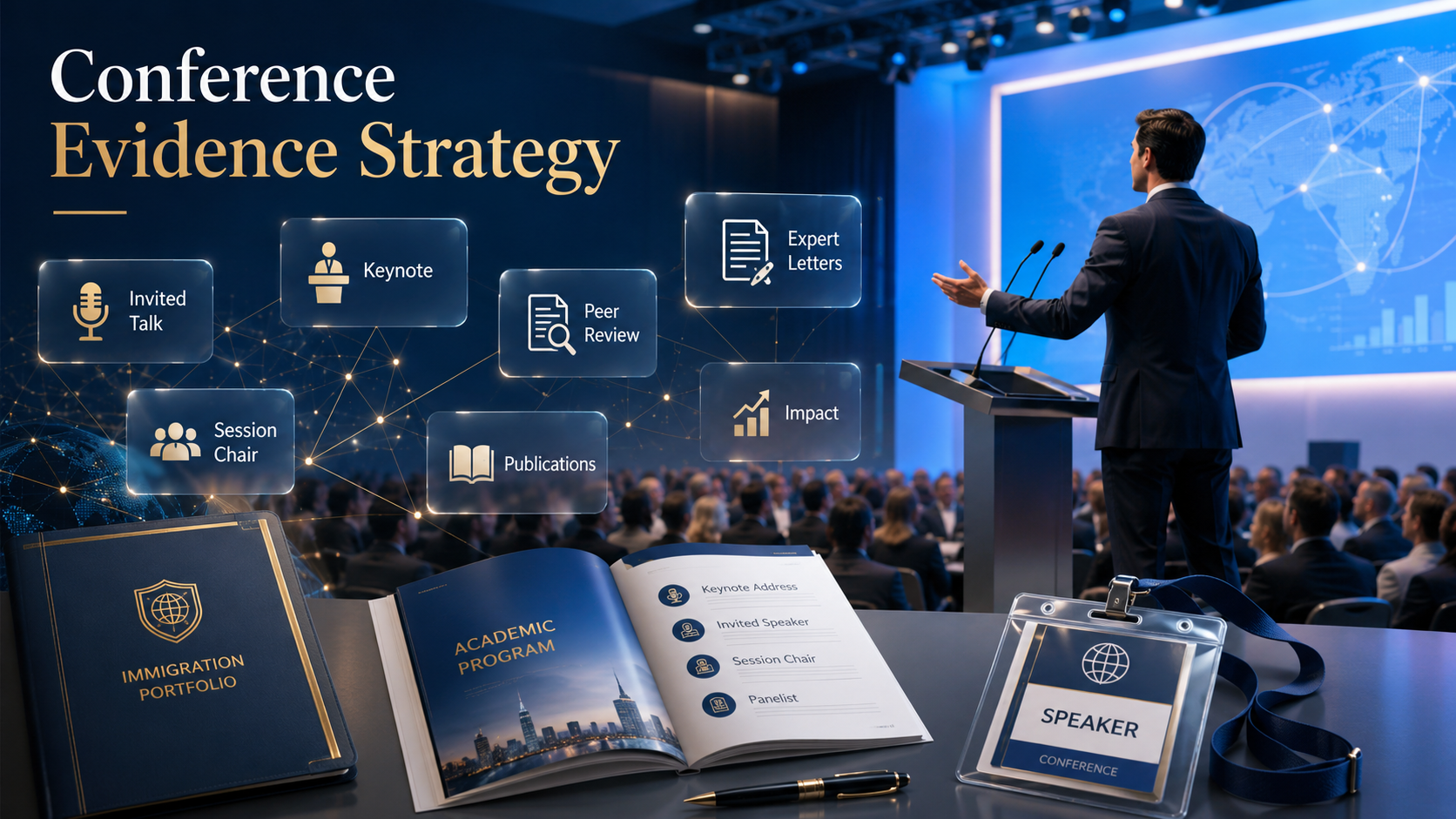
Why Conference Presentations Matter in Immigration Evidence Strategy
Conference presentations are often treated as simple resume items: a title, a date, a venue, and perhaps a link to a program page. For immigration portfolio planning, that approach is usually too thin. A presentation can be valuable, but its real strength depends on what it proves. Did the applicant present original work? Was the speaker independently selected? Was the event respected in the field? Did the audience include professionals, researchers, executives, policy stakeholders, or technical decision-makers? Did the presentation lead to citations, collaborations, media coverage, institutional recognition, professional invitations, peer review opportunities, or expert support?
For applicants preparing EB-1A, O-1A, EB-1B, or EB2 NIW materials, conference speaking can help support several evidence themes at once. It may show visibility, recognition, thought leadership, original contributions, sustained engagement with the field, and the applicant's ability to influence professional audiences. However, not every conference presentation has the same evidentiary weight. A local workshop, a paid promotional webinar, a company sales demo, and an invited keynote at a respected international conference do not communicate the same level of recognition.
This is why conference evidence should be organized strategically. The goal is not to collect every slide deck ever delivered. The goal is to identify which speaking activities help prove a meaningful professional narrative. A strong immigration portfolio does not simply say that the applicant spoke at events. It explains why those events mattered, how the applicant was selected, what the applicant presented, who the audience was, and how the presentation fits into a broader record of extraordinary ability, outstanding research, national importance, or specialized achievement.
Conference Speaking Is Not One Type of Evidence
One common mistake is assuming that all speaking activities belong in the same category. In reality, conference visibility can take many forms. Each form may support a different part of the immigration portfolio.
| Speaking Activity | What It May Help Show | Evidence Needed |
|---|---|---|
| Keynote speech | Recognition, leadership, visibility, field influence | Invitation letter, conference program, speaker bio, event reputation, audience details |
| Invited talk | Independent recognition, technical expertise, professional standing | Invitation email, selection explanation, agenda, organizer profile, topic relevance |
| Peer-reviewed presentation | Research quality, original contribution, scholarly visibility | Acceptance notice, abstract review process, proceedings, program listing, reviewer criteria |
| Panel speaker | Professional authority, industry relevance, leadership in discussion | Panel description, co-panelist credentials, moderator information, event audience |
| Session chair | Recognition by organizers, judging or leadership-like function, field participation | Appointment letter, session details, conference program, role description |
| Workshop instructor | Expertise, knowledge transfer, practical field impact | Curriculum, participant profile, organizer statement, attendance data, feedback |
| Company webinar | Potentially useful, but often weaker unless independently validated | Audience data, external participation, non-promotional framing, measurable reach |
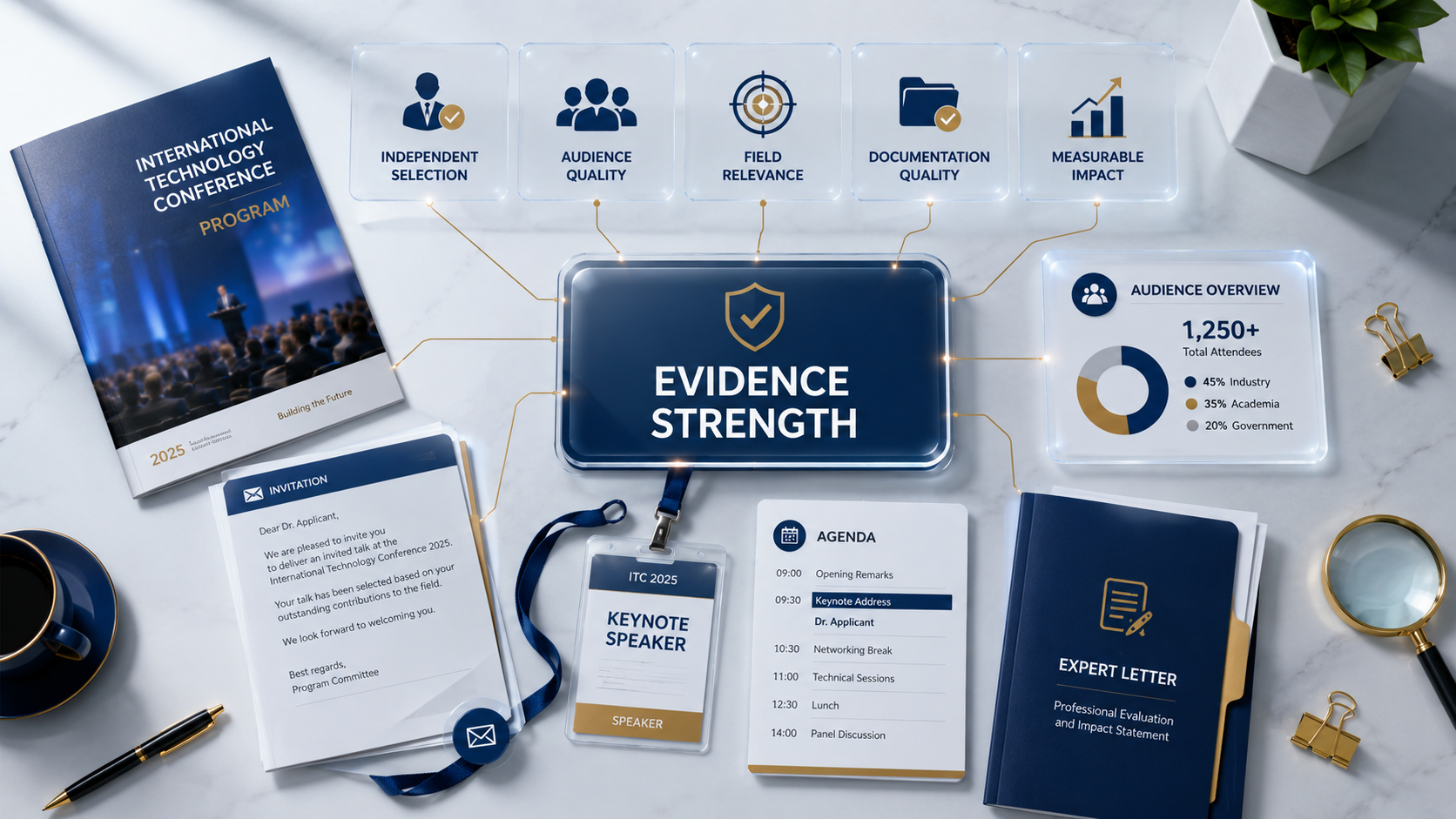
The strongest conference evidence usually combines three elements: independent selection, field relevance, and documentation quality. A presentation that was selected by an external committee, delivered to a meaningful professional audience, and supported by clear records can be far more persuasive than an undocumented claim that the applicant was a speaker.
How Conference Presentations Can Support EB-1A Strategy
EB-1A preparation often requires applicants to think beyond isolated achievements. Even when an applicant satisfies certain evidence categories, the overall portfolio must still communicate sustained acclaim, significance, and a level of recognition that goes beyond ordinary career progress. Conference evidence can help when it is connected to the applicant's strongest themes.
For an EB-1A immigration portfolio, conference presentations may help support a narrative of extraordinary ability when they demonstrate that the applicant is invited to share expertise beyond the applicant's immediate employer, classroom, or internal team. A software engineer presenting a novel architecture at an international engineering conference, an AI researcher delivering a keynote on model evaluation, a healthcare professional presenting outcomes from a major clinical implementation, or a startup founder speaking about a widely adopted technology platform may each use conference evidence differently.
Conference Evidence and Original Contributions
Conference speaking alone does not automatically prove original contributions. The stronger argument is that the presentation is one external signal of a contribution's significance. For example, if the applicant developed a new technical method and was invited to present it because other professionals wanted to understand or adopt it, the talk may support the contribution narrative. The presentation becomes more useful when paired with independent expert letters, research publications, citation impact, implementation evidence, user adoption, media coverage, awards, or follow-on invitations. Presentations also sit outside the metrics most records lean on, which is one reason citation counts alone read thinner than applicants expect.
A weak presentation claim says: the applicant spoke at a conference. A stronger presentation claim says: the applicant was invited by an independent program committee to present a specific contribution that addressed a recognized problem in the field, and the presentation reached a relevant audience of professionals who were positioned to use, evaluate, or build upon the work.
Conference Evidence and Final Merits
In EB-1A strategy, final merits analysis is about the totality of the evidence. Speaking evidence should therefore be integrated with the applicant's broader recognition pattern. If the applicant has publications, peer review service, professional awards, media coverage, leadership roles, high salary evidence, and expert letters, conference presentations can help connect these achievements into a coherent public profile. They show that the applicant is not only producing work but also being asked to explain, evaluate, and influence the direction of professional conversation.
However, conference evidence can also be overused. Listing twenty minor talks without explaining their quality can dilute the portfolio. A better approach is to select the strongest presentations and provide complete documentation for each one. Quality almost always matters more than volume.
How Conference Presentations Can Support O-1A Visa Strategy
The O-1 visa for individuals with extraordinary ability often benefits from evidence that the applicant is recognized in the field and has a record of distinguished activity. Conference presentations can help communicate that the applicant is visible, credible, and sought after by organizations outside a narrow employment context.
For O-1A preparation, the practical question is often whether the speaking evidence helps show that the applicant is known for specialized expertise. A technical founder who is repeatedly invited to present at startup, AI, fintech, cybersecurity, or engineering events may use those invitations to demonstrate professional reputation. A researcher who presents at peer-reviewed conferences may use that record to show research visibility. A healthcare innovator who trains professional audiences may use workshops and invited talks to show influence beyond routine employment.
O-1A evidence should also be current and role-specific. If the applicant's proposed U.S. work is in AI infrastructure, then conference presentations about unrelated early-career topics may have limited value. The strongest materials usually align with the applicant's current field, proposed work, and claimed area of extraordinary ability.
How Conference Presentations Can Support EB-1B Outstanding Researcher Evidence
For EB-1B outstanding researcher or professor strategy, conference evidence can be especially useful when it is connected to scholarly recognition. Peer-reviewed conference papers, invited academic talks, plenary presentations, session chair roles, program committee service, and research workshops may help show that the applicant is active in the research community. Whether that evidence is read against a bounded academic area or a broader field depends on which of the two paths the record is built for.
Academic and research-focused applicants should document not only the presentation but also the selectivity and reputation of the conference. If the event used peer review, include the acceptance notification and any available information about the review process. If the applicant was invited rather than selected through abstract submission, include the invitation and any explanation of why the applicant was chosen. If the applicant chaired a session, evaluated submissions, or served on a technical committee, that role may support a broader pattern of professional recognition and peer review.
Conference evidence for EB-1B is strongest when it reinforces the applicant's research identity. Presentations should connect to publications, citation impact, collaborations, grants, laboratory projects, patents, technical standards, or independent expert recognition. A presentation is rarely the entire story. It is usually one node in a larger research visibility network.
How Conference Presentations Can Support EB2 NIW Endeavor Framing
For EB2 NIW preparation, conference presentations can help explain the applicant's proposed endeavor and its importance. The value is not necessarily that the applicant is famous, but that the applicant's work is relevant to a broader professional, scientific, technological, healthcare, economic, educational, or public-interest problem.
For example, an AI professional may present on safer model deployment, an engineer may present on infrastructure optimization, a healthcare specialist may present on operational quality, or an entrepreneur may present on technology adoption in underserved markets. The presentation can help show that the endeavor is being discussed in professional settings and that the applicant has the expertise to advance it.
In EB2 NIW strategy, applicants should be careful not to exaggerate. A conference talk does not automatically establish national importance. It can, however, support the argument when combined with evidence of real-world application, expert letters, institutional adoption, technical documentation, publications, media coverage, grants, patents, partnerships, or measurable outcomes.
How to Evaluate the Strength of a Conference Presentation
Before adding a presentation to an immigration portfolio, ask what it actually proves. The strongest conference evidence is not always the most impressive-looking event. Sometimes a smaller but highly specialized technical conference may be more relevant than a large general event. Sometimes an invited workshop for decision-makers may be more useful than a broad public webinar. The evaluation should focus on context.
1. Was the Applicant Independently Selected?
Independent selection is one of the most important credibility factors. If a conference organizer, program committee, editorial board, scientific committee, industry association, university, or professional organization selected the applicant, the evidence is generally stronger than a self-created speaking opportunity. Documentation should show who selected the applicant and why.
- Invitation letters from organizers
- Acceptance emails from program committees
- Speaker nomination records
- Conference program pages listing the applicant
- Organizer statements explaining selection criteria
2. Was the Conference Relevant to the Field?
Relevance matters. A conference does not need to be globally famous to be useful, but it should connect clearly to the applicant's claimed field. A cybersecurity conference may be highly relevant for a security engineer, while a general entrepreneurship meetup may be less useful unless it directly relates to the applicant's venture, technology, or leadership evidence.
3. Was the Audience Meaningful?
Audience quality can be more important than audience size. A talk delivered to fifty senior researchers, industry architects, hospital administrators, or technical committee members may carry more evidentiary value than a larger audience with no clear professional connection. Useful documentation can include attendee profiles, organizer descriptions, registration pages, photographs, participant lists, institutional affiliations, or post-event reports.
4. Was the Topic Connected to the Applicant's Claimed Contribution?
A presentation is strongest when it reinforces the applicant's main immigration story. If the applicant claims original contributions in AI optimization, the conference topic should ideally connect to that contribution. If the applicant claims leadership in healthcare operations, the presentation should show expertise in that area. Random speaking engagements may make the portfolio look busy but not necessarily stronger.
5. Is There Evidence of Impact After the Presentation?
Post-presentation impact can make speaking evidence more powerful. Examples include follow-up invitations, publication in proceedings, citations, media coverage, professional collaborations, awards, workshop requests, adoption of a method, or expert letters referencing the presentation. Even when the impact is modest, documenting real outcomes is better than leaving the presentation as an isolated event.
Documentation Checklist for Conference Presentation Evidence
Applicants often lose evidentiary value because they keep poor records. Conference speaking should be documented while the records are still available. Websites disappear, program pages change, and organizer emails get lost. A well-prepared immigration portfolio uses multiple forms of evidence to verify the event, role, and relevance.
Core Documentation
- Official invitation email or acceptance notice
- Conference agenda or program showing the applicant's name
- Speaker bio from the event website
- Presentation title, abstract, and topic description
- Event dates, location, and format
- Organizer name and institutional background
- Conference website screenshots or archived pages
- Photographs of the applicant presenting, if available
- Recording link, video screenshot, or webinar page, if available
- Certificate of presentation, speaker badge, or appreciation letter
Strengthening Documentation
- Information about selection criteria or review process
- Acceptance rate, if officially available and verifiable
- Audience size and attendee profile
- Names and credentials of other speakers
- Proceedings publication or abstract book
- Post-event report or organizer summary
- Media coverage or social media posts from the organizer
- Expert letter explaining the importance of the presentation
- Evidence of follow-on invitations, collaborations, citations, or adoption
Do not rely only on screenshots. Screenshots can be useful, but they should be supported by official records whenever possible. If the presentation was important, ask the organizer for a short confirmation letter describing the applicant's role, the selection process, the event's audience, and the significance of the topic.
What Makes an Invited Talk Stronger Than an Ordinary Presentation?
An invited talk can be valuable because it may show that an independent organization recognized the applicant's expertise. But not every invited talk is strong. The strength depends on who invited the applicant, why the applicant was invited, and what the event represented.
A strong invited talk usually has several characteristics. The organizer is credible. The invitation is specific. The topic aligns with the applicant's recognized expertise. The audience is professional or scholarly. The applicant's role is visible in official materials. The event is not merely promotional. The presentation contributes to a conversation in the field.
By contrast, a weak invited talk may be a pay-to-speak opportunity, a casual internal company event, a promotional product webinar, or an event with no clear selection process. These events are not always useless, but they must be framed carefully. If the event does not show independent recognition, it may still help demonstrate communication, leadership, or outreach, but it should not be overstated.
Keynote, Plenary, and Featured Speaker Roles
Keynote and plenary roles can be among the strongest forms of conference evidence, especially when the event is respected and the applicant was selected for recognized expertise. A keynote role may suggest that the applicant was not simply one participant among many but was positioned as a central voice for the event. However, the word keynote alone is not enough. The portfolio should document the event's credibility and the applicant's selection.
Useful evidence includes the event program, keynote announcement, organizer biography, speaker page, promotional materials, audience profile, and a letter from the organizer explaining why the applicant was chosen. If the applicant's keynote was related to original contributions, research publications, patents, professional awards, or leadership achievements, the portfolio should make that connection explicit.
Session Chair, Moderator, and Program Committee Roles
Conference participation is not limited to presenting. Session chair, moderator, technical committee, scientific committee, and program committee roles may help show professional trust. These roles can suggest that the applicant was relied upon to evaluate, organize, or guide discussion among peers.
For some applicants, these roles may support judging, peer review, leadership, or professional recognition themes. For example, a researcher serving on a technical program committee may have reviewed abstracts or papers. A senior engineer moderating a panel of industry leaders may show professional authority. A healthcare specialist chairing a session may demonstrate recognition within a specialized community.
The evidence should describe the function. A title alone is not enough. If the applicant reviewed submissions, selected speakers, chaired scientific sessions, evaluated abstracts, or guided technical discussion, the documentation should say so clearly.
Common Mistakes in Using Conference Evidence
Many applicants have valuable speaking experience, but the evidence is presented in a way that weakens the immigration portfolio. The most common problems are avoidable.
Mistake 1: Listing Events Without Explaining Their Importance
A long list of presentations may look impressive, but USCIS-focused evidence strategy should not rely on volume alone. Each selected presentation should answer the question: why does this matter? The answer may involve independent selection, conference reputation, audience profile, technical significance, or connection to broader impact.
Mistake 2: Treating Paid or Promotional Events as Independent Recognition
Some events allow speakers to pay for visibility. Others are primarily marketing webinars. These may still have limited value, but they should not be framed as strong independent recognition unless there is evidence that the applicant was selected for expertise by an independent body.
Mistake 3: Ignoring the Audience
A presentation to a meaningful audience can support field influence. A presentation with no audience context is harder to evaluate. Applicants should gather evidence showing who attended, what industries or institutions were represented, and why the audience was relevant.
Mistake 4: Failing to Connect Presentations to the Main Petition Narrative
Conference evidence should not feel random. It should support the applicant's field definition, original contributions, leadership, research visibility, or proposed endeavor. If an event does not fit the narrative, it may belong in the CV but not necessarily as highlighted immigration evidence.
Mistake 5: Overstating Routine Academic Presentations
Academic conferences are important, but routine poster presentations or ordinary student presentations may not carry the same weight as invited talks, peer-reviewed oral presentations, plenary roles, or session leadership. The evidence should be accurate and proportionate.
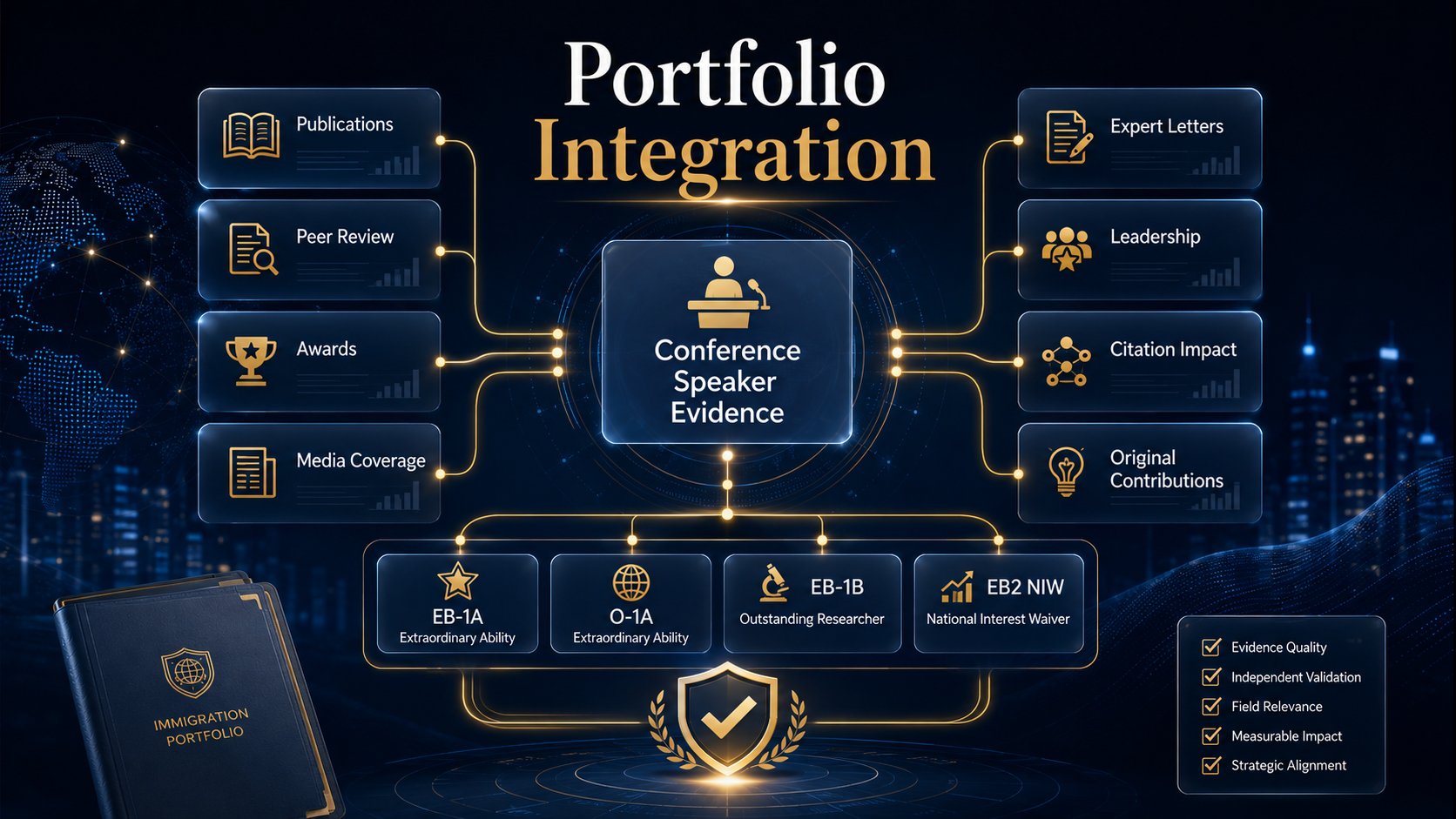
How to Integrate Speaking Evidence Into a Complete Immigration Portfolio
The best immigration portfolios do not treat conference presentations as isolated achievements. They integrate speaking evidence with publications, peer review, professional awards, media coverage, expert letters, recommendation letters, leadership roles, citation impact, patents, and original contributions.
Consider a software engineer who built a widely used infrastructure tool. A conference presentation about the tool becomes stronger if the portfolio also includes GitHub adoption, enterprise implementation, expert letters from independent engineers, media coverage, technical publications, awards, and evidence that other teams used or adapted the work. The talk helps show visibility, but the broader evidence shows significance.
Consider a researcher with publications and citation impact. Conference presentations can show that the research community invited or selected the applicant to share findings. If the applicant also served as a reviewer, session chair, or committee member, the portfolio may show a pattern of professional trust and scholarly engagement.
Consider a healthcare professional implementing a process improvement model. A conference workshop may show that other professionals wanted to learn the method. If the portfolio includes measurable outcomes, institutional letters, expert opinions, awards, and adoption evidence, the presentation becomes part of a stronger impact story.
Evidence Pairings That Often Work Well
| Conference Evidence | Best Supporting Evidence | Strategic Purpose |
|---|---|---|
| Invited keynote | Organizer letter, media coverage, expert letters, speaker profile | Shows recognition and visibility |
| Peer-reviewed conference paper | Proceedings, citations, publication record, review process | Shows research quality and scholarly impact |
| Technical workshop | Participant profile, adoption evidence, testimonials, implementation records | Shows knowledge transfer and practical influence |
| Panel speaker role | Co-panelist credentials, agenda, audience profile, organizer statement | Shows professional authority |
| Session chair role | Program listing, role description, committee appointment, review duties | Shows trust, leadership, or judging-like participation |
Examples by Professional Profile
AI Professionals and Software Engineers
For AI professionals and software engineers, strong conference evidence often focuses on technical innovation, architecture, product impact, infrastructure, model evaluation, cybersecurity, data systems, or platform adoption. A talk is stronger when it is not merely a product demo but a technical contribution that other professionals can evaluate, learn from, or apply.
Useful supporting evidence may include system diagrams, patents, technical publications, user adoption metrics, independent expert letters, open-source activity, awards, peer review, and media coverage. If the applicant spoke at a respected engineering conference, the portfolio should explain why the topic was important and how it relates to original contributions or leadership evidence.
Researchers and University Faculty
For researchers and faculty, conference presentations should be connected to the research record. Peer-reviewed oral presentations, invited seminars, plenary talks, symposium roles, and session chair positions may help show scholarly recognition. The evidence becomes stronger when paired with research publications, citation impact, editorial or peer review service, grants, awards, and independent expert letters.
Healthcare Professionals
Healthcare professionals may use conference evidence to show leadership in clinical quality, operational improvement, medical technology, public health, research, education, or specialized practice. The portfolio should avoid vague claims and focus on the measurable importance of the topic, the professional audience, and any adoption or outcomes associated with the presented work.
Entrepreneurs and Startup Founders
For entrepreneurs, conference evidence can support visibility and leadership, especially when the applicant is invited to speak about innovation, market transformation, technology deployment, or founder expertise. Stronger evidence may include investor recognition, customer adoption, professional awards, media coverage, patents, partnerships, revenue growth, and expert letters explaining the founder's role in the field.
How Expert Letters Can Strengthen Conference Evidence
Expert letters and recommendation letters can help explain why a conference presentation matters. A letter from an organizer may verify the applicant's selection, role, and audience. A letter from an independent expert may explain the technical or professional significance of the presentation topic. A letter from an attendee may describe how the presentation influenced practice, research, implementation, or decision-making.
Strong letters should be specific. They should not simply say that the applicant is talented or that the presentation was excellent. They should explain the selection process, the importance of the event, the applicant's contribution, and the relevance of the audience. For immigration evidence, specificity is usually more persuasive than praise.
A strong evidence file does not ask the reader to assume that a conference mattered. It documents the event, explains the selection, identifies the audience, and connects the presentation to the applicant's broader professional impact.
Practical Evidence Plan for Applicants
Applicants who plan to use conference presentations in an immigration portfolio should begin by creating a structured speaking evidence inventory. This inventory should not be limited to titles and dates. It should capture context.
- List every conference, webinar, workshop, panel, keynote, invited talk, and session chair role.
- Identify which events were independent, selective, peer-reviewed, invited, or leadership-oriented.
- Collect official documentation for each strong event.
- Rank presentations by relevance to the immigration narrative.
- Request organizer confirmation letters for the strongest events.
- Gather audience information, event reputation evidence, and speaker materials.
- Connect each presentation to publications, awards, media coverage, expert letters, citations, patents, or implementation evidence.
- Remove or de-emphasize weak events that distract from the strongest narrative.
This process can reveal gaps. An applicant may discover that they have many talks but few independent invitations. Another may have strong technical presentations but no organizer letters. Another may have impressive conference participation but no evidence of audience or selection. These gaps can often be improved through careful documentation and future profile planning.
How to Plan Future Conference Visibility
Conference strategy should not be improvised two weeks before filing. Applicants who are building long-term immigration profiles should think ahead. Future speaking activities can be selected based on relevance, credibility, and documentation potential.
Applicants may consider submitting abstracts to respected conferences, applying for panel opportunities, proposing technical workshops, seeking invited seminars through professional networks, participating in program committees, or building visibility through publications that lead to speaking invitations. The goal is not to chase appearances. The goal is to build a credible record of professional contribution and recognition.
For many professionals, a 6 to 18 month planning window can make a meaningful difference. During that time, applicants may strengthen research publications, peer review service, professional memberships, conference speaker roles, awards, media coverage, expert letters, and documentation quality. Every case is different, and the right timeline depends on the applicant's field, current achievements, visa goals, and filing strategy.
FAQ: Conference Presentations and Immigration Evidence
1. Are conference presentations enough for EB-1A approval?
No single type of evidence should be treated as automatically enough. Conference presentations can support an EB-1A strategy, but they are usually strongest when combined with other evidence such as publications, citation impact, professional awards, peer review, media coverage, leadership evidence, original contributions, and expert letters.
2. Is an invited talk better than a submitted conference presentation?
Not always. An invited talk can show independent recognition, but a peer-reviewed conference presentation may also be strong if the review process and event reputation are well documented. The key is what the evidence proves.
3. Do webinars count as conference evidence?
Webinars can be useful if they are professional, independently organized, relevant to the field, and well documented. A promotional webinar controlled by the applicant's employer may be weaker unless it shows meaningful external reach or professional influence.
4. Should I include every presentation in my immigration portfolio?
Usually no. It is better to highlight the strongest and most relevant presentations. A complete CV can list more activities, but the main evidence file should focus on quality, relevance, and documentation.
5. Can a session chair role help my case?
Yes, in some cases. A session chair role may show professional trust, leadership, or participation in evaluating and guiding field discussion. It is strongest when the role was assigned by a credible organizer and the responsibilities are clearly documented.
6. What if the conference website no longer exists?
Use alternative documentation such as emails, PDFs, certificates, program books, screenshots saved earlier, organizer letters, archived materials, photographs, and independent references. The more important the event, the more valuable a confirmation letter from the organizer may be.
7. Do conference presentations help EB2 NIW cases?
They can. For EB2 NIW, presentations may help explain the proposed endeavor, demonstrate professional engagement, and show that the applicant's work is relevant to broader problems. They should be paired with evidence of importance, feasibility, and the applicant's ability to advance the endeavor.
8. Can conference presentations support an O-1 visa petition?
They may support an O-1A evidence strategy when they show recognition, visibility, distinguished activity, or specialized expertise. The strongest speaking evidence aligns with the applicant's proposed work and claimed area of extraordinary ability.
9. How important is audience size?
Audience size can help, but audience quality is often more important. A specialized audience of respected professionals may be more valuable than a large but general audience with no clear connection to the field.
10. Should expert letters mention conference presentations?
Yes, when the presentation is important. Expert letters can explain why the topic mattered, why the applicant was invited or selected, and how the presentation fits into the applicant's broader contribution to the field.
Conclusion: Turn Speaking Activities Into Evidence, Not Just Resume Lines
Conference presentations can be powerful immigration evidence, but only when they are documented and framed correctly. A speaker role should not sit in the portfolio as an isolated claim. It should help answer larger questions: What is the applicant known for? Who recognized the applicant's expertise? What contribution was presented? Why was the audience meaningful? How does this event support the applicant's broader record of impact, recognition, leadership, or national importance?
For EB-1A, conference evidence may support extraordinary ability and final merits when tied to original contributions, visibility, and independent recognition. For O-1A, it may help show specialized expertise and professional reputation. For EB-1B, it can reinforce scholarly recognition and research activity. For EB2 NIW, it may help clarify the proposed endeavor and demonstrate professional relevance. In every category, the strategic value depends on the quality of the evidence and the clarity of the narrative.
Every immigration case is unique. EB1 Mentor is not a law firm and does not provide legal representation, but we help accomplished professionals build stronger immigration portfolios through publication strategy, citation strategy, peer review opportunities, conference speaking, professional memberships, award strategy, expert letters, recommendation letters, media coverage, portfolio positioning, and long-term profile development.
Strengthen your conference evidence before filing
If your speaking record includes invited talks, keynote presentations, session chair roles, academic presentations, technical workshops, or industry panels, it may deserve a more strategic place in your immigration portfolio. The right documentation can help turn conference activity into a clearer story of recognition, expertise, and field relevance.
Contact EB1 Mentor to discuss how your achievements can be organized into a stronger evidence strategy.
Build a stronger immigration evidence strategy
Every immigration case is unique. EB1 Mentor is not a law firm and does not provide legal representation, but our team helps accomplished professionals strengthen immigration portfolios through evidence planning, publication strategy, peer review opportunities, conference visibility, expert letters, recommendation letters, and long-term profile development.
Contact EB1 Mentor to discuss how your professional achievements can be organized into a stronger evidence portfolio.