
Why AI and Software Professionals Are Both Well-Positioned and Underprepared for the O-1A
The O-1A visa is designed for individuals with extraordinary ability in sciences, business, education, or athletics. In practice, it has become one of the most strategically viable nonimmigrant pathways for accomplished technology professionals — particularly those working in artificial intelligence, machine learning, data science, and senior software engineering roles.
Yet despite being well-credentialed, many applicants from the AI and software world file petitions that are either denied or hit with Requests for Evidence (RFEs). The reason is not usually a lack of achievement. It is a mismatch between how professionals present their work and what USCIS adjudicators are trained to evaluate.
This guide walks through the O-1A framework as it applies specifically to AI engineers and software professionals — with real strategic depth, not just a checklist of the eight criteria. Even a carefully built case can still be denied on final merits grounds; if that happens, understanding the difference between a motion and an AAO appeal is the next step worth getting right.
If you are exploring the O-1A as a pathway or preparing to build your evidence file, learn more about EB1 Mentor's O-1A preparation services or start with a profile evaluation.
Understanding the O-1A Standard Before You Build Your Evidence
The O-1A requires an applicant to demonstrate extraordinary ability through sustained national or international acclaim. This does not mean famous. It does not mean you need a Nobel Prize or a viral GitHub repository with millions of stars. It means that your record, taken as a whole, reflects a level of achievement that places you among the small percentage of professionals who have risen to the top of your field.
USCIS adjudicates O-1A petitions by first checking whether the applicant meets the evidentiary threshold — either a major internationally recognized prize, or at least three of eight regulatory criteria — and then applying a final merits analysis to determine whether the totality of the evidence demonstrates sustained acclaim.
Important: Meeting three criteria is the minimum threshold, not the finish line. Adjudicators have broad discretion at the final merits stage. An applicant who barely satisfies three criteria with weak evidence is far more vulnerable than one who satisfies five criteria with clearly documented, independently verifiable achievements. Build depth, not just breadth.
For AI and software professionals specifically, the challenge is that many real accomplishments do not automatically map to the O-1A's regulatory language. A senior ML engineer at a major tech company may have shipped models used by hundreds of millions of users, but that impact is not inherently visible to an adjudicator reading a petition. The evidence strategy is about making that impact legible in USCIS terms.
Which O-1A Criteria Apply Most Naturally to AI and Software Professionals
The eight O-1A regulatory criteria cover prizes and awards, membership in associations, published material about the applicant, judging the work of others, original contributions of major significance, authorship of scholarly articles, critical role in distinguished organizations, and high salary or remuneration. Not all eight will apply equally well to every applicant. Below is a strategic breakdown tailored to the technology sector.
1. Awards and Prizes
This criterion is strong when it can be satisfied. The key is that the award must be nationally or internationally recognized in the field and awarded for excellence. Internal company awards, hackathon participation prizes, and general service recognitions almost never qualify. What does qualify: competitive fellowships with selective admission rates, named research prizes from IEEE, ACM, or equivalent bodies, best paper awards at top-tier venues such as NeurIPS, ICML, ICLR, or CVPR, and national or international competitive programs such as Forbes 30 Under 30 (in a context where it represents field-wide recognition rather than general notoriety).
For many AI professionals, this criterion is not their strongest opening but can become a meaningful supporting element when properly documented.
2. Membership in Associations Requiring Outstanding Achievement
This is one of the most commonly misunderstood criteria in the technology space. The membership must require outstanding achievement in the field as a condition for admission, as judged by recognized experts. General professional memberships — ACM general member, IEEE member — do not meet this standard. What can qualify: Senior Member or Fellow status in IEEE or ACM (which requires demonstrated contributions and endorsement by peers), invitation-only research groups or advisory bodies, membership in selective national academies or their affiliate programs, and highly competitive fellowship cohorts with explicit peer evaluation for admission.
Common Mistake: Listing standard IEEE or ACM memberships as evidence under this criterion without documenting the actual requirements for admission. Adjudicators are trained to look past the name of the organization and evaluate whether the membership standard itself requires outstanding achievement. If the organization accepts general applications without peer review, it will not satisfy this criterion.
3. Published Material About the Applicant
This criterion covers media coverage, trade press articles, profiles, and any substantive published material about the applicant and their work — not authored by the applicant. For software and AI professionals, this is a highly buildable criterion. Strong examples include: profiles in major technology publications such as MIT Technology Review, Wired, TechCrunch, or VentureBeat; interviews or features in domain-specific publications covering ML research or AI policy; podcast appearances in widely distributed shows where the applicant is the expert guest being interviewed about their work; and academic press coverage of research the applicant has led.
Weaker examples that still have some value but should not be the centerpiece: brief mentions in company press releases, generic conference speaker listings, or LinkedIn features that are clearly self-generated.
4. Judging the Work of Others
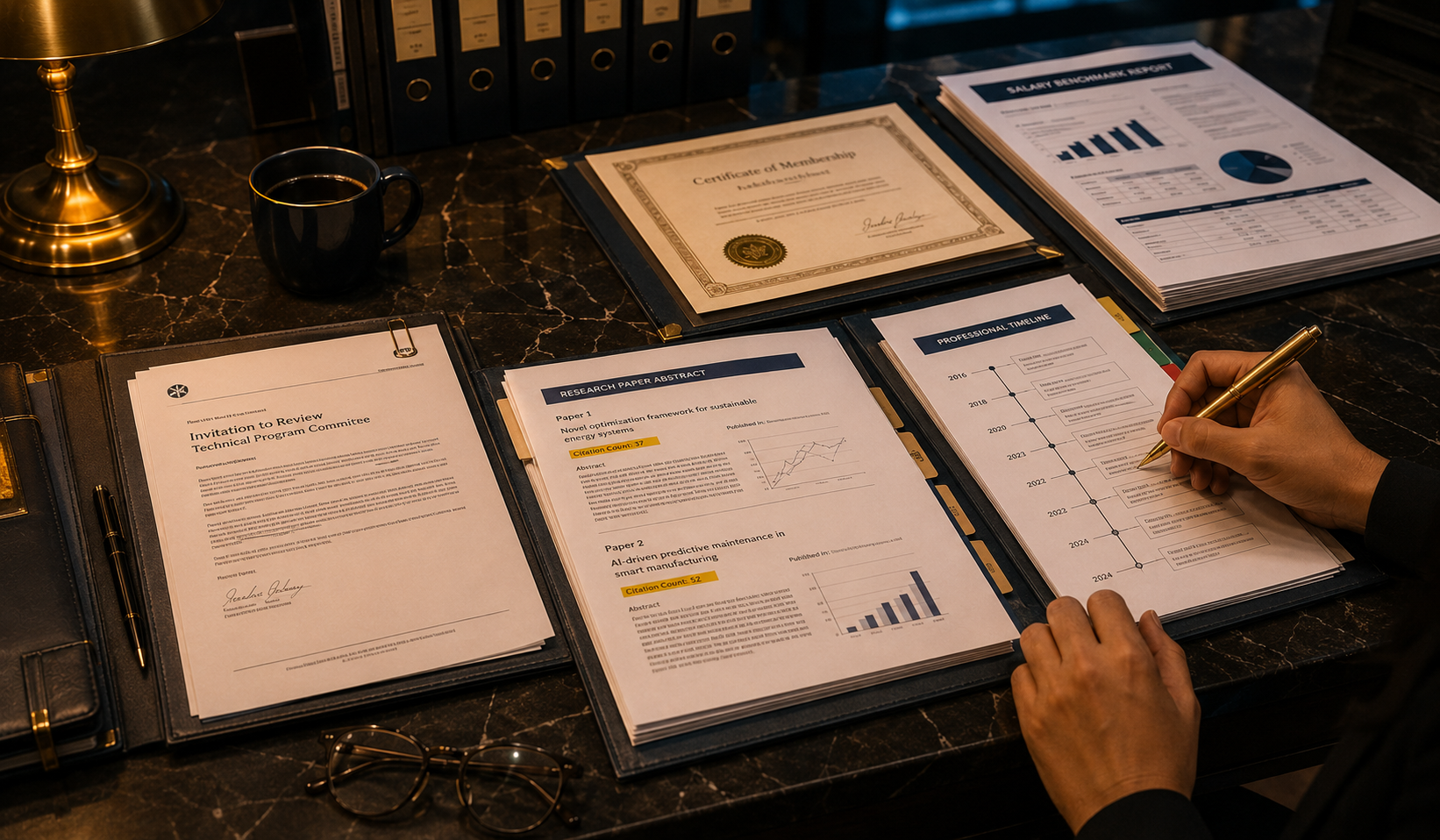
This is often the most accessible criterion for AI and software professionals and should be pursued aggressively if not already in place. Qualifying activities include: peer review for academic journals (Nature Machine Intelligence, IEEE Transactions on Neural Networks, Journal of Artificial Intelligence Research, and similar); program committee membership or paper review roles at major conferences (NeurIPS, ICLR, CVPR, ACL, KDD, AAAI); grant proposal review for NSF, NIH, or international equivalents; technical review roles for patent applications in AI or software; and judging roles for industry competitions, hackathons with formal judging structures, or innovation challenges with recognized sponsoring organizations.
The documentation strategy here matters enormously. Invitation letters, confirmation emails from conference chairs, and specific evidence of the review actually conducted — including the number of papers reviewed, the acceptance rate of the conference, and the caliber of the venue — all strengthen this criterion substantially.
5. Original Contributions of Major Significance
This is frequently the most important criterion for AI researchers and senior engineers, and also the most contested by adjudicators. The regulatory language requires the contribution to be original and of major significance to the field — not just to a company or a product.
What qualifies most strongly: technical innovations that have been adopted by other researchers or practitioners and documented through citations, GitHub stars, licensing arrangements, or industry adoption; patents with demonstrable commercial or scientific application; novel algorithmic approaches that appear in subsequent published work by others; and technical contributions that have influenced policy, standards, or downstream products in a documented way.
What adjudicators push back on: contributions that are significant internally but have no external footprint; innovations that are described in the petition but not corroborated by any independent source; and claims of originality that are not supported by expert opinion or external adoption evidence.
Expert Insight: For original contributions, the single most persuasive evidence type is citation of your work by researchers who have no relationship with you or your employer. If you have published technical work — whether in peer-reviewed journals, conference proceedings, or even preprint repositories like arXiv — build a citation tracking record using Google Scholar, Semantic Scholar, or Web of Science. A clearly documented citation history of independent use is stronger than any letter from a colleague describing your work as groundbreaking.
6. Authorship of Scholarly Articles
Published work in recognized peer-reviewed journals or major conference proceedings is strong evidence. For AI professionals, top-tier conference proceedings (NeurIPS, ICML, ICLR, CVPR, ACL) carry weight comparable to high-impact journals. Key factors: publication in recognized venues, first-author or lead-author status where possible, and citation counts that reflect real engagement from the research community.
Preprints on arXiv or similar platforms can supplement this evidence but generally should not be the primary basis for this criterion unless they have substantial independent citation counts or have received significant coverage.
7. Critical or Essential Role in Distinguished Organizations
This criterion can be very strong for senior engineers and technical leads at major technology companies. The challenge is documentation. The organization itself must be distinguished — which major technology companies typically satisfy — and the applicant's role must be shown to be critical or essential to the organization's work, not merely employed within it.
Strong evidence includes: org-level documentation of the applicant's specific scope of responsibility; statements from executives or technical leadership describing the applicant's unique contribution to the organization's mission; evidence that the applicant's work is not easily substitutable and required specialized expertise; and examples of specific high-impact decisions or innovations that the applicant drove.
8. High Salary or Remuneration
If your compensation is in the top tier for your occupation and geography, this criterion can be relatively easy to document. The comparison must be to others in the field, not to the general population. Use authoritative salary benchmarking sources such as the Bureau of Labor Statistics Occupational Employment and Wage Statistics, Levels.fyi data for the technology sector, or compensation surveys from professional associations. Your employer's HR documentation and offer letter should corroborate the figures.
Expert Insight: For O-1A petitions in the technology sector, salary evidence works best as a supporting criterion rather than a pillar. It is relatively easy to document for senior professionals at major tech companies, which means it adds credibility without carrying unusual weight on its own. Pair it with stronger qualitative evidence under original contributions, judging, and critical role for the most balanced petition architecture.
Three Hypothetical Scenarios: How AI Professionals Build O-1A Evidence
Scenario A: The Research Engineer at a Major AI Lab
Amara is a research engineer at a well-known AI laboratory. She has three first-author papers at top-tier ML conferences, a Google Scholar H-index of 12, and extensive peer review activity across multiple leading venues. She has never won a named award, but her most recent paper introduced a training efficiency technique that has been independently cited 140 times over 18 months.
Her strongest criteria: scholarly articles, original contributions (well-documented by independent citation), and judging. Her supporting criteria: published material (a Wired profile tied to her lab's research release), and critical role (supported by a detailed letter from her research director). She is a strong O-1A candidate with three to four solidly supported criteria and a persuasive final merits narrative built around her impact on the research community.
Scenario B: The Senior ML Engineer at a Fintech Scale-Up
David is a senior ML engineer who has spent seven years building fraud detection and risk models. His work has never been published academically, but he holds two patents related to real-time transaction risk scoring. He has spoken at two industry conferences and reviewed technical proposals for a government innovation grant program. His salary is in the 96th percentile for his occupation according to BLS data.
David's challenge is that his most impressive work is proprietary and external footprint is limited. His strategy should focus on: building out the judging criterion (adding conference program committee roles and journal peer review assignments); pursuing publishable technical writing — even a single industry-facing technical paper or trade press article with substantive co-authorship — to build the scholarly articles criterion; and strengthening the original contributions evidence by documenting the adoption of his patented methods in the financial technology sector through third-party licensing data or regulatory documentation.
Scenario C: The AI Startup CTO
Priya co-founded and leads the technical team at an AI startup that has raised two funding rounds and whose platform is used by enterprise clients. She has no academic publications, but she has given three keynote-level talks at industry conferences, been quoted in Bloomberg and Reuters on AI regulation topics, and holds patents in a novel edge inference architecture.
Priya's strongest criteria are published material (Bloomberg and Reuters coverage is strong), critical role (as CTO of a demonstrably distinguished company), and potentially original contributions if the patent adoption is well-documented. She should invest in building the judging criterion before filing and consider pursuing IEEE Senior Member status or comparable association recognition to add the membership criterion. Her petition narrative should foreground her industry-wide influence and the adoption of her technical innovations by enterprise clients as a form of major significance.

The Evidence Gap Problem: What Most AI Professionals Are Missing
Across the three scenarios above and in real-world O-1A preparation, the most common gaps for AI and software professionals are:
- No external footprint for their most important work. If your greatest contributions are internal systems, proprietary models, or products under NDA, you need a secondary evidence track — publications, talks, or documented external adoption — that creates an independently verifiable record of your expertise.
- Weak judging evidence. Many qualified professionals have never formally peer-reviewed a paper or served on a conference program committee simply because no one has ever suggested it. This is fixable, often within six to twelve months, and it is one of the highest-return evidence-building activities available.
- Shallow published material documentation. Having been mentioned in an article is not the same as having a well-documented media file. Gather PDFs, URLs, circulation figures, and context about why each publication matters in your field.
- Original contributions described only by colleagues. Expert support letters are valuable, but they are not a substitute for independent corroboration. Citations from unrelated researchers, adoption documentation, and patent licensing records are stronger because they are not subject to bias.
Building a Pre-Filing Evidence Timeline: What to Do in the 6–18 Months Before You Apply
| Timeframe | High-Priority Action | Criteria Supported |
|---|---|---|
| 12–18 months out | Apply for IEEE Senior Member, ACM Senior Member, or equivalent selective membership | Membership |
| 12–18 months out | Submit a paper or technical report to a peer-reviewed venue or well-regarded conference | Scholarly articles, original contributions |
| 12–18 months out | Register as a peer reviewer on Publons/Web of Science; begin accepting journal review requests | Judging |
| 6–12 months out | Apply for conference program committee roles at relevant technical venues | Judging |
| 6–12 months out | Pursue speaking opportunities at industry or academic conferences where your expertise is documented | Published material, critical role |
| 6–12 months out | Request a salary benchmarking analysis against BLS and industry sources | High salary |
| 3–6 months out | Compile citation tracking across all platforms (Google Scholar, Semantic Scholar, Web of Science) | Original contributions |
| 3–6 months out | Identify and brief 3–5 expert letter writers from outside your organization | Supports all criteria |
| 1–3 months out | Compile media file: PDFs, URLs, circulation stats, context for each publication mentioning you | Published material |
| 1–3 months out | Draft petition narrative with attorney and evidence coordinator | All |
How to Choose Your Expert Letter Writers for an O-1A Petition
Expert support letters are a critical component of any O-1A petition. Unlike EB-1A petitions, the O-1A requires a written opinion from a peer group or labor organization in the field, though in practice the broader expert letter package carries substantial weight.
The strongest expert letter writers for AI and software professionals share several characteristics. They are recognized independently in the field — through their own publications, leadership roles, or institutional affiliations. They have no direct employment relationship with the applicant or their current employer. They can speak with specificity about the applicant's contributions from a position of genuine expertise. And their letters focus on the applicant's impact on the field, not merely on their personal impressions of the applicant's intelligence or work ethic.
| Letter Writer Type | Strength Level | Key Consideration |
|---|---|---|
| Professor or researcher who has cited the applicant's work | Very Strong | Independent and verifiable; can speak to external adoption of contributions |
| Industry leader in a non-competing organization who has tracked the applicant's work | Strong | Real-world credibility; must demonstrate genuine independent knowledge |
| Conference program chair or journal editor who has worked with applicant in a review capacity | Strong | Corroborates judging criterion directly |
| Colleague or former manager at same organization | Limited | Perceived as biased; use only as supplement, never as primary voice |
| General character reference with no field-specific credentials | Weak | Adds no meaningful weight; avoid unless required for other purposes |
For guidance on building a strong expert letter strategy for your O-1A petition, explore EB1 Mentor's O-1A evidence development services.
The Final Merits Analysis: Why Your Evidence Has to Tell a Story
Meeting the regulatory threshold — three criteria with supporting evidence — is necessary but not sufficient. USCIS adjudicators apply a final merits analysis that asks whether the totality of the evidence demonstrates the level of expertise required for extraordinary ability. This is a qualitative, holistic judgment.
For AI and software professionals, the final merits narrative should answer three implicit questions that adjudicators bring to every petition:
- Is this person recognized beyond their current employer? Evidence of external recognition — citations, published material, invitations to speak or review — directly addresses this question. If all your evidence comes from within your company, the petition will feel narrow regardless of how impressive the accomplishments are.
- Has this person influenced the field, not just contributed to it? Influence means your work has changed how others think or act. Citations, adoption of methods, policy contributions, and peer recognition of impact all demonstrate influence. Internal performance reviews do not.
- Is this a sustained record or a recent spike? USCIS looks for sustained national or international acclaim. A burst of activity in the six months before filing, with nothing substantive before that, is a red flag. Build your record over time and document its trajectory.
Checklist: Is Your O-1A Evidence Portfolio Ready?
- Have you identified at least three regulatory criteria with supporting documentation for each?
- Do you have at least one criterion with multiple independent evidence items, not just a single letter?
- Are your original contributions corroborated by external sources — citations, adoption records, licensing data — rather than described only by colleagues?
- Do you have peer review or judging activity documented with invitation letters, confirmation emails, or certificates?
- Is your published material file organized with PDFs, URLs, publication dates, and circulation or impact context?
- Have you tracked your citation history across Google Scholar, Semantic Scholar, and any other relevant databases?
- Do you have at least three expert letter writers identified from outside your current organization?
- Has your salary been benchmarked against authoritative industry and BLS data?
- Is your petition narrative written in plain language that makes your impact legible to a non-specialist adjudicator?
- Have you reviewed recent AAO decisions in the technology sector to understand how similar evidence is evaluated?
Frequently Asked Questions About the O-1A for AI and Software Professionals
Do I need academic publications to qualify for the O-1A if I work in industry?
No, but you do need at least one form of externally verifiable evidence of your expertise and contributions. Academic publications are one strong path, but industry professionals can also build their cases around patent portfolios, documented adoption of technical innovations, media coverage, judging activity, and high salary evidence. The key is that your record has to extend beyond the four walls of your employer.
Can I use my GitHub repository statistics as evidence of original contributions?
Repository statistics such as stars, forks, and downloads can supplement an original contributions argument, particularly if they demonstrate widespread adoption of tools or libraries you have developed. However, they rarely stand alone as primary evidence and work best when combined with independent commentary, technical articles citing the repository, or adoption documentation from other organizations. Make sure to capture and document these figures over time rather than relying on a single screenshot.
Does working at a well-known tech company help my O-1A petition?
It can help with the critical role criterion if your role is senior and well-documented. But it does not by itself demonstrate extraordinary ability. Adjudicators evaluate you as an individual, not your employer's reputation. Many O-1A denials come from petitions that lean heavily on employer prestige without independently establishing the applicant's personal accomplishments and recognition.
What is the difference between O-1A and EB-1A for software professionals?
The O-1A is a nonimmigrant visa — it is temporary and tied to a sponsoring employer, though it can be extended. The EB-1A is an immigrant visa (green card) that is employer-independent and permanent. The evidentiary standard for EB-1A is generally considered more demanding in practice, particularly at the final merits stage. Many professionals use the O-1A as a path to remain in the United States while building a stronger record for an eventual EB-1A petition. For more information on the EB-1A pathway, explore EB1 Mentor's EB-1A preparation services.
How long does it take to build a strong O-1A evidence portfolio from scratch?
For professionals who are starting with limited external evidence, twelve to eighteen months of strategic activity — peer review, speaking, publications, media engagement — is a realistic minimum to build a credible portfolio. For professionals who already have a strong external record but have simply not documented it properly, the preparation timeline can be much shorter. Every case is different. A profile evaluation can help you understand where you stand and what gaps to address.
Can I file an O-1A without an employer sponsoring me?
The O-1A requires a petitioner — typically an employer or an agent. Self-petitioning is not available for O-1A the way it is for EB-1A. However, O-1A petitions can be filed by an agent, which gives some flexibility for consultants, contractors, and professionals working in non-traditional arrangements. Consult with a qualified immigration attorney about the petitioner requirements for your specific situation.
Are AI research papers on arXiv considered peer-reviewed publications?
ArXiv preprints are not peer-reviewed, but they are widely recognized in the AI research community as a legitimate form of scholarship and priority documentation. For O-1A purposes, papers published in peer-reviewed journal or conference proceedings are stronger evidence under the scholarly articles criterion. However, arXiv papers with substantial independent citation records can contribute meaningfully to an original contributions argument. The key distinction is between the venue (peer-reviewed vs. preprint) and the impact (cited, adopted, discussed by others).
What are the most common reasons O-1A petitions for AI professionals are denied or receive RFEs?
The most frequent issues are: failure to establish that the applicant's recognition extends beyond their current employer; original contributions described only by affiliated colleagues without independent corroboration; judging evidence that consists of general peer review invitations without documentation of the actual review activity; membership evidence that lists standard professional memberships rather than those requiring outstanding achievement for admission; and a final merits narrative that does not synthesize the evidence into a coherent argument for sustained extraordinary ability. Addressing these proactively, before filing, is far more effective than responding to an RFE after the fact.
References and Further Reading
- USCIS: O-1 Visa — Individuals with Extraordinary Ability or Achievement
- USCIS Policy Manual, Volume 2, Part M: Nonimmigrant Classifications
- 8 C.F.R. § 214.2(o): O Classification Criteria and Standards
- U.S. Bureau of Labor Statistics: Occupational Employment and Wage Statistics (OEWS)
- National Science Foundation: Funding Programs (reference for grant review participation)
- Google Scholar: Citation tracking for academic and technical publications
Note: USCIS requirements, processing times, and filing procedures are subject to change. Always verify current guidance directly with USCIS or consult a qualified immigration attorney before filing.
Building Your O-1A Evidence Portfolio: A Strategic Next Step
The O-1A visa is a realistic pathway for AI engineers, machine learning researchers, and senior software professionals — but only when the petition is built strategically. Most strong candidates are not held back by a lack of achievement. They are held back by a lack of documentation, a lack of external evidence, or a petition narrative that does not effectively translate their work into the language USCIS adjudicators use to evaluate extraordinary ability. The evidentiary picture looks quite different in fields where the work leaves no public artefact — clinical medicine is the clearest example. If you are building your own company rather than working as an employee, the evidentiary picture shifts in important ways — see our companion guide on O-1A strategy for startup founders and technical co-founders.
Building that evidence — identifying the right criteria, closing the most important gaps, and presenting a coherent record of sustained recognition — takes time and a clear strategy. Every professional's profile is different, and the path that works for a research engineer at an AI lab is not the same as the path that works for a startup CTO or a senior industry engineer whose best work has never appeared in a journal.
If you are unsure where your profile stands or which criteria offer the strongest foundation for your case, start with a professional profile evaluation from EB1 Mentor. EB1 Mentor works with accomplished professionals to develop evidence portfolios — not legal representation, but the strategic preparation that helps qualified candidates present their strongest possible case. Contact EB1 Mentor to discuss your O-1A evidence strategy.
Ready to Build Your O-1A Evidence Portfolio?
EB1 Mentor works with AI engineers, machine learning researchers, and senior software professionals to develop stronger immigration evidence portfolios. Every case is unique, and the right strategy depends on where your profile stands today. Start with a professional evaluation to understand your options.
Request a Profile Evaluation | Contact EB1 Mentor
EB1 Mentor is not a law firm and does not provide legal advice or legal representation. We help clients build stronger immigration evidence portfolios in collaboration with qualified legal counsel.