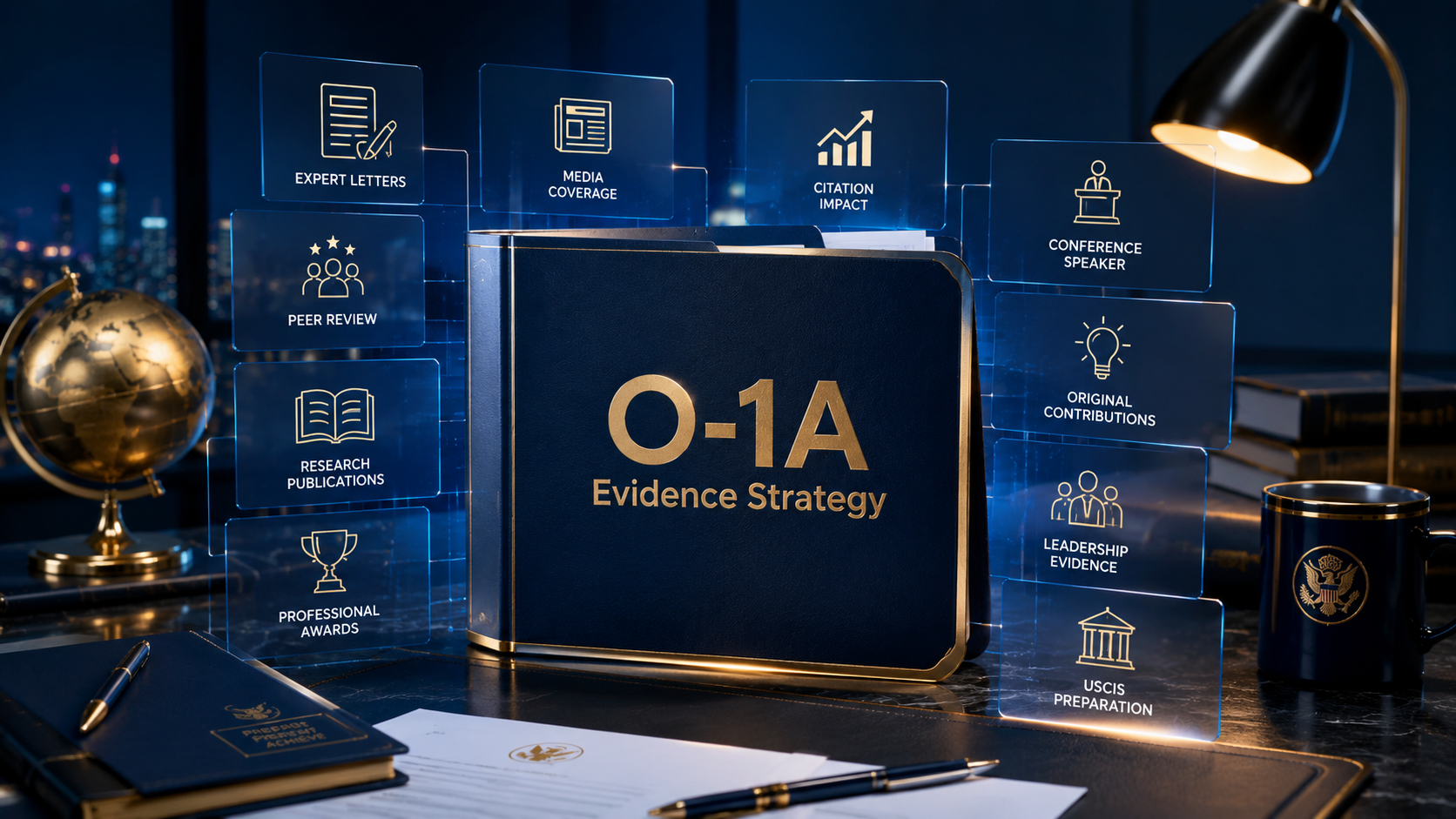
For many accomplished professionals, the O-1A visa can become an important part of a broader U.S. immigration portfolio. It is often discussed by founders, researchers, software engineers, AI professionals, healthcare innovators, product leaders, and executives who have achievements that go beyond ordinary employment. Yet one of the most common mistakes is treating an O-1A petition like an expanded resume. A resume may show employment history, but it rarely proves extraordinary ability, sustained recognition, or the kind of field-level credibility that immigration evidence needs to communicate. Some professions make that harder than others; we look separately at what this means for physicians and clinical researchers.
This article explains how applicants can think about O-1A evidence in a more strategic way. It is written from an immigration portfolio development perspective, not as legal advice. EB1 Mentor is not a law firm and does not provide legal representation. Instead, our work focuses on helping professionals strengthen the profile elements that are often used in O-1A, EB-1A, EB-1B, and EB2 NIW preparation: research publications, peer review, professional awards, media coverage, expert letters, recommendation letters, conference speaker opportunities, original contributions, leadership evidence, and long-term visibility planning. One procedural piece worth building into that strategy early is the consultation requirement itself, since it runs on someone else's timeline — see why an O-1A advisory opinion is not the same as a recommendation letter.
The goal is simple: to help highly accomplished professionals understand what makes O-1A evidence persuasive, what makes it weak, and how to build a stronger immigration portfolio before filing.
Why O-1A Strategy Requires More Than Career Success
Many strong professionals assume that a senior title, high salary, impressive company name, or long list of responsibilities will automatically translate into a strong O-1 visa profile. Those facts may help, but they are rarely enough on their own. Immigration evidence is not only about showing that someone is good at a job. It is about showing that the person has achieved recognition in the field and that the record contains objective proof of that recognition.
A software engineer may have built critical infrastructure, but the petition must explain why that work mattered beyond internal team execution. A researcher may have published papers, but the record should clarify citation impact, peer recognition, research visibility, and the importance of the work. A founder may have launched a product, but the evidence should connect business activity to innovation, market recognition, industry adoption, press coverage, awards, or expert validation. A healthcare professional may have led quality improvements, but the record should show measurable impact, professional leadership, and independent recognition.
That is why O-1A planning should start with a portfolio question: what evidence exists outside the applicant’s own statements that demonstrates distinction, influence, and recognition?
Understanding the Difference Between Resume Evidence and Immigration Evidence
A resume is usually written for hiring managers. It summarizes skills, responsibilities, and outcomes. Immigration evidence has a different purpose. It must help an evaluator understand why the applicant’s achievements are significant in a broader professional context.
Consider the difference between these two statements:
Resume-style statement: Led backend engineering for a cloud platform used by enterprise clients.
Immigration evidence statement: Led the architecture of a cloud platform that supported enterprise-scale deployment, reduced processing delays, and was later adopted across multiple business units; the significance of this work is supported by executive letters, product metrics, technical documentation, and external recognition from industry stakeholders.
The second version is not simply longer. It identifies ownership, measurable results, adoption, and independent support. That is the type of framing that can turn ordinary professional experience into meaningful immigration evidence.
Core Evidence Themes in a Strong O-1A Portfolio
Every case is different, and applicants should work with qualified immigration counsel for case-specific legal strategy. From a portfolio development perspective, however, strong O-1A preparation often involves several recurring evidence themes.
1. Recognition by Independent Experts
Expert letters can play an important role when they explain the applicant’s achievements with specificity. The strongest expert letters are not generic praise letters. They identify the expert’s own authority, explain how the expert knows the applicant’s work, describe why the applicant’s contributions matter, and connect those contributions to the field.
A weak letter says the applicant is talented, hardworking, and important to the employer. A stronger expert letter explains the technical, scientific, commercial, or professional significance of a specific contribution. It may also describe adoption, influence, originality, difficulty, or why comparable professionals would recognize the work as meaningful.
2. Publications and Research Visibility
For researchers, university faculty, AI professionals, healthcare specialists, data scientists, and technical professionals, research publications can become powerful evidence when they are positioned properly. But publication count alone is not always enough. The portfolio should explain where the work was published, how it has been cited, whether it influenced later research, and whether the applicant has developed a recognizable research direction.
Citation impact should be presented carefully. A citation number is more persuasive when it is contextualized: who cited the work, what kinds of institutions or researchers used it, whether the citing papers are in relevant fields, and whether the citation pattern shows meaningful influence. The same principle applies to conference papers, book chapters, patents, standards participation, or technical reports.
3. Peer Review and Judging
Peer review can support a record of professional recognition when it shows that the applicant has been trusted to evaluate the work of others. This may include journal peer review, conference program committee service, grant review, competition judging, fellowship evaluation, award judging, or technical review panels.
The quality and selectivity of the reviewing role matters. A single informal review may not carry the same weight as repeated review assignments for respected journals, conferences, professional societies, or competitive programs. Strong documentation may include invitation emails, completed review confirmations, reviewer dashboards, editorial acknowledgments, certificates, reviewer guidelines, and evidence showing the reputation of the venue.
4. Professional Awards and Distinctions
Award evidence is strongest when the award is selective, competitive, and relevant to the applicant’s field. Many applicants list certificates, internal recognitions, or participation badges as awards. Those may be useful background evidence, but they may not carry the same weight as professional awards judged by independent experts or issued by recognized organizations.
Useful award documentation may include selection criteria, number of nominees or applicants, judging process, biographies of judges, award announcement pages, press coverage, winner lists, and evidence showing the reputation of the awarding organization. The goal is to show not only that the applicant received an award, but also why the award matters.
5. Media Coverage and Public Recognition
Media coverage can be valuable when it is independent, credible, and focused on the applicant’s work or achievements. A short company press release may be less persuasive than an independent article discussing the applicant’s contribution, innovation, research, startup, product, or professional impact.
Strong media evidence should answer several questions: who published the article, why the publication is credible, whether the article is about the applicant rather than merely mentioning them, and whether the coverage reflects recognition in the field. For professionals in technology, research, healthcare, engineering, entrepreneurship, and business, media coverage should ideally connect to a broader narrative of influence.
How to Build an O-1A Evidence Map
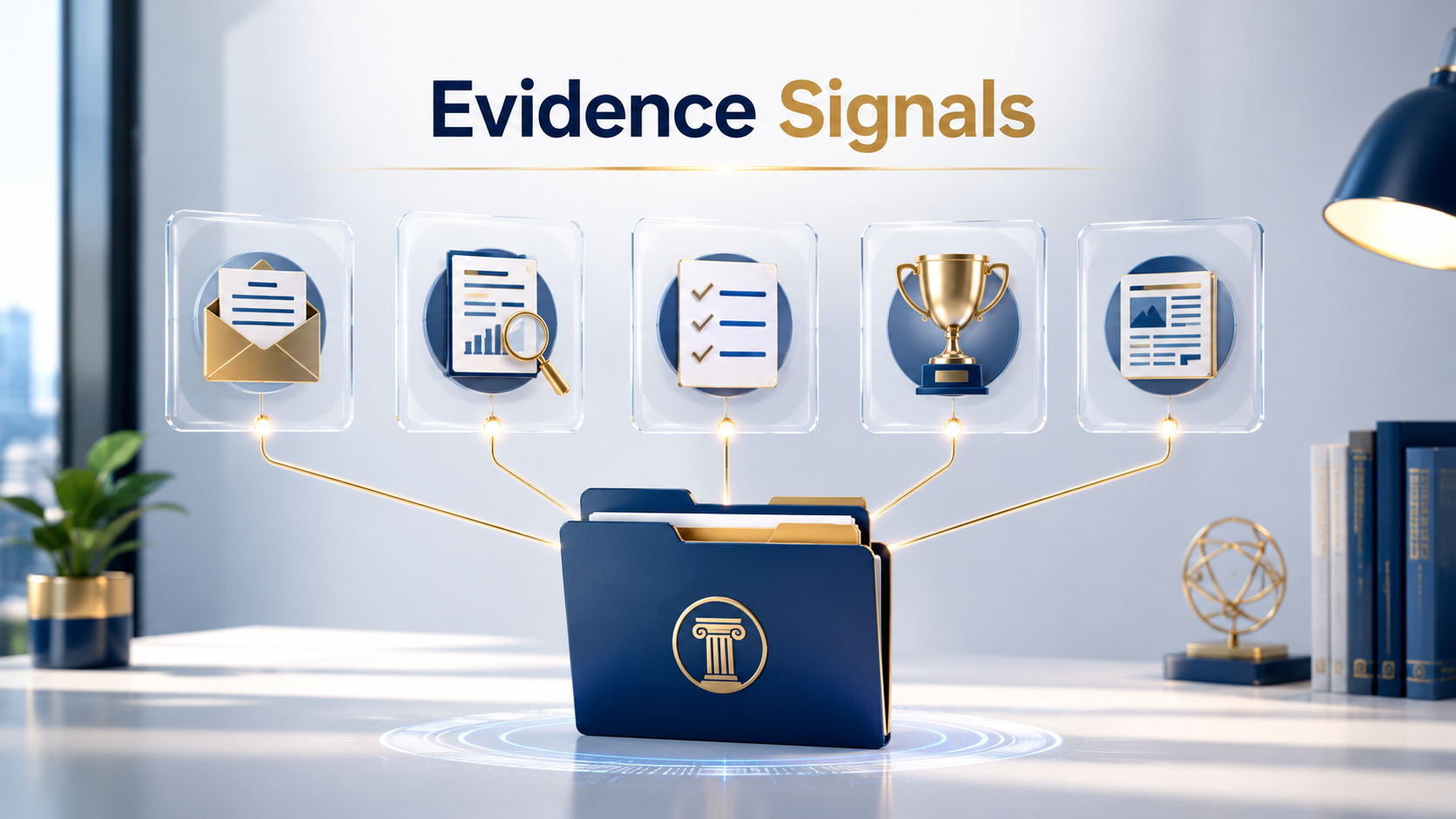
Before collecting documents randomly, applicants should build an evidence map. An evidence map is a structured view of the applicant’s achievements, supporting documents, weak areas, and future development priorities. It helps avoid a common problem: submitting many pages of documents without a clear story.
A strong evidence map usually includes the following categories:
- Achievement: What did the applicant accomplish?
- Field relevance: Why does this matter in the applicant’s profession or industry?
- Evidence source: Is the proof internal, external, independent, published, measurable, or testimonial?
- Recognition type: Does the evidence show awards, media, peer review, citations, leadership, original contributions, membership, high salary, or another form of distinction?
- Strength level: Is the evidence strong, moderate, weak, or only background support?
- Development gap: What could be improved before filing?
Example: Software Engineer Evidence Map
| Evidence Area | Weak Version | Stronger Version |
|---|---|---|
| Technical contribution | Worked on backend systems | Owned architecture for a high-scale system with measurable performance gains and executive confirmation |
| Recognition | Manager says applicant is excellent | Independent experts explain why the system is innovative and difficult |
| Visibility | Internal project only | Conference talk, technical article, open-source adoption, patent filing, or external media coverage |
| Judging | No review activity | Peer review, hackathon judging, technical committee service, or award judging |
Example: Researcher Evidence Map
| Evidence Area | Weak Version | Stronger Version |
|---|---|---|
| Publications | List of papers with no explanation | Research publications organized by theme, venue quality, citation impact, and field relevance |
| Citations | Total citation count only | Citation impact explained through citing authors, institutions, paper relevance, and influence on later work |
| Peer recognition | One generic recommendation letter | Expert letters from independent scholars explaining originality and significance |
| Service | Occasional review | Documented peer review for journals, conferences, or scientific programs |
Common O-1A Evidence Mistakes
Many applicants have strong careers but weak documentation. Others have good documentation but poor positioning. The following mistakes can reduce the persuasive value of an otherwise promising case.
Mistake 1: Submitting Too Much Without Explaining Significance
A large file is not automatically a strong file. USCIS review is not helped by hundreds of pages that do not clearly connect to the applicant’s achievements. The petition should help the reader understand what each document proves and why it matters.
Mistake 2: Relying Only on Employer Letters
Employer letters can be useful, especially for leadership and critical role evidence. But a record based only on internal praise may look like ordinary employment support. Independent expert letters, media coverage, peer review, awards, publications, and outside recognition can help create a more balanced record.
Mistake 3: Confusing Importance to a Company With Importance to a Field
An applicant may be very important to an employer, but O-1A strategy often benefits from showing broader professional recognition. Internal success should be connected to external signals such as adoption, publications, patents, industry discussion, conference speaker roles, expert validation, or measurable impact beyond a single team.
Mistake 4: Treating Recommendation Letters as Character References
Recommendation letters should not read like employment references. They should be evidence documents. The strongest letters discuss specific achievements, explain why those achievements are unusual or important, and identify the writer’s basis for evaluating the applicant’s work.
Mistake 5: Ignoring Portfolio Development Until the Last Minute
Many valuable evidence categories take time to build. Research visibility, peer review activity, conference speaking, media coverage, award strategy, professional memberships, and expert relationships rarely appear overnight. A stronger immigration portfolio is often the result of months of structured planning. These timelines are easier to see in practice; several worked examples trace what changed over eighteen months.
O-1A, EB-1A, EB-1B, and EB2 NIW: How the Portfolio Mindset Overlaps
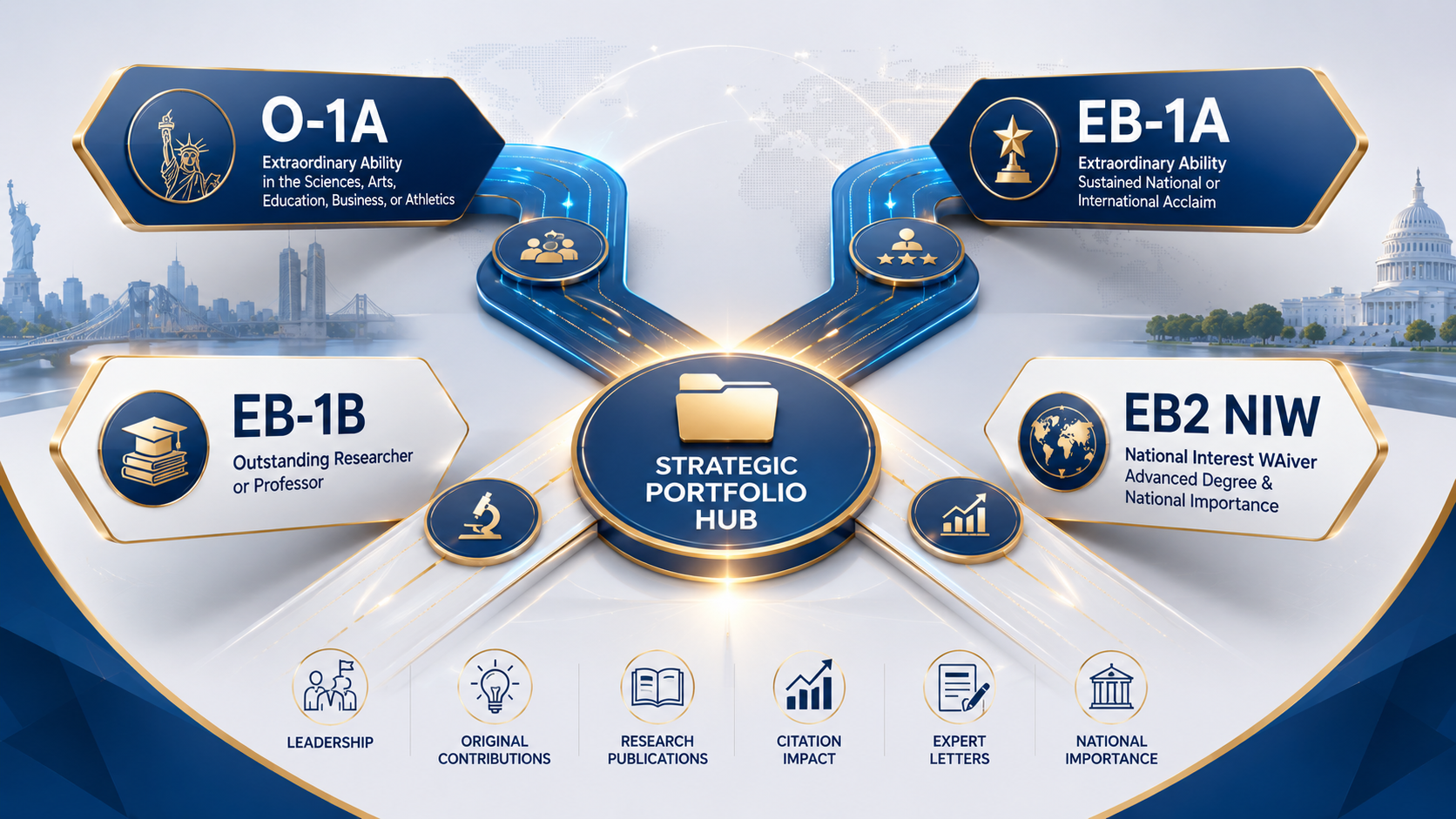
Although O-1A, EB-1A, EB-1B, and EB2 NIW are different immigration categories, portfolio development often overlaps. A professional who is preparing for an O-1 visa may also be building long-term evidence for an EB1 visa pathway. A researcher considering EB-1B may also benefit from better publication strategy, citation strategy, peer review documentation, and expert letters. An entrepreneur considering EB2 NIW may need to frame the national importance and practical impact of a proposed endeavor.
The key is not to assume that the same evidence should be presented the same way in every category. Instead, applicants should build a flexible evidence base that can support different strategies with the guidance of qualified immigration counsel.
| Category | Common Portfolio Focus | Development Priorities |
|---|---|---|
| O-1A | Recognition, distinction, and achievement in the field | Awards, media, expert letters, peer review, leadership, publications, original contributions |
| EB-1A | Sustained acclaim and extraordinary ability | Field-level impact, final merits strategy, independent recognition, citation impact, major contributions |
| EB-1B | Outstanding research or teaching record | Research publications, citations, peer review, academic recognition, institutional support |
| EB2 NIW | Proposed endeavor and national importance | Endeavor framing, practical impact, expert support, implementation record, future plan |
Building Evidence for Different Professional Profiles
Software Engineers and AI Professionals
Software engineers and AI professionals often have strong technical achievements that are not visible outside their companies. The challenge is to translate internal technical work into evidence that demonstrates innovation, leadership, and recognition. Useful documentation may include architecture diagrams, performance metrics, patent materials, open-source contributions, technical publications, conference presentations, expert letters, media coverage, and proof that the applicant’s work was adopted or relied upon by others.
For AI professionals, it is especially important to distinguish between using existing tools and making meaningful contributions. A stronger record may show model development, system architecture, measurable performance improvements, deployment at scale, research publications, peer review, or recognized thought leadership in applied AI.
Researchers and University Faculty
Researchers and faculty members should organize their portfolio around research themes, publication record, citation impact, invited talks, peer review activity, grants or awards where relevant, and independent evaluations from experts. A list of papers is only the starting point. The stronger strategy explains the importance of the research area, the applicant’s role in the work, and how the field has responded.
Healthcare Professionals
Healthcare professionals may build evidence through clinical innovation, research publications, quality improvement projects, leadership in professional societies, conference presentations, peer review, patient-care initiatives, awards, and expert letters. The key is to show measurable professional impact while being careful with privacy and documentation requirements.
Entrepreneurs and Startup Founders
Founders often have evidence in the form of company growth, product adoption, fundraising, patents, media coverage, awards, revenue, partnerships, customer traction, accelerators, and leadership recognition. However, business activity should not be presented as impact automatically. The portfolio should explain why the founder’s work is innovative, recognized, and important in the market or field.
Practical Checklist Before Filing an O-1A Petition
The following checklist can help applicants identify whether their evidence is ready for attorney review and case preparation:
- Do you have independent evidence of recognition beyond your employer?
- Can you clearly explain your most important original contributions?
- Do you have expert letters that discuss significance rather than generic praise?
- Are your publications organized by theme, venue, and impact?
- Have you documented citation impact in a meaningful way?
- Do you have proof of peer review, judging, or evaluation of others’ work?
- Are your awards supported by selection criteria and evidence of reputation?
- Does your media coverage focus on you or your work in a substantive way?
- Can you show leadership or critical role evidence with measurable results?
- Does your portfolio tell a coherent story of professional distinction?
How Expert Letters Should Be Planned
Expert letters are often most effective when planned early. The applicant should identify which achievements need explanation and which experts are best positioned to explain them. A letter from a famous person who does not know the work may be less useful than a detailed letter from a respected expert who can explain why the contribution matters.
Strong expert letters usually include:
- The expert’s credentials and authority in the field.
- The basis for knowing the applicant or the applicant’s work.
- A specific explanation of the applicant’s contribution.
- Why the contribution was difficult, original, influential, or important.
- Evidence of adoption, use, citation, implementation, or recognition.
- A clear connection between the applicant’s work and the broader field.
How to Make Conference Speaker Evidence Stronger
Being a conference speaker can support professional visibility, but the context matters. A stronger record explains whether the conference is selective, who attends, whether speakers are invited or peer-reviewed, and why the applicant was chosen. Evidence may include the invitation, agenda, speaker biography, event website, attendance information, photos, presentation slides, session description, and post-event coverage.
Conference evidence can also support a broader thought leadership strategy. For example, a researcher may use conference speaking to demonstrate visibility in a specialized field. A founder may use it to show recognition as an industry voice. A software engineer may use it to show technical authority beyond internal employment.
How Long-Term Portfolio Planning Helps
Some applicants are ready to file quickly because they already have a mature evidence record. Others need a structured development period. Long-term planning can help applicants improve areas that are currently thin, such as peer review, media coverage, awards, expert letters, citation strategy, or professional memberships.
A realistic portfolio plan may include a three-month, six-month, or twelve-month strategy depending on the applicant’s starting point. The purpose is not to manufacture achievements. The purpose is to identify real accomplishments and create opportunities for those accomplishments to be documented, recognized, and communicated properly.
Frequently Asked Questions About O-1A Evidence Strategy
1. Is a strong resume enough for an O-1A visa?
No. A strong resume can help organize the record, but O-1A preparation usually requires objective evidence of recognition, achievement, and distinction. The portfolio should include documents that prove significance, not only job history.
2. Can O-1A evidence also help with EB-1A later?
Sometimes, yes. Many evidence categories overlap, including awards, media coverage, peer review, publications, original contributions, leadership, and expert letters. However, EB-1A has its own legal standards and final merits analysis, so applicants should not assume that an O-1A record automatically satisfies EB-1A requirements.
3. Are expert letters the same as recommendation letters?
Not exactly. Recommendation letters often focus on character, work ethic, and professional reliability. Expert letters should focus on significance, originality, influence, and field relevance. In immigration evidence, specificity matters much more than general praise.
4. Do I need research publications for O-1A?
Not every O-1A profile is research-based. Entrepreneurs, executives, engineers, designers, healthcare professionals, and business leaders may use other evidence categories. However, research publications can be valuable when they are relevant to the applicant’s field and supported by citation impact or expert recognition.
5. Does media coverage need to be national?
Media coverage should be credible, independent, and substantively connected to the applicant’s work. The importance of a publication may depend on the field, audience, geography, and topic. Applicants should avoid relying only on promotional content with little independent editorial value.
6. Can internal company achievements support O-1A?
Yes, internal achievements may support the record, especially when they show leadership, critical role, original contributions, or measurable impact. But they are stronger when supported by objective documentation and independent recognition.
7. How many expert letters are needed?
There is no universal number that works for every case. Quality, relevance, independence, and specificity are more important than volume. A few detailed letters may be more useful than many generic letters.
8. Should I build peer review evidence before filing?
If peer review is relevant to your field, it can be a valuable part of the portfolio. Journal reviews, conference reviews, award judging, fellowship evaluation, and technical committee service may help demonstrate professional trust and recognition.
9. What is the biggest evidence mistake applicants make?
One of the biggest mistakes is submitting evidence without explaining why it matters. A document should not just be included; it should support a clear argument about recognition, distinction, impact, or professional authority.
10. Can EB1 Mentor prepare my legal petition?
No. EB1 Mentor is not a law firm and does not provide legal representation or legal advice. EB1 Mentor helps professionals strengthen their immigration portfolios through evidence development, profile strategy, documentation planning, publication strategy, peer review opportunities, expert letter support, media visibility, and related preparation services.
Conclusion: Strong O-1A Strategy Starts Before the Petition
A persuasive O-1A profile is rarely built by collecting documents at the last minute. It is built by understanding what the evidence must prove, identifying the strongest achievements, strengthening weak areas, and presenting a coherent record of professional recognition. Whether the applicant is a researcher, AI professional, software engineer, healthcare innovator, founder, executive, or faculty member, the same principle applies: the evidence should show why the applicant stands out in the field.
Every immigration case is unique. Professional guidance can help applicants build stronger portfolios, avoid common evidence mistakes, and prepare more clearly for attorney-led petition strategy. If you are planning an O-1 visa, EB-1A, EB-1B, or EB2 NIW pathway and want to strengthen your immigration evidence, you can contact EB1 Mentor here: Contact EB1 Mentor.
Build a Stronger Immigration Portfolio
Every immigration case is unique. EB1 Mentor is not a law firm and does not provide legal representation, but professional portfolio guidance can help accomplished applicants strengthen evidence for O-1A, EB-1A, EB-1B, and EB2 NIW preparation.