

Why Critical Role Evidence Matters
Critical role evidence can be one of the most powerful parts of an immigration portfolio because it connects a person’s work to real organizational, technical, scientific, business, or public impact. For EB-1A, O-1A, EB-1B, and even EB2 NIW strategy, the question is rarely whether the applicant worked hard. The stronger question is whether the applicant performed in a role that was genuinely important to a distinguished organization, project, product, research group, institution, or field-level initiative. That connection is hardest to draw in team-delivered work, where professional convention discourages individual attribution; a composite engineering case shows what it takes.
Many strong professionals misunderstand this category. They assume that a senior title, a well-known employer, or a long job description is enough. In reality, strong immigration evidence usually needs more than status. It needs context, proof, and a clear explanation of why the role was critical.
A software engineer may have worked on a platform used by millions of people. A researcher may have led a funded project that shaped a laboratory’s direction. A healthcare professional may have designed a clinical workflow adopted across a hospital network. An entrepreneur may have built technology that became central to a company’s revenue or operations. These stories can be meaningful, but only if they are documented correctly.
At EB1 Mentor, we often see applicants with impressive careers but underdeveloped evidence. Their achievements are real, but the portfolio does not explain them with enough precision. This article explains how to build critical role evidence in a way that is practical, credible, and aligned with a stronger immigration portfolio.
What Critical Role Evidence Usually Needs to Show
Critical role evidence is strongest when it answers three questions clearly:
- What was the organization, project, or initiative?
- Why was it important or distinguished?
- Why was the applicant’s role essential, influential, or unusually important?
The role should not be described only as a job. It should be positioned as a contribution within a larger structure. A title such as senior engineer, principal scientist, founder, director, product lead, or professor may help, but it does not prove criticality by itself. The evidence should show decision-making responsibility, technical ownership, leadership, measurable outcomes, dependence by others, or specialized expertise that made the applicant difficult to replace.
Practical rule: A critical role argument becomes stronger when the evidence shows both importance of the organization and importance of the person’s function inside that organization.
Critical Role Is Not the Same as Employment
One common mistake is submitting employment verification letters that simply confirm dates, salary, and job duties. These letters may be useful background documents, but they often do not prove critical role evidence. Immigration evidence should go further. It should explain what the applicant actually influenced and why the organization needed that influence.
For example, a weak statement says that the applicant worked as a machine learning engineer and developed models for internal products. A stronger statement explains that the applicant led the design of a fraud detection model that reduced false positives, improved review efficiency, supported a high-volume transaction system, and became part of the company’s core risk infrastructure.
The difference is not only writing style. It is evidentiary depth. The stronger version identifies the system, the function, the result, and the applicant’s ownership.

Where Critical Role Evidence Appears Across Immigration Strategies
EB-1A Extraordinary Ability
For EB-1A, critical role evidence may help show that the applicant has played a leading or critical role for organizations or establishments with a distinguished reputation. This can be especially valuable when combined with other evidence such as original contributions, peer review, research publications, conference speaker invitations, professional awards, media coverage, expert letters, and citation impact.
However, EB-1A strategy should not treat critical role evidence as isolated. It should support the broader final merits narrative: that the applicant is among a small percentage who have risen to the top of the field. This means the evidence should not only show internal job performance. It should show why the role reflects recognized expertise, unusual responsibility, or influence beyond ordinary employment.
O-1A Visa Strategy
For an O-1 visa strategy, critical role evidence can help demonstrate extraordinary ability in the sciences, education, business, athletics, or other qualifying fields. O-1A evidence often benefits from a clear project-based structure: what the applicant led, how selective or important the opportunity was, what results followed, and why the applicant was chosen. Founders face a distinct version of this challenge, since the organization itself is one they created — our dedicated guide on O-1A evidence strategy for startup founders looks at how critical-role evidence works when there is no independent employer to describe your role.
O-1A applicants should also be careful not to rely only on employer praise. Independent evidence, external recognition, press, awards, conference activity, patents, expert letters, and documentation of business or technical impact can make the portfolio more persuasive.
EB-2 NIW Endeavor Framing
EB2 NIW does not use the same framework as EB-1A or O-1A, but critical role evidence can still support the applicant’s broader story. If the applicant is proposing a national interest endeavor, evidence of prior leadership, essential technical work, implementation success, or organizational reliance can help show that the person is well positioned to advance the proposed endeavor. A composite account of exactly this problem, and how it was resolved after an RFE, is told in the story of an engineer whose critical role during a grid crisis became the center of her case.
For EB2 NIW, the role should be connected to future capacity. The portfolio should explain how past work demonstrates the applicant’s ability to continue creating value in the United States.
What Makes an Organization or Project Distinguished?
Critical role evidence often has two sides: the applicant’s role and the reputation or importance of the organization. A distinguished organization does not always need to be globally famous, but the portfolio should document why it matters.
Helpful evidence may include:
- Industry ranking, reputation, or market position
- Major clients, users, partners, or institutional stakeholders
- Funding, grants, revenue scale, or investment history
- Public recognition, awards, media coverage, or government partnerships
- Research output, citation influence, patents, or technology adoption
- Conference visibility, academic reputation, or professional society recognition
- Scale of operations, user base, infrastructure, or public impact
A startup can be distinguished if it has strong evidence of innovation, funding, adoption, patents, public recognition, or industry relevance. A university laboratory can be distinguished through publications, grants, citations, institutional reputation, and collaborations. A hospital department can be distinguished through specialized care, research programs, patient volume, or recognized clinical outcomes.
How to Prove the Applicant’s Role Was Critical
The strongest portfolios usually combine several types of proof. No single document has to do everything. Instead, the evidence should create a consistent picture.
1. Role Ownership
Show what the applicant owned. This might include a product module, research direction, clinical protocol, business unit, technical architecture, patent portfolio, strategic partnership, publication pipeline, or operational system. Ownership is stronger when it is specific.
2. Decision-Making Authority
Evidence should show whether the applicant made decisions that affected others. Did they approve technical designs? Lead a team? Set research priorities? Represent the organization externally? Train others? Influence product roadmap? Manage budgets or partnerships?
3. Measurable Impact
Numbers are powerful when accurate and documented. Examples include revenue influenced, users served, systems improved, processing time reduced, citations received, publications generated, patents filed, grants supported, costs reduced, quality improved, or adoption expanded.
4. Organizational Reliance
A role is more likely to appear critical when other people, teams, customers, researchers, or executives relied on the applicant’s work. Evidence can include internal documents, product launch records, project plans, letters from executives, client testimonials, technical documentation, or public announcements.
5. Specialized Expertise
Some roles are critical because the applicant had rare expertise. This should be explained clearly. The portfolio should not merely say the applicant is highly skilled. It should explain why the expertise was uncommon and why the organization needed it.
Weak vs Strong Critical Role Evidence
| Weak Evidence | Stronger Evidence |
|---|---|
| General job description | Specific explanation of project ownership and measurable outcomes |
| Letter saying the applicant was valuable | Letter explaining why the applicant was essential and difficult to replace |
| Company website only | Company reputation evidence, rankings, press, adoption, funding, or market data |
| Title without context | Title plus authority, leadership scope, decisions, and impact |
| Claims without documents | Claims supported by independent records, screenshots, reports, publications, or public evidence |
Examples by Professional Profile
Software Engineers and AI Professionals
A software engineer may build critical role evidence around architecture, scalability, AI systems, security infrastructure, platform reliability, product launches, or developer tools. A strong portfolio explains how the work affected users, revenue, engineering productivity, risk reduction, or technical direction.
For AI professionals, the evidence may include model deployment, automation systems, research publications, patents, data infrastructure, evaluation frameworks, conference speaker roles, and expert letters explaining technical originality. The key is to avoid vague language such as worked on AI. The portfolio should explain the model, system, adoption, and impact.
Researchers and University Faculty
Researchers can use critical role evidence from funded projects, laboratory leadership, collaborative research, citation impact, peer review, editorial roles, conference presentations, student supervision, patents, and original contributions. Strong evidence may show that the applicant led a research direction, created a method used by others, or played an essential role in a significant grant or scientific initiative.
Healthcare Professionals
Healthcare professionals may document leadership in clinical programs, specialized treatment workflows, patient care innovation, hospital committees, quality improvement projects, medical research, training programs, or public health initiatives. Strong evidence should clarify the institutional importance of the program and the applicant’s specific role.
Entrepreneurs and Startup Founders
Founders often have strong potential for critical role evidence, but the portfolio must be carefully structured. Simply founding a company is not enough. The evidence should show product-market importance, growth, funding, customer adoption, revenue, partnerships, media coverage, awards, patents, or industry influence. It should also show the founder’s direct role in strategy, technology, leadership, and execution.
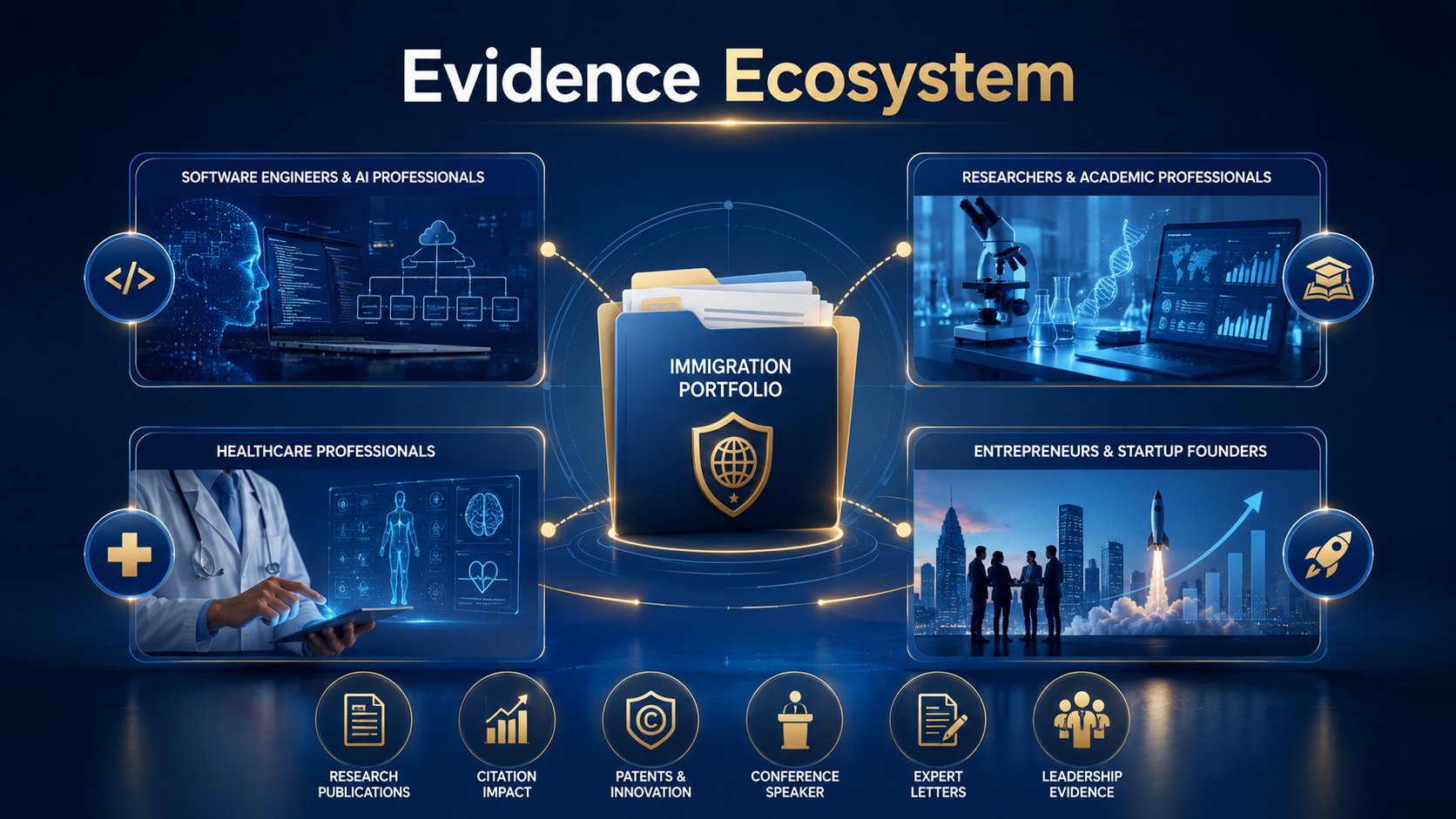
Documents That Can Support Critical Role Evidence
Useful documents may include:
- Detailed employer or executive letters
- Independent expert letters
- Organizational charts
- Project reports and launch records
- Product screenshots or public release notes
- Research publications and citation records
- Patent filings or invention disclosures
- Conference speaker pages
- Press coverage and media mentions
- Awards and professional recognition
- Customer, partner, or stakeholder letters
- Grant documents or funded project summaries
- Internal performance evidence when appropriate and permitted
The best evidence is specific, consistent, and credible. It should avoid exaggeration. Overstated claims can weaken a petition because they may sound promotional rather than evidentiary.
How Expert Letters Should Discuss Critical Role
Expert letters can be very useful, but they must be substantive. A strong expert letter does not simply praise the applicant. It explains the organization or project, the applicant’s responsibilities, why those responsibilities were important, what outcomes followed, and why the applicant’s work reflects unusual ability or influence.
When possible, letters should come from people who have enough authority to evaluate the role. This may include executives, principal investigators, senior technical leaders, department heads, external collaborators, clients, industry experts, or recognized academics. Independent letters may be especially helpful when they can explain broader significance beyond the employer’s internal perspective.
Common Mistakes to Avoid
Mistake 1: Submitting Generic Letters
Generic letters are one of the biggest problems in immigration evidence. Phrases such as outstanding professional, valuable team member, and excellent employee do not prove critical role by themselves. The letter should explain facts, not just adjectives.
Mistake 2: Focusing Only on the Company
A famous company does not automatically prove the applicant played a critical role. The evidence must connect the applicant to important work within that organization.
Mistake 3: Focusing Only on the Applicant
An impressive resume does not automatically prove that the organization was distinguished. The portfolio should document the organization’s reputation or the importance of the project.
Mistake 4: Using Numbers Without Support
Numbers can help, but unsupported numbers may create risk. Whenever possible, connect metrics to documents, screenshots, reports, public sources, or detailed letters.
Mistake 5: Ignoring the Final Merits Narrative
For EB-1A especially, meeting a criterion is not the end of the analysis. The evidence should also support the broader argument that the applicant has sustained acclaim and recognized expertise in the field.
A Practical Critical Role Evidence Checklist
- Identify the organization, project, product, or initiative.
- Document why it was important, distinguished, or influential.
- Explain the applicant’s exact responsibilities.
- Show decision-making authority or technical ownership.
- Provide measurable results where possible.
- Collect letters from people with direct knowledge.
- Include independent evidence when available.
- Connect the role to the applicant’s broader immigration portfolio.
- Remove vague claims and unsupported exaggeration.
- Make sure all evidence is consistent across the petition.
How Critical Role Evidence Connects With Other Criteria
Critical role evidence becomes stronger when it aligns with other parts of the portfolio. For example, if the applicant claims leadership in AI infrastructure, the portfolio may also include research publications, conference speaker invitations, peer review service, citation impact, patents, professional awards, and expert letters. If the applicant claims business leadership, the portfolio may also include media coverage, revenue impact, high salary evidence, professional memberships, and original contributions.
The goal is not to repeat the same claim in every section. The goal is to build a coherent picture. Each evidence category should support the same professional identity.
FAQ: Critical Role Evidence
1. Is a senior job title enough to prove critical role?
No. A senior title can help, but the evidence should explain what the applicant actually did, why the work mattered, and how the organization relied on the applicant.
2. Can a startup founder use critical role evidence?
Yes. Founders can often build strong evidence if they document company significance, product adoption, revenue, funding, awards, patents, media coverage, or market impact.
3. Does the organization have to be famous?
Not always. The organization should be documented as distinguished, important, specialized, innovative, or influential in a relevant way. Evidence matters more than assumptions.
4. Can internal company evidence be used?
Sometimes, if it is accurate, permitted, and appropriate. Public evidence and independent documentation are usually safer and more persuasive when available.
5. Are recommendation letters enough?
Usually not by themselves. Recommendation letters are stronger when supported by documents, metrics, public records, publications, press, patents, or project evidence.
6. How is an expert letter different from a recommendation letter?
A recommendation letter often discusses direct work experience with the applicant. An expert letter may evaluate the applicant’s work from a broader field perspective. Both should be factual and specific.
7. Can critical role evidence help with final merits?
Yes, especially when it shows that the applicant’s role reflects recognized expertise, sustained impact, leadership, or influence beyond ordinary employment.
8. Should critical role evidence include salary?
Salary can support a broader portfolio when relevant, but it is not a substitute for proving critical responsibilities and impact.
9. Can conference presentations support critical role?
They can support the broader narrative if they show that the applicant was selected to present important work, represent an organization, or share expertise with a professional audience.
10. What is the biggest warning for applicants?
Do not assume that impressive work is self-explanatory. Immigration evidence should guide the reader through the importance of the organization, the importance of the role, and the significance of the applicant’s impact.
Conclusion: Critical Role Evidence Requires Strategy, Not Just Documents
Strong critical role evidence is built through careful positioning. It is not simply a collection of employment letters or job descriptions. It is a structured explanation of why the applicant’s work mattered, why the organization or project was important, and why the applicant’s role was unusually significant.
For EB-1A, EB1 visa, O-1 visa, EB2 NIW, and other high-achievement immigration strategies, this category can help connect professional success to immigration evidence. But every immigration case is unique. The strongest portfolios are built with attention to timing, evidence quality, consistency, and long-term profile development.
If you are preparing an immigration portfolio and want help identifying stronger evidence opportunities, expert letters, recommendation letters, media coverage, conference speaker strategy, research visibility, peer review, professional awards, or original contributions, you can contact EB1 Mentor here: [https://eb1mentor.com/contact.php](https://eb1mentor.com/contact.php).
EB1 Mentor is not a law firm and does not provide legal representation. Our role is to help accomplished professionals build stronger, better organized, and more strategically presented immigration portfolios.
Build a Stronger Immigration Portfolio
Every immigration case is unique. Professional guidance can help applicants identify stronger evidence, organize achievements, and build a clearer long-term portfolio strategy.