
On this page
| Structure | Typical relationship | Core documentary focus | Frequent mismatch |
|---|---|---|---|
| U.S. employer | Petitioner directly employs beneficiary | Employer-beneficiary agreement and described activities | Outside work appears without explanation |
| Agent as employer | Agent employs and coordinates engagements | Agent terms plus complete activity itinerary | Agent role changes across documents |
| Agent for employers | Agent represents multiple actual employers | Authority, employer agreements, dates, and locations | Employers are unnamed or agreements are missing |
| Foreign employer through agent | Foreign employer uses U.S. filing agent | Foreign-employer terms and agent authority | Responsibility for U.S. work is unclear |
Begin with the relationship map
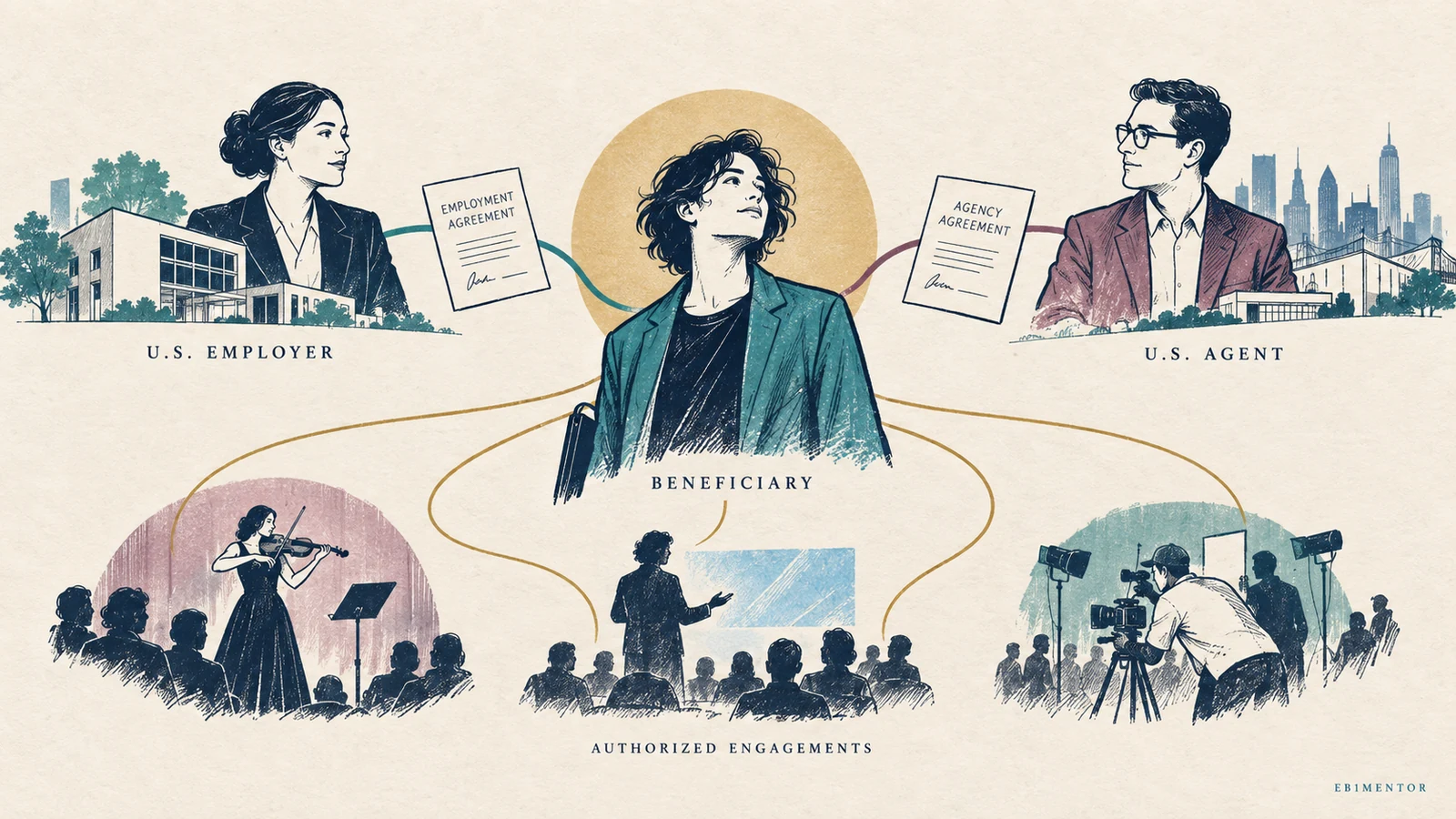
List the beneficiary, proposed petitioner, every actual employer or client, each venue or worksite, and the agreements connecting them. Then mark who controls the work, who pays, who schedules, who may modify duties, and who authorized the filing. This map often reveals the appropriate petitioner structure more accurately than starting with a preferred label.
Key takeaways
- Map every employer, engagement, and source of authority before selecting the petitioner.
- Match contract evidence to the precise agent scenario.
- Keep the I-129, O supplement, itinerary, and agreements consistent.
- Do not describe an intermediary as an employer if the facts show only representation.
Direct employer filing
A direct U.S. employer structure is comparatively linear when that entity will employ the beneficiary for the described event or activities. The record should still establish a genuine position, authorized signatory, terms of employment, requested period, locations, and duties in the area of extraordinary ability. Corporate existence alone does not explain the actual proposed work.
For direct employer filing, build a relationship record rather than a prose assumption. Identify each party, its role, authority, agreement, dates, and connection to the proposed work. Then compare that record with the forms and itinerary. Any role that changes from one document to another should be resolved before filing, because structural ambiguity can affect otherwise credible evidence. The section-level review for item 2 should end with a recorded decision: supported, limited, requires corroboration, or excluded.
Agent as actual employer
An agent may itself be the employer while also coordinating services involving other entities. In that model, the agreement between agent and beneficiary should identify wages and other terms, and the itinerary should make the additional work intelligible. Documents should not alternately describe outside entities as the sole employers and the agent as the sole employer without explaining the allocation of roles.
For agent as actual employer, build a relationship record rather than a prose assumption. Identify each party, its role, authority, agreement, dates, and connection to the proposed work. Then compare that record with the forms and itinerary. Any role that changes from one document to another should be resolved before filing, because structural ambiguity can affect otherwise credible evidence. The section-level review for item 3 should end with a recorded decision: supported, limited, requires corroboration, or excluded.
Agent representing multiple employers
When the agent represents both the beneficiary and multiple employers, the record should establish authority and include the contracts or summaries of oral agreements governing the beneficiary’s work for each employer. A complete itinerary identifies dates, actual employers, locations, and services. A list of prospective clients without documented engagements does not perform the same function.
- Every actual employer and engagement is identified.
- The petitioner’s authority is supported rather than assumed.
- Contract evidence matches the selected agent scenario.
- Dates, duties, compensation, and locations reconcile across the complete filing.
- The structure can be explained without changing the meaning of any agreement.
Foreign employer through a U.S. agent
A foreign employer may use a U.S. agent to file where the regulatory and documentary requirements are satisfied. The record should make the foreign employer relationship, the U.S. agent’s authority, the beneficiary’s terms, and the U.S. activities transparent. Avoid allowing corporate geography to obscure who is responsible for which promises in the petition.
For foreign employer through a u.s. agent, build a relationship record rather than a prose assumption. Identify each party, its role, authority, agreement, dates, and connection to the proposed work. Then compare that record with the forms and itinerary. Any role that changes from one document to another should be resolved before filing, because structural ambiguity can affect otherwise credible evidence. The section-level review for item 5 should end with a recorded decision: supported, limited, requires corroboration, or excluded.
Consistency is the central control
After selecting the structure, read the petition as if each document came from a different source. The petitioner name, employer names, compensation, dates, locations, duties, and authority should reconcile. When a relationship is complex, an explanatory chart can be useful, but the chart must summarize executed or otherwise credible evidence rather than replace it.
Consistency is the central control audit questions
For consistency is the central control, build a relationship record rather than a prose assumption. Identify each party, its role, authority, agreement, dates, and connection to the proposed work. Then compare that record with the forms and itinerary. Any role that changes from one document to another should be resolved before filing, because structural ambiguity can affect otherwise credible evidence. The section-level review for item 6 should end with a recorded decision: supported, limited, requires corroboration, or excluded.
Questions to resolve before relying on employer agent petitioner
- For begin with the relationship map, identify the controlling source, the precise fact established, the limitation that remains, and the decision owner. Record whether review item 1 is supported, needs corroboration, must be narrowed, or should be excluded before the final consistency check. Compare it with direct employer filing and explain which source controls if the two sections imply different roles, dates, duties, boundaries, or conclusions.
- For direct employer filing, identify the controlling source, the precise fact established, the limitation that remains, and the decision owner. Record whether review item 2 is supported, needs corroboration, must be narrowed, or should be excluded before the final consistency check. Compare it with agent as actual employer and explain which source controls if the two sections imply different roles, dates, duties, boundaries, or conclusions.
- For agent as actual employer, identify the controlling source, the precise fact established, the limitation that remains, and the decision owner. Record whether review item 3 is supported, needs corroboration, must be narrowed, or should be excluded before the final consistency check. Compare it with agent representing multiple employers and explain which source controls if the two sections imply different roles, dates, duties, boundaries, or conclusions.
- For agent representing multiple employers, identify the controlling source, the precise fact established, the limitation that remains, and the decision owner. Record whether review item 4 is supported, needs corroboration, must be narrowed, or should be excluded before the final consistency check. Compare it with foreign employer through a u.s. agent and explain which source controls if the two sections imply different roles, dates, duties, boundaries, or conclusions.
- For foreign employer through a u.s. agent, identify the controlling source, the precise fact established, the limitation that remains, and the decision owner. Record whether review item 5 is supported, needs corroboration, must be narrowed, or should be excluded before the final consistency check. Compare it with consistency is the central control and explain which source controls if the two sections imply different roles, dates, duties, boundaries, or conclusions.
- For consistency is the central control, identify the controlling source, the precise fact established, the limitation that remains, and the decision owner. Record whether review item 6 is supported, needs corroboration, must be narrowed, or should be excluded before the final consistency check. Compare it with begin with the relationship map and explain which source controls if the two sections imply different roles, dates, duties, boundaries, or conclusions.
The completed review should leave an auditable explanation of u.s. employers, agents, and other o-1a petitioner structures. A second reader should be able to reconstruct the petitioner structure, proposed-work facts, evidence source, and editorial decision without relying on undocumented assumptions. Test the analysis once from the perspective of a form reviewer, once from the perspective of the contracting parties, and once from the perspective of an independent field reader. Those reviews answer different questions and may expose different gaps. Where official forms, instructions, regulations, or policy guidance have changed, the current official version controls; the article framework should be updated rather than used as a substitute for current requirements.
For a broader foundation supporting U.S. Employers, Agents, and Other O-1A Petitioner Structures, continue with o1a petition structure. Use that article to verify the surrounding classification context before applying this topic-specific framework.
For the next cross-check within U.S. Employers, Agents, and Other O-1A Petitioner Structures, compare this analysis with o1a agent multiple employers. The linked guide addresses a different evidentiary function and should not be treated as a substitute for the present record.
Sources and further reading
- 8 CFR 214.2(o), O Classification RequirementsElectronic Code of Federal Regulations
Controlling regulatory provisions for O classification, petition documentation, agents, consultations, events, and validity.
- USCIS Policy Manual, Volume 2, Part M, Chapter 3 - PetitionersUSCIS
USCIS guidance concerning eligible O petitioners and agent filing structures.
- USCIS Policy Manual, Volume 2, Part M, Chapter 4 - O-1 BeneficiariesUSCIS
USCIS guidance on O-1A eligibility, evidence, totality review, and work in the area of ability.
- Form I-129, Petition for a Nonimmigrant WorkerUSCIS
Current USCIS form page and filing resources for Form I-129.
- Instructions for Form I-129, Petition for a Nonimmigrant WorkerUSCIS
Official filing instructions addressing petitioners, agents, multiple locations, and required supplements.
Frequently asked questions
Can an O-1A beneficiary self-petition?
O-1 classification requires an eligible petitioner. A beneficiary-owned entity may sometimes petition, but that remains an entity-filed petition and the facts must support the structure.
Can one agent petition cover multiple employers?
Certain agent filings may involve multiple employers when the applicable requirements, authority, contracts, and complete itinerary are documented.
Does calling a company an agent make it one?
No. The actual relationships, business role, authority, agreements, and proposed work must support the asserted filing structure.
Why does the itinerary matter to petitioner structure?
It identifies the services, employers, dates, and locations that allow USCIS to understand the scope of an agent or multi-engagement filing.
Public update history
Initial publication with current official-source review and topic-specific evidence organization.
Contributors and review roles
Author
EB1 Mentor Editorial Team
Immigration evidence education team · EB1 Mentor
Prepares source-aware educational guides about extraordinary-ability immigration categories and evidence organization. The material is general information, not legal advice.