
On this page
Classification checkpoints
- NIW is a waiver request within EB-2; the underlying EB-2 classification must be established first.
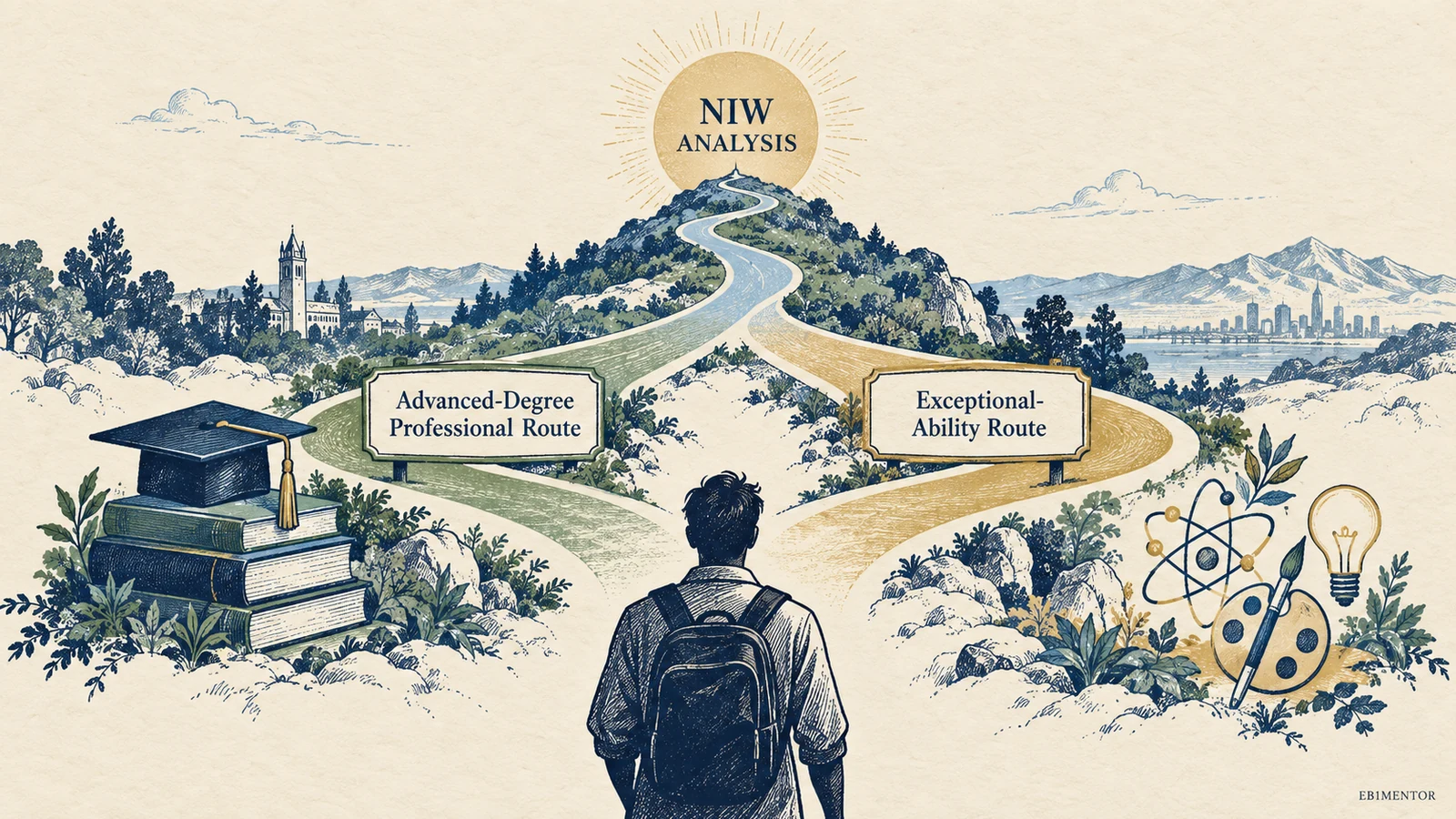
- The two principal underlying routes are advanced-degree professional and exceptional ability in the sciences, arts, or business.
- Degree equivalency, progressive experience, profession, specialty, and relationship to the proposed endeavor require separate proof.
- Exceptional ability requires the regulatory evidence threshold and a final showing of expertise significantly above that ordinarily encountered.
Start with a two-gate eligibility decision
A national interest waiver does not replace the underlying employment-based second-preference classification. The first gate asks whether the person qualifies for EB-2 as an advanced-degree professional or as an individual of exceptional ability in the sciences, arts, or business. Only after that classification is established does the waiver analysis ask whether the job-offer and labor-certification requirements should be waived in the national interest. A strong file labels these gates separately so evidence of national importance is not used to conceal a missing degree, profession, specialty, or exceptional-ability element.
| Route | Core question | Evidence center | Frequent mismatch |
|---|---|---|---|
| Advanced-degree professional | Does the person hold the qualifying degree, and is the proposed occupation a profession connected to the specialty? | Degrees, equivalency, transcripts, experience and occupation records | A degree is shown without connecting specialty and proposed occupation |
| Bachelor plus progressive experience | Is there a U.S. bachelor or foreign equivalent followed by at least five years of progressive specialty experience? | Degree equivalency and detailed post-degree experience letters | Experience predates the degree or does not show progression |
| Exceptional ability | Does the evidence satisfy the regulatory route and demonstrate expertise significantly above the ordinary level? | Criterion records plus a final ability synthesis | Three documents are counted without the required overall showing |
Decision branch A: advanced-degree professional
Begin with the credential itself. Record the institution, country, field, degree level, attendance dates, award date, and documents establishing completion. For a foreign credential, use a reliable equivalency analysis that identifies the underlying academic records and the U.S. degree compared. Do not convert a combination of partial studies, certificates, or experience into a foreign-equivalent bachelor unless the governing standard and evidence support that conclusion. If the credential title is unfamiliar, explain its academic level and entry requirements rather than relying on translation alone.
Next test whether the proposed occupation is a profession and whether the qualifying degree or experience is in the relevant specialty. The January 2025 USCIS guidance emphasizes the underlying relationship rather than treating any advanced degree as portable to any endeavor. Define the occupation from the actual proposed work, not a convenient broad label. Explain why entry into that occupation normally requires at least a bachelor degree or why it otherwise falls within the statutory profession concept, and connect the field of study to the knowledge used in the endeavor.
The occupation and specialty analysis should be built around a precise description of future work. Use Defining the Proposed Endeavor With Specificity and Credible Scope to prevent the underlying classification from being analyzed against an abstract career label.
Decision branch B: bachelor plus five progressive years
Degree completion
Confirm the qualifying U.S. bachelor or single foreign-equivalent degree and its award date.
Post-degree starting point
Exclude experience that does not follow the qualifying baccalaureate for this equivalency route.
Specialty alignment
Map duties and knowledge to the specialty relevant to the proposed occupation.
Progression
Show increasing responsibility, complexity, knowledge, authority, or scope across at least five years.
Endeavor connection
Explain how the resulting advanced expertise will be used in the proposed endeavor.
Experience letters should do more than verify dates and titles. They should identify full- or part-time status, major duties, technical or professional subject matter, progression, and the writer's basis of knowledge. Reconcile overlapping employment and convert part-time periods cautiously. A sequence of jobs is not necessarily progressive; progression may appear through more complex assignments, greater independent judgment, leadership, deeper specialization, larger scope, or responsibility for consequential results. Create a dated progression map and tie each claimed development to contemporaneous records.
Decision branch C: exceptional ability
Exceptional ability is a distinct route, not a lesser version of the advanced-degree path. The regulation describes exceptional ability as expertise significantly above that ordinarily encountered in the sciences, arts, or business and provides categories of evidence. Build one file for the initial evidentiary showing and a second synthesis explaining why the complete record establishes the required level. Evidence may include academic records, experience, licensure, remuneration, professional memberships, recognition, and comparable evidence when the listed categories do not readily apply, but each item must be analyzed rather than merely counted.
| Evidence family | Verification question | Context question |
|---|---|---|
| Academic record | What degree, diploma, certificate, or similar award relates to the area? | How does it reflect relevant expertise? |
| Experience | What letters establish at least the claimed period and duties? | Does the work demonstrate depth beyond ordinary practice? |
| License or certification | What authority issued it and what does it permit? | Is it selective or routine for entry? |
| Remuneration | What was paid and how is it verified? | Is the comparison group appropriate? |
| Professional membership | What exact membership and admission rules apply? | What does membership show about expertise? |
| Recognition | Who recognized achievements and on what basis? | Is the recognition independent and field-relevant? |
The exceptional-ability conclusion should identify the relevant comparison baseline and explain why the verified expertise is significantly above what is ordinarily encountered. Avoid transferring acclaim concepts from EB-1A or O-1A without examining the EB-2 standard. At the same time, do not assume that meeting a minimum number of regulatory evidence categories automatically completes the classification. Address quality, relevance, timing, independence, and relationship to the proposed endeavor.
Run a cross-gate consistency audit
- The selected underlying route is stated consistently throughout the petition.
- Degree level and foreign equivalency are supported by complete academic records.
- The proposed occupation is defined from actual future work.
- The degree specialty or exceptional ability relates to the proposed endeavor.
- Bachelor-plus-five experience follows the qualifying degree and demonstrates progression.
- Exceptional-ability evidence is synthesized beyond a document count.
- Names, dates, employers, duties, and fields reconcile across forms and exhibits.
- The NIW prongs are analyzed only after the underlying classification is established.
A final eligibility memorandum should state the chosen route, list every element, cite the best source for each fact, and identify unresolved limitations. If both underlying routes are presented, keep their facts and conclusions separate instead of creating a hybrid. Then carry forward only the verified occupation, specialty, expertise, and endeavor description into the Dhanasar analysis. This sequencing makes the full petition easier to audit and prevents evidence prepared for one question from being treated as proof of another.
Resolve difficult underlying-classification records
Credential records can become difficult when institutions merged, transcripts use unfamiliar grading systems, degree names changed, or documents are unavailable. Build a provenance log showing each institution, issuing authority, original record, translation, equivalency source, and verification attempt. A credential evaluation should explain its methodology and should not silently add together education and experience when the claimed regulatory route requires a single foreign-equivalent degree. If evidence is incomplete, identify the gap rather than converting an evaluator's conclusion into missing primary documentation.
Progressive experience should be reviewed duty by duty. Create a matrix with dates, hours, employer, supervisor, core specialty, complexity, independence, leadership, and outcome. Look for genuine development rather than title inflation. A person can progress within one employer or across employers, and a senior title can still involve repetitive duties. Letters written years later should identify the writer's role and source of knowledge; payroll, promotion, project, and performance records can corroborate the chronology. Resolve gaps, overlaps, part-time periods, and experience obtained before the qualifying degree.
For exceptional ability, test comparable evidence with the same discipline used for listed categories. State which listed criterion does not readily apply to the occupation, why, what alternative record is offered, and what evidentiary function makes it comparable. Do not use comparable evidence merely because the listed evidence is unavailable or weak. Then integrate all established evidence into a final comparison with ordinary expertise in the field, using a defined baseline and reliable context rather than adjectives such as exceptional or elite.
Finally, connect the underlying qualification to the proposed endeavor. Identify the degree specialty, advanced knowledge, or exceptional ability actually used by the planned activities. If the endeavor crosses disciplines, explain the bridge through coursework, research, experience, outputs, or other evidence. Do not assume that success in one business or technical setting proves qualification for a materially different occupation. This relationship should be consistent in the petition classification, endeavor definition, support letters, and future-work plan.
Sources and further reading
- USCIS Policy Manual, Volume 6, Part F, Chapter 5 - Advanced Degree or Exceptional AbilityUSCIS
Current USCIS guidance on underlying EB-2 eligibility and national interest waivers.
- Policy Alert: Second Preference Eligibility for National Interest Waiver PetitionsUSCIS
January 2025 USCIS clarification of underlying EB-2 and NIW analysis.
- Matter of Dhanasar, 26 I&N Dec. 884 (AAO 2016)USCIS Administrative Appeals Office
Precedent decision establishing the current three-prong NIW framework.
- 8 CFR 204.5(k), Members of the Professions Holding Advanced Degrees or Persons of Exceptional AbilityElectronic Code of Federal Regulations
Regulatory definitions and evidentiary provisions for EB-2 classification.
- Employment-Based Immigration: Second Preference EB-2USCIS
USCIS public overview of EB-2 and NIW eligibility.
- Form I-140, Immigrant Petition for Alien WorkersUSCIS
Current USCIS Form I-140 filing page and instructions.
Frequently asked questions
Can an advanced degree be in any field?
The record should connect the qualifying degree or specialty to the proposed occupation and endeavor; an unrelated degree should not be assumed sufficient.
Does five years of experience replace any missing degree?
The bachelor-plus-five route has specific degree and progressive post-degree experience requirements. Experience should not be used as an unrestricted substitute.
Is meeting three exceptional-ability evidence categories enough?
The initial evidence threshold and the overall exceptional-ability showing should both be addressed.
Can both underlying routes be presented?
Potentially, but each route should be established independently rather than blended into a hybrid standard.
Public update history
Initial publication with current official-source review and a topic-specific NIW evidence framework.
Contributors and review roles
Author
EB1 Mentor Editorial Team
Immigration evidence education team · EB1 Mentor
Prepares source-aware educational guides about extraordinary-ability immigration categories and evidence organization. The material is general information, not legal advice.