
On this page
- EB-1A Case Architecture: From Threshold Criteria to Final Merits
- Design from the governing framework
- Create criterion modules
- Build a separate final-merits synthesis
- Cross-reference without double counting
- Create a navigable exhibit system
- Draft from verified facts
- Use independent review gates
- Build an evidence map for eb-1a case architecture: from threshold criteria to final merits
- Choose comparisons that fit the field and the claim
- Use letters for explanation, not substitution
- Control timing, chronology, and consistency
- Maintain a source and citation log
- Complete a claim-by-claim quality review
Key takeaways
- Case architecture should follow the governing framework rather than the order in which documents were collected.
- Separate classification-wide requirements, criterion findings, and final-merits synthesis.
- Use evidence once as a source of fact and cross-reference its distinct relevance without duplicating or double counting.
- Stable exhibit identifiers, page citations, source logs, and chronology make the record reviewable.
- Quality control should test legal elements, factual consistency, source reliability, accessibility, and filing instructions.
EB-1A Case Architecture: From Threshold Criteria to Final Merits
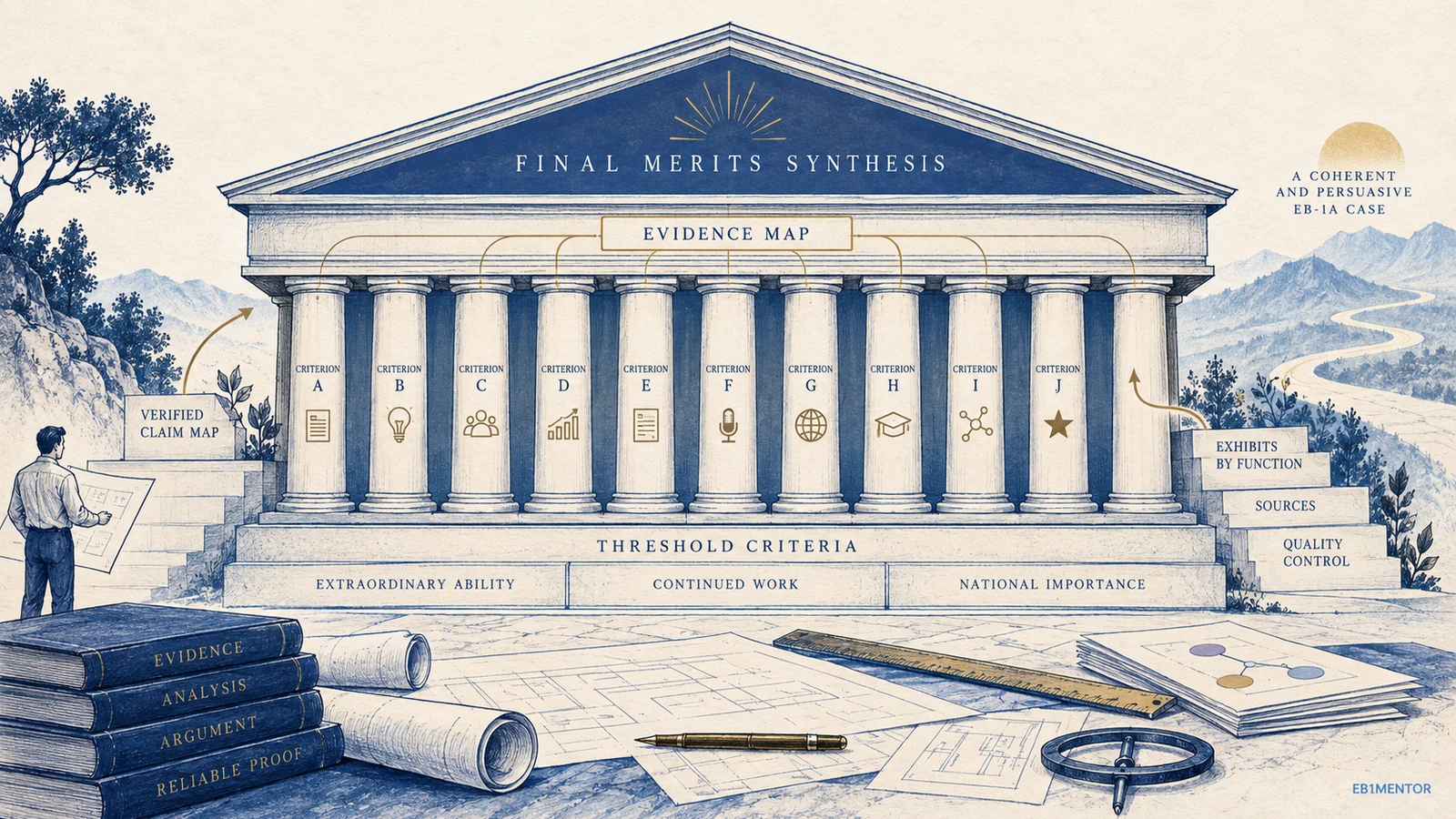
A coherent EB-1A case architecture separates classification-wide requirements, individual criterion modules, and final-merits synthesis while allowing evidence to be cross-referenced accurately. Start with a verified claim map, organize exhibits by evidentiary function, and make every material conclusion traceable to reliable proof.
Read this topic alongside the EB-1A extraordinary ability overview, which explains the classification-wide framework and the relationship between initial evidence and the complete eligibility analysis.
Design from the governing framework
Begin with the classification definition, evidentiary route, potentially applicable criteria, final-merits standard, intended continued work, and prospective U.S. benefit. Turn each requirement into a question the record must answer. Do not begin with a folder of awards, articles, and letters and then search for headings under which to place them. Framework-first design reveals unsupported elements and prevents document volume from controlling the theory.
Create criterion modules
Each criterion module should state the exact elements, identify the material facts, present primary proof, add source and field context, address limitations, and explain why the evidence satisfies that criterion. Use a consistent module structure without forcing every criterion into identical prose. Awards require selection and recognition context; contributions require originality and major significance; remuneration requires a valid comparison; critical roles require role evidence and distinguished reputation.
Build a separate final-merits synthesis
After the criterion analysis, evaluate what the established facts collectively show about sustained acclaim, independent recognition, influence, continuity, and relative standing. Do not copy the criterion conclusions into a final section and call it synthesis. Identify patterns and connections, acknowledge shared underlying achievements, and explain the evidentiary weight of the strongest independent and comparative records.
Cross-reference without double counting
One record may have several legitimate uses. A contribution may lead to media coverage, an award, judging invitations, and a critical role. Cite the same source where relevant and explain each distinct proposition, but recognize the common cause when evaluating overall weight. Duplicating the exhibit or describing each consequence as an unrelated achievement can make the record appear inflated and harder to review.
Create a navigable exhibit system
Use stable exhibit numbers, descriptive titles, issuing source, date, and page ranges. Group records by function: primary proof, selection or reputation context, independent impact, comparisons, and testimony. Provide complete translations and readable scans. Bookmark large electronic records when supported. Every material proposition should cite an exact exhibit and page rather than directing the reader to hundreds of pages.
Draft from verified facts
Maintain a claim ledger containing the approved statement, source, citation, owner, and status. Draft only after central facts are reconciled. If a strong phrase cannot be tied to proof, narrow or remove it. Use technical explanations where needed, but define specialized terms. Avoid unnecessary repetition, marketing language, outcome predictions, and unsupported descriptions such as world-renowned, groundbreaking, or unparalleled.
Use independent review gates
Run an element review, final-merits review, chronology review, source audit, translation review, form consistency review, and usability review. Different reviewers or separate passes reduce confirmation bias. Freeze exhibit numbering before the final citation check. Confirm current form editions, instructions, fees, filing location, signatures, and page limitations through official USCIS sources immediately before filing.
Build an evidence map for eb-1a case architecture: from threshold criteria to final merits
Create a claim table before drafting. For each proposition, record the governing element, the exact fact asserted, the primary record, independent context, any witness explanation, the relevant date, and the exhibit location. State claims no more broadly than the evidence permits. This method separates a document that proves an event occurred from material that explains selectivity, reputation, scale, influence, or comparative standing. It also exposes situations in which several documents repeat the same assertion without independently establishing it.
Test reliability as well as relevance. Record who created each document, when it was created, how the source obtained the information, whether the source is affiliated with the beneficiary, and what limitations affect the evidence. Preserve complete pages, methodology, definitions, footnotes, and access dates when using online records or datasets. A polished screenshot with no publisher, date, or context may be less useful than an ordinary record whose origin and meaning can be verified.
Choose comparisons that fit the field and the claim
Comparative evidence should identify the population, discipline or occupation, geography, seniority, time period, unit of measurement, data source, methodology, and important limitations. Avoid comparing unlike compensation components, citation patterns across unrelated disciplines, local performance with global rankings, or an internal title with field-wide standing without a reasoned bridge. If several benchmarks exist, explain why the selected comparison is relevant rather than choosing only the most favorable figure.
Field context should come from sources capable of explaining the issue. Depending on the claim, that may include official selection rules, professional standards, government data, recognized surveys, independent adoption records, licensing or commercialization records, documented citations, media records, or evidence from unaffiliated organizations. Independence does not make a source automatically persuasive, and affiliation does not make it useless; disclose the relationship and evaluate the source's actual knowledge.
Use letters for explanation, not substitution
Plan testimonial letters after identifying a specific explanatory need. The writer should describe qualifications, relationship to the beneficiary, basis of knowledge, concrete facts, and the records that support those facts. Strong letters distinguish the beneficiary's individual work from team or employer achievements and explain significance in terms recognized by the field. Multiple letters using the same structure and adjectives usually add less than distinct accounts grounded in first-hand knowledge and corroborating evidence.
For related evidence-development methods, use the EB-1A evidence-planning and exhibit guide. Cross-references should help a reader understand why evidence matters; they should not replace the classification-specific analysis on this page.
Control timing, chronology, and consistency
Build a dated chronology of education, roles, projects, recognition, publications, judging, compensation, and proposed work. Eligibility generally must be established under the facts and requirements applicable at filing, so distinguish evidence created later to document an earlier fact from an achievement that occurred later. Reconcile dates, names, titles, locations, organizations, metrics, and role descriptions across forms, letters, exhibits, translations, public profiles, and the petition narrative. Material differences should be corrected or accurately explained, not silently edited away.
Run separate reviews by legal element, chronology, source quality, and final-merits value. A document can satisfy an initial criterion yet carry limited weight in the overall analysis; another document may not independently satisfy a criterion but may provide important context. Keeping those functions distinct helps prevent double counting and unsupported conclusions while allowing the record to be evaluated as a coherent whole.
Maintain a source and citation log
For every legal or factual source, record a stable identifier, title, publisher, URL, publication or effective date when available, access date, relevant passage, and the proposition supported. Distinguish statutes and regulations, current USCIS policy, form instructions, precedent or adopted decisions, non-precedent decisions, government data, and secondary commentary. Verify current versions before filing and do not describe a non-precedent outcome as a binding rule for unrelated cases.
The extraordinary ability research-sources guide provides a fuller source hierarchy. Its method is especially useful when a phrase in policy, a decision, and a factual exhibit appear to address similar ideas but have different authority and evidentiary functions.
Complete a claim-by-claim quality review
- Each material claim is tied to the correct legal element and to a specific, readable exhibit page.
- Dates, names, titles, amounts, percentages, rankings, citations, and counts match the underlying source or are accurately qualified.
- The beneficiary’s individual contribution is separated from the achievements of a team, employer, laboratory, client, or organization.
- Affiliations, sponsorships, commercial relationships, and source limitations are disclosed rather than hidden behind an independence label.
- Translations are complete and consistent, and online evidence retains publisher, date, URL, methodology, and surrounding context.
- The threshold-criteria analysis and final-merits analysis are both addressed without treating criterion counting as automatic approval.
Ask a reviewer who did not collect the evidence to locate the support for several central claims using only the narrative, citations, and index. If the reviewer must infer which page matters, decode unexplained acronyms, or reconcile conflicting descriptions, improve the record before filing. Good organization cannot create eligibility, but it makes reliable evidence easier to evaluate and weak or unsupported assertions easier to correct.
Use the ten evidentiary criteria guide to test each claimed element against the exact regulatory language and the evidence actually available.
Then review the final-merits guide to evaluate what the established evidence shows in the record as a whole. These internal guides are educational tools, not outcome predictions.
Sources and further reading
- USCIS Policy Manual, Volume 6, Part F, Chapter 2USCIS
USCIS guidance on EB-1 extraordinary ability requirements, evidence, and final-merits analysis.
- 8 CFR 204.5(h), Aliens with Extraordinary AbilityElectronic Code of Federal Regulations
Current regulatory text for EB-1 extraordinary ability.
- Instructions for Form I-140, Immigrant Petition for Alien WorkersUSCIS
Official Form I-140 filing and initial-evidence instructions.
- Form I-140, Immigrant Petition for Alien WorkersUSCIS
Current USCIS form page, editions, alerts, and filing information.
Frequently asked questions
Should a petition follow the order documents were collected?
No. It should follow the governing requirements and a coherent evidence theory, with documents organized by evidentiary function.
Should the same exhibit be duplicated under every criterion?
Usually cross-reference a stable exhibit when it has several legitimate uses, and explain its distinct relevance in each section.
Is final merits just a summary of the three criteria?
No. It evaluates whether the complete record establishes sustained acclaim and top-of-field standing.
Is a longer petition necessarily stronger?
No. Relevance, reliability, completeness, navigation, and accurate analysis matter more than page count.
Public update history
Initial publication of EB-1A Case Architecture: From Threshold Criteria to Final Merits.
Contributors and review roles
Author
EB1 Mentor Editorial Team
Immigration evidence education team · EB1 Mentor
Prepares source-aware educational guides about extraordinary-ability immigration categories and evidence organization. The material is general information, not legal advice.