
On this page
- Selectivity and venue reputation require different evidence
- Explain how artists were selected
- Document the venue independently
- Show the beneficiary’s place in the display
- Use a series without repetition
- Test curatorial review, acceptance, participation, and institutional standing
- Reconstruct how the artist and work were selected
- Records that prove curatorial authority and venue reputation
- Exhibition-prestige claims that rely on appearance alone
- Comparing juried selection, invitation, rental, and open access
- What selective exhibition evidence adds at final merits
- Exhibition selectivity and reputation checklist
- Questions to answer about curation and artistic standing
Key takeaways
- Exhibition evidence is more useful when the selection process and venue reputation can be understood. Build a record that distinguishes curated recognition from an open listing or paid display and identifies the artist’s work precisely.
- The analysis must separately address selectivity, curatorial review, and independent evidence of the exhibition or showcase standing.
- A strong record combines open-call, invitation, or submission rules with submission and acceptance data when available.
- The record should avoid this recurring error: rental access is described as curatorial selection.
Selectivity and venue reputation require different evidence
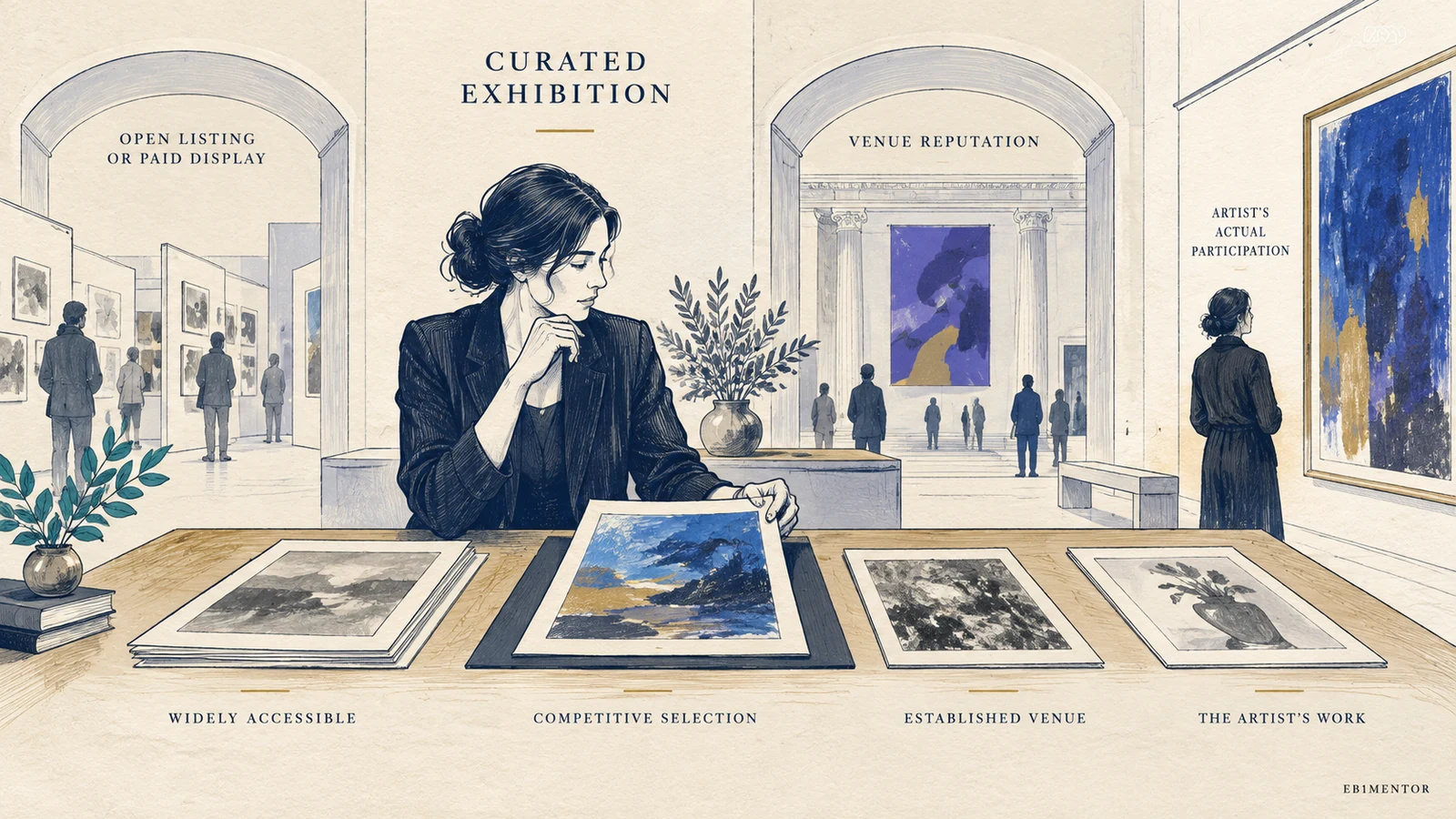
Exhibition evidence is more useful when the selection process and venue reputation can be understood. Build a record that distinguishes curated recognition from an open listing or paid display and identifies the artist’s work precisely.
Place Proving Exhibition Selectivity, Reputation, and the Artist’s Participation within the complete framework by reviewing the EB-1A evidentiary criteria overview. This page then isolates the proof, context, and final-merits questions specific to proving exhibition selectivity, reputation, and the artist’s participation.
Explain how artists were selected
Preserve call-for-entry rules, curatorial standards, jury or curator identity, acceptance rates, invitation basis, category limits, and the exhibition’s relationship to the field. Paid participation or open submission does not automatically defeat relevance, but the process and resulting display should be described accurately. A selective group show and a rental display may have different weight.
Document the venue independently
Use institutional history, professional directories, recognized media, catalogs, curator credentials, prior exhibitions, audience, funding, and field treatment to explain reputation. Avoid relying only on the venue’s promotional adjectives. A respected local venue can be meaningful within its field without being described as internationally prominent.
Show the beneficiary’s place in the display
Identify titles, medium, dates, catalog pages, wall labels, images, press, invitation, and organizer confirmation. If the exhibition includes many artists, explain how the beneficiary was selected and whether the work was featured, juried, awarded, or simply included. Distinguish a venue’s general reputation from recognition of the artist’s individual work.
Use a series without repetition
Several exhibitions may show continuity, but repeated displays at the same affiliated venue should not be presented as independent recognition without context. Build a chronological table with venue, selection, work, audience, and independent source. Explain changes in scale or reputation and avoid counting duplicate online listings for one event.
Test curatorial review, acceptance, participation, and institutional standing
Build the analysis around selectivity, curatorial review, and independent evidence of the exhibition or showcase standing. The matrix below prevents a certificate, title, metric, or endorsement from doing more work than it can support. Each row identifies a distinct proposition. A complete record should show both the underlying fact and the context needed to interpret it, while disclosing affiliations, missing data, methodological limits, and dates.
| Proposition | Preferred record | Quality-control question |
|---|---|---|
| Explain how artists were selected | Open-call, invitation, or submission rules | A selective group show and a rental display may have different weight. |
| Document the venue independently | Curator or jury credentials | A respected local venue can be meaningful within its field without being described as internationally prominent. |
| Show the beneficiary’s place in the display | Submission and acceptance data when available | Distinguish a venue’s general reputation from recognition of the artist’s individual work. |
| Use a series without repetition | Independent criticism, history, or institutional recognition | Explain changes in scale or reputation and avoid counting duplicate online listings for one event. |
Reconstruct how the artist and work were selected
Use the sequence below before drafting. It is designed for this topic, not as a generic exhibit checklist. The order matters because identify curator or jury authority should be completed before a conclusion is drawn from measure selectivity. If a step exposes an unsupported assumption, revise the claim or obtain a better record rather than repeating the same assertion in additional letters.
Reconstruct the selection process
Step 1: review open-call, invitation, or submission rules. Use it to test explain how artists were selected, and record the source, operative date, scope, beneficiary connection, and any limitation before moving to the next step.
Identify curator or jury authority
Step 2: review curator or jury credentials. Use it to test document the venue independently, and record the source, operative date, scope, beneficiary connection, and any limitation before moving to the next step.
Measure selectivity
Step 3: review submission and acceptance data when available. Use it to test show the beneficiary’s place in the display, and record the source, operative date, scope, beneficiary connection, and any limitation before moving to the next step.
Document venue reputation
Step 4: review independent criticism, history, or institutional recognition. Use it to test use a series without repetition, and record the source, operative date, scope, beneficiary connection, and any limitation before moving to the next step.
Records that prove curatorial authority and venue reputation
Assign a precise job to every source. Open-call, invitation, or submission rules should establish the controlling fact or rule. Curator or jury credentials should authenticate the beneficiary's connection. Submission and acceptance data when available should establish the relevant scope or comparison. Independent criticism, history, or institutional recognition should explain why the verified fact matters beyond the beneficiary or an affiliated organization. A source may serve more than one job, but the analysis should identify each use rather than treating repetition as corroboration.
For proving exhibition selectivity, reputation, and the artist’s participation, preserve complete records rather than favorable fragments. Capture the publisher or custodian, author when relevant, title, effective or publication date, access date, page or section, methodology, and the exact proposition supported. For translated evidence, retain the source language and compliant translation materials. For confidential evidence, use lawful redactions that preserve enough context to evaluate authenticity, scope, and the beneficiary's role.
Exhibition-prestige claims that rely on appearance alone
| Risk signal | Why it weakens the analysis | Corrective action |
|---|---|---|
| Rental access is described as curatorial selection | It leaves explain how artists were selected unsupported or broader than the underlying record. | Return to reconstruct the selection process and obtain or explain open-call, invitation, or submission rules. |
| Invitation language has no decision context | It leaves document the venue independently unsupported or broader than the underlying record. | Return to identify curator or jury authority and obtain or explain curator or jury credentials. |
| Venue reputation substitutes for proof of display | It leaves show the beneficiary’s place in the display unsupported or broader than the underlying record. | Return to measure selectivity and obtain or explain submission and acceptance data when available. |
| Follower counts are used as the only prestige measure | It leaves use a series without repetition unsupported or broader than the underlying record. | Return to document venue reputation and obtain or explain independent criticism, history, or institutional recognition. |
Comparing juried selection, invitation, rental, and open access
Define the field, occupation or artistic discipline at the level actually supported by the record. Then identify the relevant geography, career level, time period, population, denominator, and measurement method. For proving exhibition selectivity, reputation, and the artist’s participation, that means the comparison must illuminate selectivity, curatorial review, and independent evidence of the exhibition or showcase standing; it should not be narrowed only to produce a favorable result or broadened only when claiming influence. Explain why the selected benchmark is more probative than plausible alternatives.
What selective exhibition evidence adds at final merits
Meeting an evidentiary criterion is not the end of the analysis. At final merits, evaluate the quality, independence, timing, geographic and professional reach, selectivity or consequence of the evidence, and what it shows about sustained acclaim and standing near the top of the field. For this topic, state exactly how independent criticism, history, or institutional recognition changes the interpretation of the primary record. Do not multiply the weight of one achievement merely because it appears under several criteria.
Read the paired analysis, Artistic Exhibitions and Showcases: Qualifying Displays and Venues, for the adjacent evidence question that should be evaluated separately.
After completing the proving exhibition selectivity, reputation, and the artist’s participation analysis, use the EB-1A final-merits guide to evaluate the evidence in the complete record rather than as an isolated checkbox.
To organize the records identified for proving exhibition selectivity, reputation, and the artist’s participation, use the evidence-planning and exhibit-organization guide to convert each claim, source, context, limitation, and cross-reference into a traceable filing structure.
Exhibition selectivity and reputation checklist
- Open-call, invitation, or submission rules is dated, authenticated, and tied to explain how artists were selected.
- Curator or jury credentials is dated, authenticated, and tied to document the venue independently.
- Submission and acceptance data when available is dated, authenticated, and tied to show the beneficiary’s place in the display.
- Independent criticism, history, or institutional recognition is dated, authenticated, and tied to use a series without repetition.
- The record directly addresses this risk: rental access is described as curatorial selection.
- The record directly addresses this risk: invitation language has no decision context.
- The record directly addresses this risk: venue reputation substitutes for proof of display.
- The record directly addresses this risk: follower counts are used as the only prestige measure.
- The analysis answers "Can an open-call exhibition be selective?" and "Does a paid display automatically fail?" without turning fact-dependent guidance into a universal rule.
- The criterion analysis and final-merits analysis are separated, and the same achievement is not double counted.
Questions to answer about curation and artistic standing
Before finalizing this section, ask whether an independent reader could answer these questions from the cited record: Can an open-call exhibition be selective? Does a paid display automatically fail? Can multiple shows at one venue be counted separately? If the answer depends on an undefined label, an affiliated conclusion, an unexplained metric, or a missing date, revise the claim and evidence map. The goal is not document volume; it is a verifiable chain from fact to context to criterion-specific relevance.
Sources and further reading
- USCIS Policy Manual, Volume 6, Part F, Chapter 2USCIS
USCIS guidance on EB-1 extraordinary ability criteria and final merits.
- 8 CFR 204.5(h), Aliens with Extraordinary AbilityElectronic Code of Federal Regulations
Current regulatory text for EB-1 extraordinary ability criteria.
- Instructions for Form I-140, Immigrant Petition for Alien WorkersUSCIS
Official filing and initial-evidence instructions.
- AAO DecisionsUSCIS Administrative Appeals Office
Official decisions useful for issue research with appropriate authority limitations.
Frequently asked questions
Can an open-call exhibition be selective?
Possibly, but the evidence should show the actual applicant pool, review process, acceptance, and venue reputation rather than relying on the label.
Does a paid display automatically fail?
Its evidentiary weight depends on the facts. The record must accurately describe payment, selection, venue, and artistic recognition.
Can multiple shows at one venue be counted separately?
They can be distinct events, but affiliation, selection, and independent recognition should be explained without inflating the record.
Why identify the curator?
Curator identity, expertise, and role can help explain selection and professional context when the evidence supports it.
Public update history
Rebuilt Proving Exhibition Selectivity, Reputation, and the Artist’s Participation with a criterion-specific evidence matrix, workflow, risk diagnostic, final-merits analysis, and filing-quality checklist.
Contributors and review roles
Author
EB1 Mentor Editorial Team
Immigration evidence education team · EB1 Mentor
Prepares source-aware educational guides about extraordinary-ability immigration categories and evidence organization. The material is general information, not legal advice.